“Empowering Smarter Business Decisions Through Data-Driven Insights”
Global AI in Drug Discovery Market Size, Share & Trends Analysis Report By Technology (Machine Learning, Deep Learning, Natural Language Processing (NLP), Computer Vision and Other AI Technologies), By Drug Discovery Stage (Target Identification & Validation, Hit Identification & Screening, Lead Optimization, Preclinical Testing, Clinical Trials and Drug Repurposing), By Application (Oncology, Neurology, Cardiovascular Diseases, Infectious Diseases, Metabolic Disorders and Others), By End User (Pharmaceutical Companies, Biotechnology Companies, Contract Research Organizations (CROs), Research Institutes and Others), Forecast (2026–2035)
- Report Code: SMR-100010
- Historic Range: 2025–2035
- Publish date: Jun-2026
Global AI in Drug Discovery Market Size, Share & Trends Analysis Report By Technology (Machine Learning, Deep Learning, Natural Language Processing (NLP), Computer Vision and Other AI Technologies), By Drug Discovery Stage (Target Identification & Validation, Hit Identification & Screening, Lead Optimization, Preclinical Testing, Clinical Trials and Drug Repurposing), By Application (Oncology, Neurology, Cardiovascular Diseases, Infectious Diseases, Metabolic Disorders and Others), By End User (Pharmaceutical Companies, Biotechnology Companies, Contract Research Organizations (CROs), Research Institutes and Others), Forecast (2026–2035).
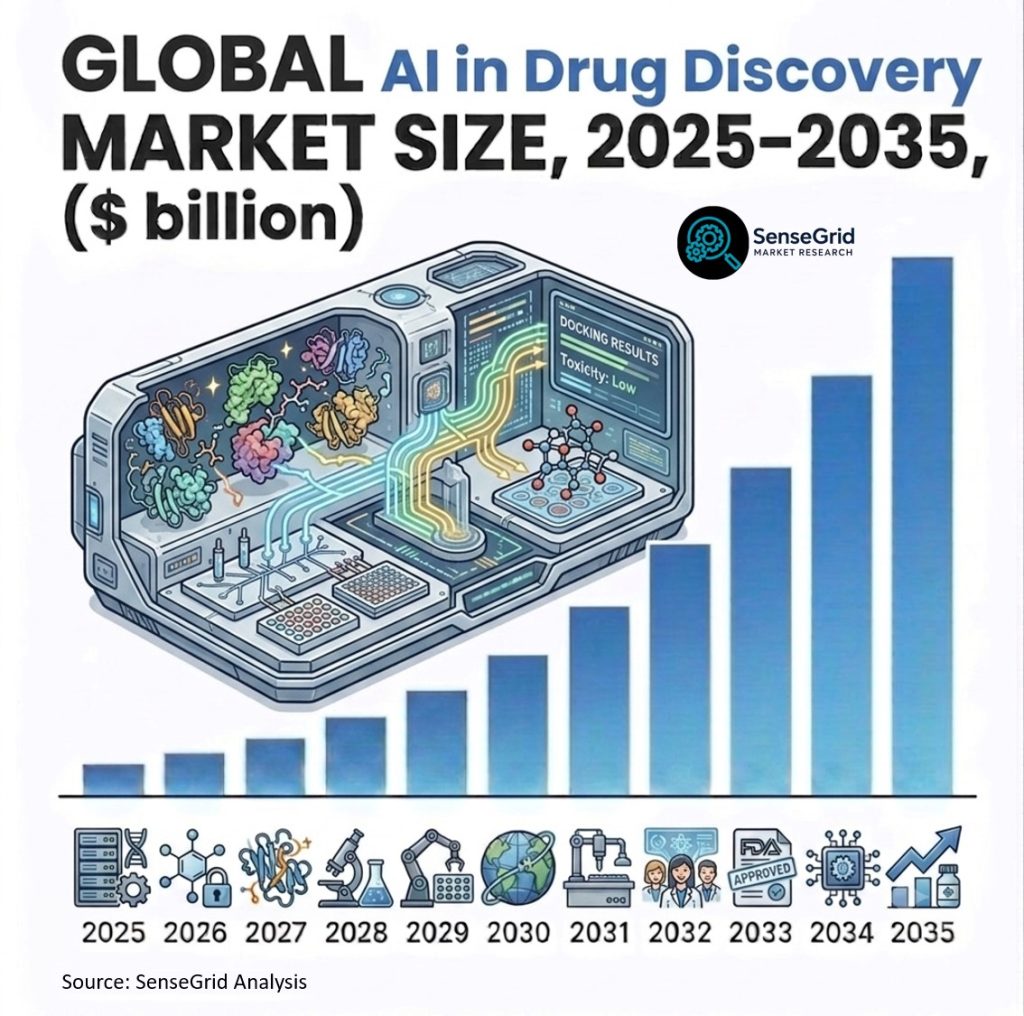
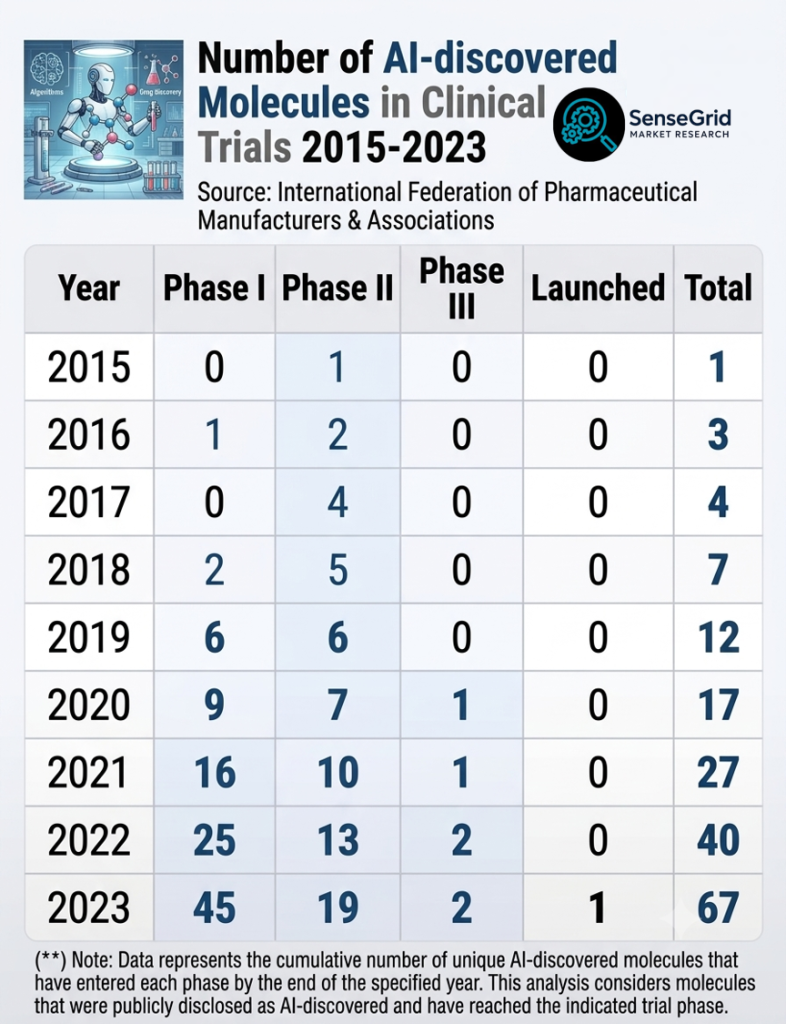
Global AI in drug discovery market is growing at a CAGR of 22.0% during the forecast period (2026-2035). The industry was valued at $2.4 billion in 2025 and is projected to reach $16.1 billion in 2035. The global AI in drug discovery is experiencing rapid acceleration driven by increasing integration of machine learning in pharmaceutical R&D, higher drug development costs, and growing computational biology adoption across research institutions and large pharmaceutical companies. As of 2025, more than 200+ publicly documented AI-enabled drug discovery initiatives and collaborations exist globally, spanning academic institutions, public research organizations, and pharmaceutical companies. In addition, scientific literature and clinical trial registries indicate that more than 200-300 drug candidates have been identified, optimized, or repurposed using AI assistance. Public pharmaceutical R&D trends show that more than 𝟓𝟎% of top global pharmaceutical companies have integrated AI-based tools into drug discovery workflows. Additionally, publicly announced partnerships between pharmaceutical companies and AI research groups have exceeded more than 200 collaborations globally, reflecting strong industry-wide adoption and validation of AI-driven drug discovery methods.
Market Dynamics
- Rising Investments in AI-Driven Biotech Platforms
Increasing venture capital and corporate funding in AI-based drug discovery platforms is accelerating early-stage drug development and target identification. For instance, in 2025, Recursion Pharmaceuticals raised significant funding in partnership with NVIDIA to expand its AI supercomputing infrastructure for large-scale drug discovery and biological modeling.
- Strategic Collaborations Between Pharma and AI Companies
Pharmaceutical companies are partnering with AI firms to shorten drug development timelines and improve success rates in clinical trials. For instance, in 2025, Sanofi entered a collaboration with Exscientia to develop multiple AI-designed drug candidates targeting oncology and immunology indications using generative AI platforms.
- Launch of AI-Powered Drug Discovery Platforms
The introduction of advanced AI platforms is enabling faster molecule screening, predictive modeling, and virtual clinical trials. For instance, in 2026, Isomorphic Labs (an Alphabet company) advanced its AI-driven drug design platform, leveraging AlphaFold-based models to accelerate discovery of novel therapeutic molecules.
Market Segmentation
- Based on technology, the market is segmented into machine learning, deep learning, natural language processing (NLP), computer vision, and other AI technologies.
- Based on the drug discovery stage, the market is segmented into target identification & validation, hit identification & screening, lead optimization, preclinical testing, clinical trials, and drug repurposing.
- Based on the application, the market is segmented into oncology, neurology, cardiovascular diseases, infectious diseases, metabolic disorders, and others.
- Based on the end user, the market is segmented into pharmaceutical companies, biotechnology companies, contract research organizations (CROs), research institutes, and others.
Target Identification & Validation segment Dominates the Market with the Largest Share
The target identification & validation segment held the highest market share in the global AI in drug discovery market, driven by rapid adoption of AI/ML in genomics, proteomics, and disease pathway mapping. This stage dominates because it delivers the highest efficiency gains in early drug discovery by improving target accuracy and reducing downstream clinical failure rates. According to the National Institutes of Health (NIH), the All of Us Research Program has enrolled over 747,000 participants, generated more than 535,000 whole-genome sequences, and produced over 275 million genetic variants, making it one of the most comprehensive biomedical datasets globally for AI-driven target discovery and validation. The program also integrates millions of electronic health records, enabling large-scale genotype–phenotype analysis for precision drug target identification. In addition, the National Human Genome Research Institute (NHGRI) reports that the cost of sequencing a human genome has dropped from nearly $100 million in 2001 to under USD 1,000 today, enabling massive expansion of genomic datasets used in AI-powered drug discovery pipelines. This dramatic cost reduction has significantly accelerated target identification research across pharmaceutical and biotech companies.
Machine Learning Holds a Significant Market Share
The machine learning segment held the highest market share, making it the dominant technology segment owing to its wide deployment across virtual screening, molecular simulation, and predictive modeling workflows. The dominance of machine learning is strongly supported by the scale of computational adoption in drug R&D. Industry benchmarks indicate that over 80% of AI-driven drug discovery workflows today involve machine learning models at the screening or prediction stage, compared to less than 20% for alternative AI methods such as computer vision or NLP-based biomedical text mining. In addition, machine learning systems in drug discovery are increasingly trained on datasets containing 10–50 billion molecular interaction records across global bioinformatics databases, enabling large-scale compound prediction and toxicity analysis. Modern ML platforms can evaluate over 1–5 million chemical compounds per screening cycle, significantly accelerating early-stage drug discovery timelines from years to months. Furthermore, cloud-based drug discovery platforms report that ML-based models reduce computational screening costs by 30–60% compared to traditional high-throughput laboratory screening methods, making it the most cost-efficient AI technology in pharmaceutical R&D.
Regional Outlook
The global AI in drug discovery market is segmented geographically into North America (the US and Canada), Europe (the UK, Germany, France, Italy, Spain, Russia, and Rest of Europe), Asia-Pacific (India, China, Japan, South Korea, Australia & New Zealand, ASEAN Countries, and Rest of Asia-Pacific), and the Rest of the World (Middle East & Africa and Latin America).
Europe’s Strong Research Ecosystem Driving AI in Drug Discovery Growth
Europe AI in Drug Discovery market is supported by strong public funding for life sciences, cross-border research programs, and increasing adoption of AI-driven healthcare innovation. According to the European Commission, Horizon Europe has a total budget of €95.5 billion (2021–2027), with a significant portion allocated to health, biotechnology, AI, and personalized medicine research, supporting advanced drug discovery initiatives across member states. In addition, the European Bioinformatics Institute (EMBL-EBI) maintains some of the global largest biological and genomic databases, containing millions of genomic sequences, protein structures, and multi-omics datasets, which are widely used in AI-based drug discovery, target identification, and molecular modeling. Furthermore, the European Medicines Agency (EMA) is increasingly supporting the use of AI, real-world evidence, and advanced analytics in regulatory science, accelerating the approval and validation of innovative therapeutics. Strong collaboration between leading pharmaceutical companies such as Roche Holding AG, Novartis AG, and AstraZeneca PLC with AI and biotech firms is further driving adoption of AI-powered drug discovery technologies across Europe.
North America Region Dominates the Market with Major Share
North America held the highest market share in the AI in drug discovery market, driven by strong pharmaceutical R&D infrastructure, advanced AI adoption, and significant public-private investments in biomedical innovation. According to the National Institutes of Health, the All of Us Research Program has enrolled more than 747,000 participants and generated over 535,000 whole-genome sequences, making it one of the largest biomedical datasets supporting precision medicine and AI-driven drug discovery research. The program has also identified more than 275 million genetic variants, significantly enhancing target identification and disease modeling capabilities. Furthermore, the U.S. Food and Drug Administration continues to accelerate approvals of AI-enabled diagnostics and companion diagnostic tools, supporting the integration of AI in drug development and personalized therapies. In addition, organizations such as the Advanced Research Projects Agency.
Market Players Outlook
The major companies operating in the global AI in drug discovery market include Alphabet Inc. (Isomorphic Labs), Microsoft Corp., IBM Corp., NVIDIA Corp. and Bristol Myers Squibb Company. Industry players are focusing on partnerships, collaborations, and mergers, and acquisitions activities to broaden their market reach, foster innovation, and reinforce their market standing.
Recent Developments
- In June 2026, SK Biopharmaceuticals and Insilico Medicine signed a strategic AI drug discovery partnership valued at more than $2.5 billion to develop neuroimmune therapies. The collaboration leverages Insilco’s generative AI platform for candidate design, while SK Biopharmaceuticals manages late-stage development and commercialization.
- In June 2026, Incyte Corp. and Genesis Therapeutics expanded their AI drug discovery collaboration with an upfront investment of $120 million, including equity funding and research commitments. The partnership focuses on applying Genesis’ molecular AI platform and Incyte’s proprietary datasets to accelerate small-molecule drug discovery across oncology, hematology, and inflammation targets.
- In June 2026, Sanofi and Owkin entered a multi-year collaboration to develop next-generation AI biopharma agents for end-to-end drug discovery and development. The partnership builds on earlier oncology-focused cooperation and aims to deploy agentic AI systems for target identification, drug positioning, and clinical research optimization.
- In May 2026, Incyte Corp. and Genesis Therapeutics further strengthened their AI-driven drug discovery partnership with expanded funding of $80 million upfront and additional equity investment. The collaboration now covers multiple therapeutic targets and integrates large-scale AI model training using proprietary pharmaceutical datasets.
- In March 2026, Eli Lilly and Company and Insilico Medicine announced an expanded collaboration valued at up to $2.75 billion to accelerate AI-driven drug discovery for oral therapies. The partnership integrates Insilico’s Pharma. AI platform with Lilly’s drug development capabilities to design and advance novel preclinical drug candidates for multiple disease areas.
The Report Covers
- Market valuation analysis for 2026 with projections through 2035.
- Profiles of leading AI in drug discovery companies, covering recent developments and strategic initiatives.
- Segment-wise revenue forecasts and estimates ($ Million).
- Comprehensive country-level insights across key geographic regions.
- Analysis of high-growth segments and future market opportunities.
- Evaluation of market penetration and expansion strategies.
- Competitive landscape assessment and player positioning analysis.
Key Market Players
- AbCellera Biologics Inc.
- Alphabet Inc. (Google DeepMind)
- Amazon Web Services, Inc.
- Arctoris Ltd.
- Atomwise, Inc.
- BenevolentAI Ltd.
- BioAge Labs, Inc.
- Certara, Inc.
- Cyclica Inc.
- Deep Genomics Inc.
- Envisagenics, Inc.
- Evotec SE
- Exscientia plc
- Generate: Biomedicines, Inc.
- Genesis Therapeutics, Inc.
- Healx Limited
- IBM Corp.
- Iktos S.A.
- Immunai, Inc.
- Insilico Medicine
- Insitro, Inc.
- Isomorphic Labs Ltd.
- Lantern Pharma Inc.
- Microsoft Corp.
- NVIDIA Corp.
- Oracle Corp.
- Owkin, Inc.
- PathAI, Inc.
- Peptone Ltd.
- Quris Technologies Ltd.
- Recursion Pharmaceuticals, Inc.
- Relay Therapeutics, Inc.
- Schrödinger, Inc.
- Standigm Inc.
- Tempus AI, Inc.
- Valo Health, Inc.
- Verge Genomics, Inc.
- XtalPi Holdings Ltd.
LIST OF TABLES
- AI in Drug Discovery Market Forecast & Estimation Analysis by Technology Type, 2025–2035 ($ Million)
- Machine Learning in Drug Discovery Market Forecast & Estimation Analysis by Region, 2025–2035 ($ Million)
- Deep Learning in Drug Discovery Market Forecast & Estimation Analysis by Region, 2025–2035 ($ Million)
- Natural Language Processing (NLP) in Drug Discovery Market Forecast & Estimation Analysis by Region, 2025–2035 ($ Million)
- Computer Vision AI in Drug Discovery Market Forecast & Estimation Analysis by Region, 2025–2035 ($ Million)
- AI in Drug Discovery Market Forecast & Estimation Analysis by Drug Discovery Stage Type, 2025–2035 ($ Million)
- AI Target Identification & Validation Market Forecast & Estimation Analysis by Region, 2025–2035 ($ Million)
- AI Hit Identification & Screening Market Forecast & Estimation Analysis by Region, 2025–2035 ($ Million)
- AI Lead Optimization Market Forecast & Estimation Analysis by Region, 2025–2035 ($ Million)
- AI Preclinical Testing Market Forecast & Estimation Analysis by Region, 2025–2035 ($ Million)
- AI Clinical Trials Market Forecast & Estimation Analysis by Region, 2025–2035 ($ Million)
- AI Drug Repurposing Market Forecast & Estimation Analysis by Region, 2025–2035 ($ Million)
- AI In Drug Discovery Market Forecast & Estimation Analysis by Application, 2025–2035 ($ Million)
- AI In Oncology Drug Discovery Market Forecast & Estimation Analysis by Region, 2025–2035 ($ Million)
- AI In Neurology Drug Discovery Market Forecast & Estimation Analysis by Region, 2025–2035 ($ Million)
- AI In Cardiovascular Diseases Drug Discovery Market Forecast & Estimation Analysis by Region, 2025–2035 ($ Million)
- AI In Infectious Diseases Drug Discovery Market Forecast & Estimation Analysis by Region, 2025–2035 ($ Million)
- AI In Metabolic Disorders Drug Discovery Market Forecast & Estimation Analysis by Region, 2025–2035 ($ Million)
- AI In Drug Discovery Market Forecast & Estimation Analysis by End-User, 2025–2035 ($ Million)
- AI Data Center For Pharmaceutical Companies Market Forecast & Estimation Analysis by Region, 2025–2035 ($ Million)
- AI Data Center for Biotechnology Companies Market Forecast & Estimation Analysis by Region, 2025–2035 ($ Million)
- AI Data Center for Contract Research Organizations (CROs) Market Forecast & Estimation Analysis by Region, 2025–2035 ($ Million)
- AI Data Center for Research Institutes Market Forecast & Estimation Analysis by Region, 2025–2035 ($ Million)
- AI In Drug Discovery Market Research and Analysis by Region, 2025–2035 ($ Million)
- North American AI In Drug Discovery Market Forecast & Estimation Analysis by Region, 2025–2035 ($ Million)
- North American AI In Drug Discovery Market Forecast & Estimation Analysis by Technology Type, 2025–2035 ($ Million)
- North American AI In Drug Discovery Market Forecast & Estimation Analysis by Drug Discovery Stage Type, 2025–2035 ($ Million)
- North American AI In Drug Discovery Market Forecast & Estimation Analysis by Application, 2025–2035 ($ Million)
- North American AI In Drug Discovery Market Forecast & Estimation Analysis by End User, 2025–2035 ($ Million)
- Europe AI In Drug Discovery Market Forecast & Estimation Analysis by Region, 2025–2035 ($ Million)
- Europe AI In Drug Discovery Market Forecast & Estimation Analysis by Technology Type, 2025–2035 ($ Million)
- Europe AI In Drug Discovery Market Forecast & Estimation Analysis by Drug Discovery Stage Type, 2025–2035 ($ Million)
- Europe AI In Drug Discovery Market Forecast & Estimation Analysis by Application, 2025–2035 ($ Million)
- Europe AI In Drug Discovery Market Forecast & Estimation Analysis by End User, 2025–2035 ($ Million)
- Asia-Pacific AI In Drug Discovery Market Forecast & Estimation Analysis by Region, 2025–2035 ($ Million)
- Asia-Pacific AI in Drug Discovery Market Forecast & Estimation Analysis by Technology Type, 2025–2035 ($ Million)
- Asia-Pacific AI in Drug Discovery Market Forecast & Estimation Analysis by Drug Discovery Stage Type, 2025–2035 ($ Million)
- Asia-Pacific AI in Drug Discovery Market Forecast & Estimation Analysis by Application, 2025–2035 ($ Million)
- Asia-Pacific AI in Drug Discovery Market Forecast & Estimation Analysis by End User, 2025–2035 ($ Million)
- Rest of the World AI In Drug Discovery Market Forecast & Estimation Analysis by Region, 2025–2035 ($ Million)
- Rest of the World AI In Drug Discovery Market Forecast & Estimation Analysis by Technology Type, 2025–2035 ($ Million)
- Rest of the World AI In Drug Discovery Market Forecast & Estimation Analysis by Drug Discovery Stage Type, 2025–2035 ($ Million)
- Rest of the World AI In Drug Discovery Market Forecast & Estimation Analysis by Application, 2025–2035 ($ Million)
- Rest of the World AI In Drug Discovery Market Forecast & Estimation Analysis by End User, 2025–2035 ($ Million)
List of Figures
- AI In Drug Discovery Market Share Forecast & Estimation by Technology Type, 2025 Vs 2035 (%)
- Machine Learning in Drug Discovery Market Forecast & Estimation Analysis by Region, 2025 Vs 2035 (%)
- Deep Learning in Drug Discovery Market Forecast & Estimation Analysis by Region, 2025 Vs 2035 (%)
- Natural Language Processing (NLP) in Drug Discovery Market Forecast & Estimation Analysis by Region, 2025 Vs 2035 (%)
- Computer Vision in Drug Discovery Market Forecast & Estimation Analysis by Region, 2025 Vs 2035 (%)
- AI In Drug Discovery Market Share Forecast & Estimation by Drug Discovery Stage Type, 2025 Vs 2035 (%)
- AI Target Identification & Validation in Drug Discovery Market Share Forecast & Estimation by Region, 2025 Vs 2035 (%)
- Hit Identification & Screening in Drug Discovery Market Share Forecast & Estimation by Region, 2025 Vs 2035 (%)
- Lead Optimization in Drug Discovery Market Share Forecast & Estimation by Region, 2025 Vs 2035 (%)
- Preclinical Testing in Drug Discovery Market Share Forecast & Estimation by Region, 2025 Vs 2035 (%)
- Clinical Trials in Drug Discovery Market Share Forecast & Estimation by Region, 2025 Vs 2035 (%)
- Drug Repurposing in Drug Discovery Market Share Forecast & Estimation by Region, 2025 Vs 2035 (%)
- Global AI In Drug Discovery Market Share Forecast & Estimation by Application, 2025 Vs 2035 (%)
- AI In Oncology Drug Discovery Market Share Forecast & Estimation by Region, 2025 Vs 2035 (%)
- AI In Neurology Drug Discovery Market Share Forecast & Estimation by Region, 2025 Vs 2035 (%)
- AI In Cardiovascular Diseases Drug Discovery Market Share Forecast & Estimation by Region, 2025 Vs 2035 (%)
- AI In Infectious Diseases Drug Discovery Market Share Forecast & Estimation by Region, 2025 Vs 2035 (%)
- AI In Metabolic Disorders Drug Discovery Market Share Forecast & Estimation by Region, 2025 Vs 2035 (%)
- AI In Drug Discovery Market Share Forecast & Estimation by End User, 2025 Vs 2035 (%)
- AI In Drug Discovery for Pharmaceutical Companies Market Share Forecast & Estimation by Region, 2025 Vs 2035 (%)
- AI In Drug Discovery for Biotechnology Companies Market Share Forecast & Estimation by Region, 2025 Vs 2035 (%)
- AI In Drug Discovery for Contract Research Organizations (CROs) Market Share Forecast & Estimation by Region, 2025 Vs 2035 (%)
- AI In Drug Discovery for Research Institutes Market Share Forecast & Estimation by Region, 2025 Vs 2035 (%)
- AI In Drug Discovery Market Forecast & Estimation by Region, 2025–2035 ($ Million)
- US AI In Drug Discovery Market Size Estimation, 2025–2035 ($ Million)
- Canada AI In Drug Discovery Market Size Estimation, 2025–2035 ($ Million)
- UK AI In Drug Discovery Market Size Estimation, 2025–2035 ($ Million)
- France AI In Drug Discovery Market Size Estimation, 2025–2035 ($ Million)
- Germany AI In Drug Discovery Market Size Estimation, 2025–2035 ($ Million)
- Italy AI In Drug Discovery Market Size Estimation, 2025–2035 ($ Million)
- Spain AI In Drug Discovery Market Size Estimation, 2025–2035 ($ Million)
- Russia AI In Drug Discovery Market Size Estimation, 2025–2035 ($ Million)
- Rest of Europe AI In Drug Discovery Market Size Estimation, 2025–2035 ($ Million)
- India AI In Drug Discovery Market Size Estimation, 2025–2035 ($ Million)
- China AI In Drug Discovery Market Size Estimation, 2025–2035 ($ Million)
- Japan AI In Drug Discovery Market Size Estimation, 2025–2035 ($ Million)
- South Korea AI In Drug Discovery Market Size Estimation, 2025–2035 ($ Million)
- Australia and New Zealand AI In Drug Discovery Market Size Estimation, 2025–2035 ($ Million)
- ASEAN Economies AI In Drug Discovery Market Size Estimation, 2025–2035 ($ Million)
- Rest of Asia-Pacific AI In Drug Discovery Market Size Estimation, 2025–2035 ($ Million)
- Latin America AI In Drug Discovery Market Size Estimation, 2025–2035 ($ Million)
- Middle East & Africa AI In Drug Discovery Market Size Estimation, 2025–2035 ($ Million)
Download Global AI in Drug Discovery Market Sample Report
Contact Us
- Chat On WhatsApp
- Phone :+91-9131799396
- Hi Link Residency, Airport Road, Indore, 452005
- sensegridmarketresearch@gmail.com
Select User License Type
Analyst Support, Customization & Verified Analysis
REPORT BY INDUSTRIES
- Food & Beverages
- Healthcare & Lifesciences
- Semiconductors & Electronics
- Information Technology
- Automotive
- Automation
- Energy & Power
- Consumer Goods & Services
- Agriculture