“Empowering Smarter Business Decisions Through Data-Driven Insights”

Global Electrolyzer Market Size, Share & Trends Analysis Report By Technology (Alkaline Electrolyzer (AEL), Proton Exchange Membrane (PEM) Electrolyzer, Solid Oxide Electrolyzer (SOEC), Anion Exchange Membrane (AEM) Electrolyzer, and Others), By Capacity (Below 500 kW, 500 kW–2 MW, 2 MW–5 MW, and Above 5 MW), By Product Type (Traditional/Conventional Electrolyzer and Modular Electrolyzer), By End-Use Industry (Chemicals, Refining, Power Generation, Mobility & Transportation, Steel Manufacturing, Electronics & Electrolyzers, and Others), Forecast (2026–2035)
- Report Code: SMR-100010
- Historic Range: 2025–2035
- Publish date: Jun-2026
Global Electrolyzer Market Size, Share & Trends Analysis Report By Technology (Alkaline Electrolyzer (AEL), Proton Exchange Membrane (PEM) Electrolyzer, Solid Oxide Electrolyzer (SOEC), Anion Exchange Membrane (AEM) Electrolyzer, and Others), By Capacity (Below 500 kW, 500 kW–2 MW, 2 MW–5 MW, and Above 5 MW), By Product Type (Traditional/Conventional Electrolyzer and Modular Electrolyzer), By End-Use Industry (Chemicals, Refining, Power Generation, Mobility & Transportation, Steel Manufacturing, Electronics & Electrolyzers, and Others), Forecast (2026–2035)
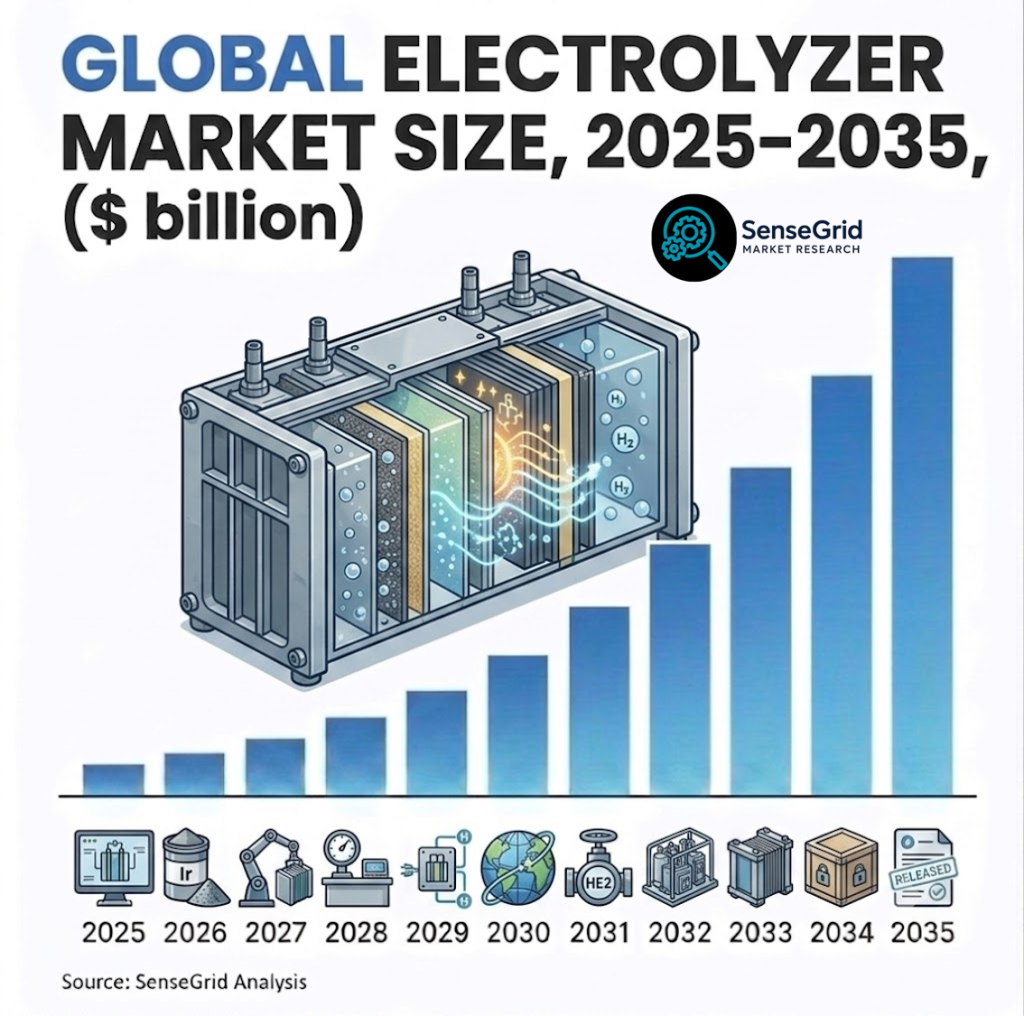
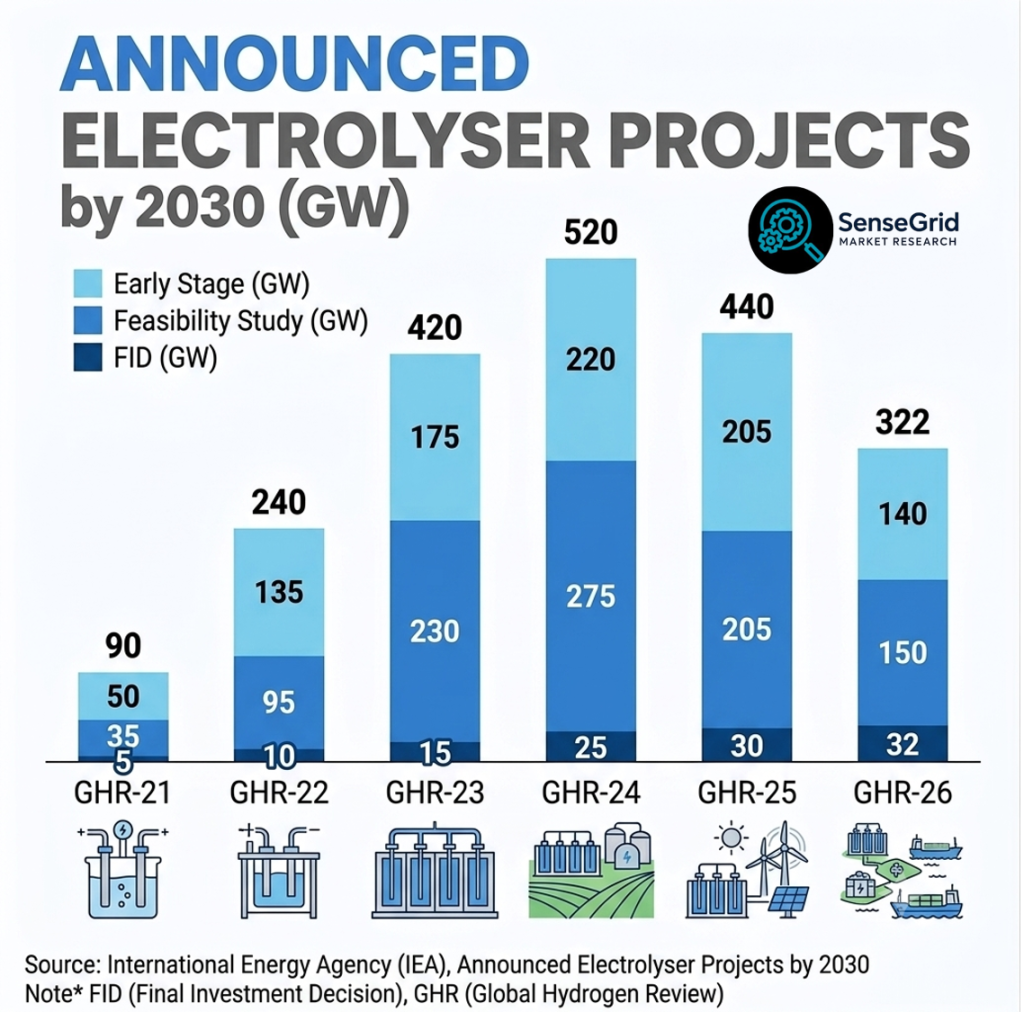
Global electrolyzer market is growing at a CAGR of 18.5% during the forecast period (2026-2035). The industry was valued at $3.2 billion in 2025 and is projected to reach $17.4 billion in 2035. The global electrolyzer market is gaining significant momentum as countries accelerate investments in clean hydrogen to support decarbonization, energy security, and industrial transformation. Electrolyzers, which use electricity to split water into hydrogen and oxygen, are at the core of the green hydrogen value chain and are expected to play a crucial role in reducing emissions across hard-to-abate sectors such as steel, chemicals, shipping, and heavy transportation. According to the International Energy Agency (IEA), global electrolyzer deployment could potentially reach 230–520 GW by 2030 if announced projects progress toward commercialization and investment commitments continue to strengthen.
- Global electrolyzer manufacturing capacity has reached 61 GW per year, with 16 GW more under construction, signaling strong industry expansion.
- Global installed water electrolysis capacity surpassed 2 GW in 2024, with over 1 GW added by mid-2025.
- China controls 65% of global installed electrolyzer capacity and FID-approved projects, reinforcing its market leadership.
- More than 200 low-emissions hydrogen projects have reached final investment decision (FID) since 2020.
- Low-emissions hydrogen production grew 10% in 2024 and is projected to reach 1 Mt in 2025.
- Operational and FID-approved projects are expected to deliver 4.2 Mtpa of low-emissions hydrogen by 2030, nearly 5× current production levels.
Market Dynamics
- Investments in Large-Scale Green Hydrogen Projects Boost Electrolyzer Demand
Governments and private investors are committing substantial capital to accelerate green hydrogen production and strengthen energy security. Large-scale hydrogen hubs require significant electrolyzer capacity, creating sustained demand for advanced systems. For instance, the NEOM Green Hydrogen Company is developing one of the world’s largest green hydrogen facilities, supported by multi-billion-dollar investments and gigawatt-scale electrolyzer deployment.
- Strategic Collaborations Accelerate Electrolyzer Deployment
Partnerships between technology providers, energy companies, and industrial firms are helping scale hydrogen production and reduce commercialization risks. These collaborations enable knowledge sharing, supply chain development, and faster project execution. For instance, John Cockerill Hydrogen partnered with AM Green to support large-scale green hydrogen and ammonia projects through advanced electrolyzer solutions.
- Launch of Advanced Electrolyzer Systems Strengthens Market Growth
Manufacturers are introducing larger, more efficient electrolyzer systems to improve performance and lower hydrogen production costs. Technological advancements are enhancing system scalability, reliability, and energy efficiency, making green hydrogen more competitive. For instance, Electric Hydrogen Co. commercialized its 100 MW electrolyzer platform, designed to significantly reduce the cost of green hydrogen production for industrial-scale applications.
Market Segmentation
- Based on the technology, the market is segmented into alkaline electrolyzer (AEL), proton exchange membrane (PEM) electrolyzer, solid oxide electrolyzer (SOEC), anion exchange membrane (AEM) electrolyzer, and others.
- Based on the capacity, the market is segmented into Below 500 kW, 500 kW–2 MW, 2 MW–5 MW, and above 5 MW.
- By product type, the market is segmented into traditional/conventional electrolyzer and modular electrolyzers.
- By end-use industry, the market is segmented into chemicals, refining, power generation, mobility & transportation, steel manufacturing, electronics & electrolyzers, and others.
Alkaline Electrolyzer (AEL) Segment Holds the Largest Share
The global electrolyzer market is primarily driven by the widespread adoption of alkaline electrolyzers (AEL), owing to their technological maturity, lower capital costs, and proven performance in large-scale hydrogen production. AEL systems remain the preferred choice for utility-scale green hydrogen projects as they offer high reliability and cost-effective operation. According to the International Energy Agency, alkaline electrolyzers accounted for approximately 840 MW of the 1.39 GW global installed water electrolysis capacity in 2023—around 60% of the total installed capacity, maintaining their position as the leading electrolyzer technology.
Chemical Holds a Significant Market Share
The global electrolyzer market is experiencing significant growth owing to rising hydrogen demand from the chemical industry, particularly for ammonia and methanol production. Hydrogen serves as a critical feedstock in these processes, and the industry’s transition toward low-carbon and green chemicals is accelerating investments in electrolyzer-based hydrogen production. According to the International Energy Agency, the chemical sector accounts for the majority of global hydrogen consumption, with ammonia production alone consuming approximately 31 million tonnes of hydrogen annually, making it one of the largest hydrogen-consuming industries worldwide. As governments and manufacturers pursue decarbonization targets, green hydrogen produced via electrolyzers is increasingly being adopted to replace fossil fuel-based hydrogen in chemical manufacturing, supporting sustained market expansion.
Regional Outlook
The global electrolyzer market is segmented geographically into North America (the US and Canada), Europe (the UK, Germany, France, Italy, Spain, Russia, and the Rest of Europe), Asia-Pacific (India, China, Japan, South Korea, Australia & New Zealand, ASEAN Countries, and the Rest of Asia-Pacific), and the Rest of the World (Middle East & Africa and Latin America).
Strong Policy Support and Expanding Hydrogen Project Pipeline in Europe
The Europe electrolyzer market is witnessing significant growth, supported by ambitious decarbonization targets, renewable energy integration, and substantial investments in green hydrogen infrastructure. The region’s hydrogen strategy and funding programs are accelerating commercial-scale electrolyzer deployment across multiple industries. According to the European Commission, the European Union has set a target of deploying at least 40 GW of renewable hydrogen electrolyzer capacity by 2030, making Europe one of the world’s largest planned hydrogen markets. Furthermore, the region hosts a substantial share of global announced hydrogen projects, supported by initiatives such as the Hydrogen Bank and Important Projects of Common European Interest (IPCEI), driving continued market expansion.
Asia-Pacific Region Dominates the Market with Major Share
The Asia-Pacific electrolyzer market is experiencing robust growth, driven by large-scale green hydrogen investments, expanding electrolyzer manufacturing capacity, and strong government support across China, Japan, South Korea, and Australia. The region benefits from a rapidly growing project pipeline aimed at decarbonizing industries such as chemicals, steel, and transportation. According to the International Energy Agency, China accounts for approximately 65% of global installed electrolyzer capacity and projects that have reached Final Investment Decision (FID), making it the leading market for electrolyzer deployment worldwide. Additionally, China represents the majority of global electrolyzer manufacturing capacity, reinforcing Asia-Pacific’s position as the largest regional market.
Market Players Outlook
The major companies operating in the global electrolyzer market include Cummins Inc., thyssenkrupp nucera AG & Co. KGaA, Siemens Energy AG, Plug Power Inc., John Cockerill Hydrogen, among others. Industry participants are focusing on electrolyzer manufacturing capacity expansion, technological advancements, strategic partnerships, large-scale green hydrogen projects, and investments in next-generation electrolyzer technologies to strengthen their competitive position and expand their global market presence.
Recent Developments
- In June 2026, Hygenco Green Energies Private Limited secured a $105 million equity investment, co-led by the International Finance Corporation, Siemens Financial Services, and the Fullerton Carbon Action Fund, to accelerate the development of large-scale green hydrogen projects.
- In February 2026, Waaree Clean Energy Solutions signed an agreement with Zero Footprint Industries Ltd. to deploy 50 MW of alkaline electrolyzers under an Electrolyzer-as-a-Service (EAAS) model for decentralized green hydrogen projects in India.
- In July 2025, Repsol S.A. acquired a minority stake in Stargate Hydrogen to support the expansion of electrolyzer manufacturing, technology development, and global commercialization.
- In March 2025, Next Hydrogen Solutions Inc. entered a strategic partnership with Sungrow Hydrogen Sci. & Tech. Co., Ltd. to scale electrolyzer production by leveraging Sungrow’s 3 GW manufacturing facility and jointly commercialize water electrolysis technologies.
- In February 2025, Siemens AG signed a strategic partnership with Guofu Hydrogen and RCT GH Hydrogen to accelerate global green hydrogen production and electrolyzer manufacturing through industrial automation and digitalization.
The Report Covers
- Market valuation analysis for 2026 with forecasts through 2035.
- Profiles of leading electrolyzer companies, including recent developments and strategic initiatives.
- Segment-wise revenue forecasts and estimates (USD million).
- Comprehensive country-level analysis across major regions.
- Analysis of high-growth segments and emerging opportunities.
- Evaluation of market penetration and expansion strategies.
- Competitive landscape assessment and market share analysis.
Key Market Players
- Advanced Micro Devices, Inc. (AMD)
- Asahi Kasei Corp.
- Bloom Energy Corp.
- Cummins Inc.
- Electric Hydrogen Co.
- Elogen SAS
- Enapter AG
- Giner Inc.
- Hitachi Zosen Corp.
- H-TEC SYSTEMS GmbH
- HydrogenPro ASA
- ITM Power plc
- John Cockerill Hydrogen
- Kawasaki Heavy Industries, Ltd.
- LONGi Hydrogen Technology Co., Ltd.
- McPhy Energy S.A.
- Mitsubishi Power Americas, Inc.
- Nel ASA
- Next Hydrogen Solutions Inc.
- Ohmium International Inc.
- Peric Hydrogen Technologies Co., Ltd.
- Plug Power Inc.
- Shandong Saikesaisi Hydrogen Energy Co., Ltd.
- Siemens Energy AG
- Sunfire GmbH
- Sungrow Hydrogen Sci. & Tech. Co., Ltd.
- Teledyne Energy Systems Inc.
- thyssenkrupp nucera AG & Co. KGaA
- Tianjin Mainland Hydrogen Equipment Co., Ltd.
- Topsoe A/S
- Verdagy Inc.
LIST OF TABLES
- Electrolyzer Market Forecast & Estimation Analysis by Technology, 2025–2035 ($ Million)
- Alkaline Electrolyzer (AEL) Market Forecast & Estimation Analysis by Region, 2025–2035 ($ Million)
- Proton Exchange Membrane (PEM) Electrolyzer Market Forecast & Estimation Analysis by Region, 2025–2035 ($ Million)
- Solid Oxide Electrolyzer (SOEC) Market Forecast & Estimation Analysis by Region, 2025–2035 ($ Million)
- Anion Exchange Membrane (AEM) Electrolyzer Market Forecast & Estimation Analysis by Region, 2025–2035 ($ Million)
- Other Electrolyzer Technologies Market Forecast & Estimation Analysis by Region, 2025–2035 ($ Million)
- Electrolyzer Market Forecast & Estimation Analysis by Capacity, 2025–2035 ($ Million)
- Below 500 kW Electrolyzer Market Forecast & Estimation Analysis by Region, 2025–2035 ($ Million)
- 500 kW–2 MW Electrolyzer Market Forecast & Estimation Analysis by Region, 2025–2035 ($ Million)
- 2 MW–5 MW Electrolyzer Market Forecast & Estimation Analysis by Region, 2025–2035 ($ Million)
- Above 5 MW Electrolyzer Market Forecast & Estimation Analysis by Region, 2025–2035 ($ Million)
- Electrolyzer Market Forecast & Estimation Analysis by Product Type, 2025–2035 ($ Million)
- Traditional/Conventional Electrolyzer Market Forecast & Estimation Analysis by Region, 2025–2035 ($ Million)
- Modular Electrolyzer Market Forecast & Estimation Analysis by Region, 2025–2035 ($ Million)
- Global Electrolyzer Market Forecast & Estimation Analysis by End-Use Industry, 2025–2035 ($ Million)
- Electrolyzers for Chemicals Industry Market Forecast & Estimation Analysis by Region, 2025–2035 ($ Million)
- Electrolyzers for Refining Industry Market Forecast & Estimation Analysis by Region, 2025–2035 ($ Million)
- Electrolyzers for Power Generation Market Forecast & Estimation Analysis by Region, 2025–2035 ($ Million)
- Electrolyzers for Mobility & Transportation Market Forecast & Estimation Analysis by Region, 2025–2035 ($ Million)
- Electrolyzers for Steel Manufacturing Market Forecast & Estimation Analysis by Region, 2025–2035 ($ Million)
- Electrolyzers for Electronics & Semiconductors Market Forecast & Estimation Analysis by Region, 2025–2035 ($ Million)
- Electrolyzers for Other End-Use Industries Market Forecast & Estimation Analysis by Region, 2025–2035 ($ Million)
- Electrolyzer Market Research and Analysis by Region, 2025–2035 ($ Million)
- North America Electrolyzer Market Forecast & Estimation Analysis by Region, 2025–2035 ($ Million)
- North America Electrolyzer Market Forecast & Estimation Analysis by Technology, 2025–2035 ($ Million)
- North America Electrolyzer Market Forecast & Estimation Analysis by Capacity, 2025–2035 ($ Million)
- North America Electrolyzer Market Forecast & Estimation Analysis by Product Type, 2025–2035 ($ Million)
- North America Electrolyzer Market Forecast & Estimation Analysis by End-Use Industry, 2025–2035 ($ Million)
- Europe Electrolyzer Market Forecast & Estimation Analysis by Region, 2025–2035 ($ Million)
- Europe Electrolyzer Market Forecast & Estimation Analysis by Technology, 2025–2035 ($ Million)
- Europe Electrolyzer Market Forecast & Estimation Analysis by Capacity, 2025–2035 ($ Million)
- Europe Electrolyzer Market Forecast & Estimation Analysis by Product Type, 2025–2035 ($ Million)
- Europe Electrolyzer Market Forecast & Estimation Analysis by End-Use Industry, 2025–2035 ($ Million)
- Asia-Pacific Electrolyzer Market Forecast & Estimation Analysis by Region, 2025–2035 ($ Million)
- Asia-Pacific Electrolyzer Market Forecast & Estimation Analysis by Technology, 2025–2035 ($ Million)
- Asia-Pacific Electrolyzer Market Forecast & Estimation Analysis by Capacity, 2025–2035 ($ Million)
- Asia-Pacific Electrolyzer Market Forecast & Estimation Analysis by Product Type, 2025–2035 ($ Million)
- Asia-Pacific Electrolyzer Market Forecast & Estimation Analysis by End-Use Industry, 2025–2035 ($ Million)
- Rest of the World Electrolyzer Market Forecast & Estimation Analysis by Region, 2025–2035 ($ Million)
- Rest of the World Electrolyzer Market Forecast & Estimation Analysis by Technology, 2025–2035 ($ Million)
- Rest of the World Electrolyzer Market Forecast & Estimation Analysis by Capacity, 2025–2035 ($ Million)
- Rest of the World Electrolyzer Market Forecast & Estimation Analysis by Product Type, 2025–2035 ($ Million)
- Rest of the World Electrolyzer Market Forecast & Estimation Analysis by End-Use Industry, 2025–2035 ($ Million)
List of Figures
- Electrolyzer Market Share Forecast & Estimation by Technology, 2025 Vs 2035 (%)
- Alkaline Electrolyzer (AEL) Market Share Forecast & Estimation by Region, 2025 Vs 2035 (%)
- Proton Exchange Membrane (PEM) Electrolyzer Market Share Forecast & Estimation by Region, 2025 Vs 2035 (%)
- Solid Oxide Electrolyzer (SOEC) Market Share Forecast & Estimation by Region, 2025 Vs 2035 (%)
- Anion Exchange Membrane (AEM) Electrolyzer Market Share Forecast & Estimation by Region, 2025 Vs 2035 (%)
- Other Electrolyzer Technologies Market Share Forecast & Estimation by Region, 2025 Vs 2035 (%)
- Electrolyzer Market Share Forecast & Estimation by Capacity, 2025 Vs 2035 (%)
- Below 500 kW Electrolyzer Market Share Forecast & Estimation by Region, 2025 Vs 2035 (%)
- 500 kW–2 MW Electrolyzer Market Share Forecast & Estimation by Region, 2025 Vs 2035 (%)
- 2 MW–5 MW Electrolyzer Market Share Forecast & Estimation by Region, 2025 Vs 2035 (%)
- Above 5 MW Electrolyzer Market Share Forecast & Estimation by Region, 2025 Vs 2035 (%)
- Electrolyzer Market Share Forecast & Estimation by Product Type, 2025 Vs 2035 (%)
- Traditional/Conventional Electrolyzer Market Share Forecast & Estimation by Region, 2025 Vs 2035 (%)
- Modular Electrolyzer Market Share Forecast & Estimation by Region, 2025 Vs 2035 (%)
- Global Electrolyzer Market Share Forecast & Estimation by End-Use Industry, 2025 Vs 2035 (%)
- Electrolyzers for Chemicals Industry Market Share Forecast & Estimation by Region, 2025 Vs 2035 (%)
- Electrolyzers for Refining Industry Market Share Forecast & Estimation by Region, 2025 Vs 2035 (%)
- Electrolyzers for Power Generation Market Share Forecast & Estimation by Region, 2025 Vs 2035 (%)
- Electrolyzers for Mobility & Transportation Market Share Forecast & Estimation by Region, 2025 Vs 2035 (%)
- Electrolyzers for Steel Manufacturing Market Share Forecast & Estimation by Region, 2025 Vs 2035 (%)
- Electrolyzers for Electronics & Semiconductors Market Share Forecast & Estimation by Region, 2025 Vs 2035 (%)
- Electrolyzers for Other End-Use Industries Market Share Forecast & Estimation by Region, 2025 Vs 2035 (%)
- Electrolyzer Market Forecast & Estimation by Region, 2025–2035 ($ Million)
- US Electrolyzer Market Size Estimation, 2025–2035 ($ Million)
- Canada Electrolyzer Market Size Estimation, 2025–2035 ($ Million)
- UK Electrolyzer Market Size Estimation, 2025–2035 ($ Million)
- France Electrolyzer Market Size Estimation, 2025–2035 ($ Million)
- Germany Electrolyzer Market Size Estimation, 2025–2035 ($ Million)
- Italy Electrolyzer Market Size Estimation, 2025–2035 ($ Million)
- Spain Electrolyzer Market Size Estimation, 2025–2035 ($ Million)
- Russia Electrolyzer Market Size Estimation, 2025–2035 ($ Million)
- Rest of Europe Electrolyzer Market Size Estimation, 2025–2035 ($ Million)
- India Electrolyzer Market Size Estimation, 2025–2035 ($ Million)
- China Electrolyzer Market Size Estimation, 2025–2035 ($ Million)
- Japan Electrolyzer Market Size Estimation, 2025–2035 ($ Million)
- South Korea Electrolyzer Market Size Estimation, 2025–2035 ($ Million)
- Australia and New Zealand Electrolyzer Market Size Estimation, 2025–2035 ($ Million)
- ASEAN Economies Electrolyzer Market Size Estimation, 2025–2035 ($ Million)
- Rest of Asia-Pacific Electrolyzer Market Size Estimation, 2025–2035 ($ Million)
- Latin America Electrolyzer Market Size Estimation, 2025–2035 ($ Million)
- Middle East & Africa Electrolyzer Market Size Estimation, 2025–2035 ($ Million)
Download Global Electrolyzer Market Sample Report
Contact Us
- Chat On WhatsApp
- Phone :+91-9131799396
- Hi Link Residency, Airport Road, Indore, 452005
- sensegridmarketresearch@gmail.com
Select User License Type
Analyst Support, Customization & Verified Analysis
REPORT BY INDUSTRIES
- Food & Beverages
- Healthcare & Lifesciences
- Semiconductors & Electronics
- Information Technology
- Automotive
- Automation
- Energy & Power
- Consumer Goods & Services
- Agriculture