“Empowering Smarter Business Decisions Through Data-Driven Insights”


Global Aircraft Component MRO Market Size, Share & Estimation Analysis Report By Component Type (Engine Components, Avionics Components, Landing Gear Components, Airframe Components, Hydraulic & Pneumatic Components, Electrical Components, Cabin Interior Components, Auxiliary Power Unit (APU) Components and Others), By Service Type (Maintenance, Repair, Overhaul, Inspection & Testing and Modification & Upgrades), By Aircraft Type (Narrow-Body Aircraft, Wide-Body Aircraft, Regional Aircraft, Business Jets, Military Aircraft and Helicopters), By End User (Airlines, Aircraft Leasing Companies, Defense Organizations and MRO Service Providers), Forecast (2026–2035)
- Report Code: SMR-100010
- Historic Range: 2025–2035
- Publish date: Jun-2026
Global Aircraft Component MRO Market Size, Share & Estimation Analysis Report By Component Type (Engine Components, Avionics Components, Landing Gear Components, Airframe Components, Hydraulic & Pneumatic Components, Electrical Components, Cabin Interior Components, Auxiliary Power Unit (APU) Components and Others), By Service Type (Maintenance, Repair, Overhaul, Inspection & Testing and Modification & Upgrades), By Aircraft Type (Narrow-Body Aircraft, Wide-Body Aircraft, Regional Aircraft, Business Jets, Military Aircraft and Helicopters), By End User (Airlines, Aircraft Leasing Companies, Defense Organizations and MRO Service Providers), Forecast (2026–2035)
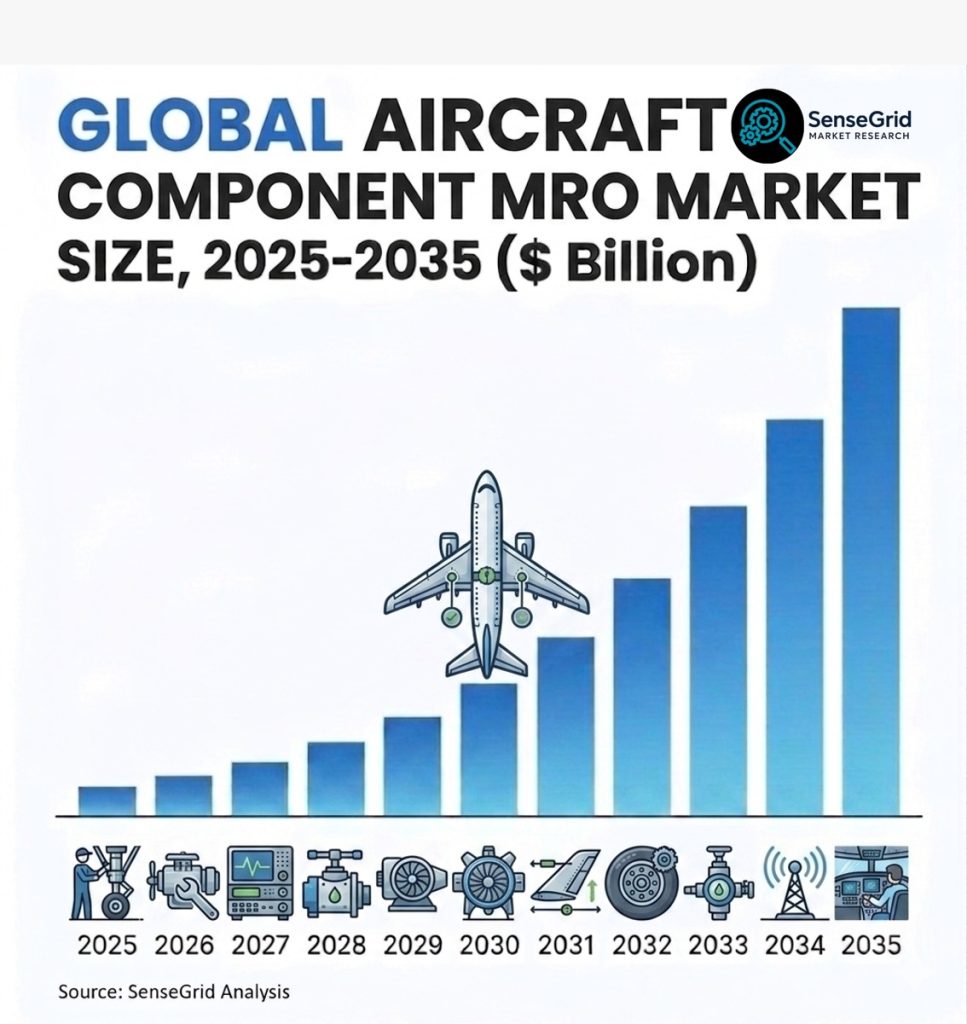
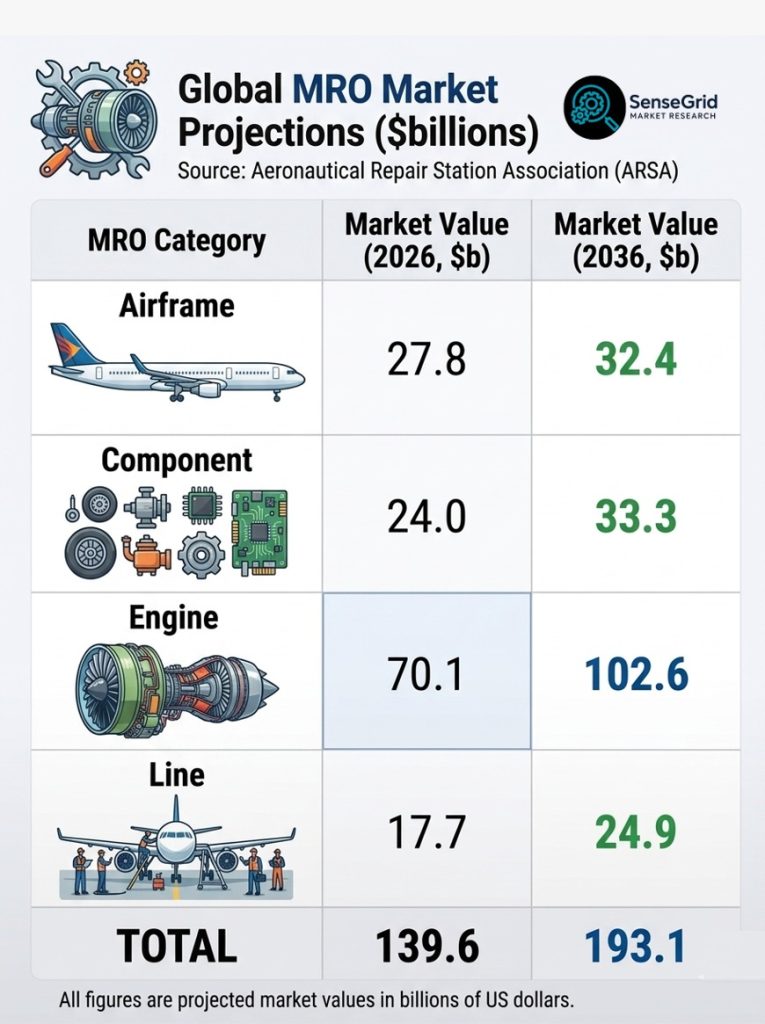
Global aircraft component MRO market is growing at a CAGR of 7.1% during the forecast period (2026-2035). The industry was valued at $25.8 billion in 2025 and is projected to reach $51.4 billion in 2035. The global aircraft component MRO market is witnessing significant growth driven by the expanding global aircraft fleet, rising air passenger traffic, and increasing demand for efficient aircraft maintenance and component replacement services. Pivotal factors include aging aircraft fleets, extended aircraft operational life, and a growing focus on aviation safety and regulatory compliance. According to the Aeronautical Repair Station Association (ARSA), Global commercial aircraft fleet reached approximately 𝟑𝟎,𝟎𝟒𝟔 aircraft in 2026 and is projected to approach 𝟒𝟏,𝟎𝟎𝟎 aircraft by 2036. Global passenger revenues surpassed $𝟏 𝐭𝐫𝐢𝐥𝐥𝐢𝐨𝐧 in 2025 for the first time. Global air travel demand reached approximately 𝟓.𝟐 𝐛𝐢𝐥𝐥𝐢𝐨𝐧 passengers in 2025.
- Aircraft manufacturers recorded nearly 𝟏𝟕,𝟎𝟎𝟎 unfilled aircraft orders in 2026. The current aircraft backlog represents more than 12 years of production demand. The average global aircraft fleet age increased to nearly 13 years in 2025.
- Supply chain disruptions are projected to delay production of over 𝟔,𝟎𝟎𝟎 aircraft before 2030, while workforce shortages continue to intensify, with 𝟒𝟏% of U.S. aircraft mechanics aged above 60 and nearly 𝟒𝟓,𝟎𝟎𝟎 expected to retire over the next decade.
- The global civil MRO industry comprises around 𝟓,𝟎𝟑𝟗 companies, of which nearly 79% are SMEs, supporting approximately 𝟒𝟐𝟖,𝟔𝟔𝟒 maintenance professionals globally, including 𝟏𝟗𝟐,𝟎𝟒𝟒 employees across 𝟑,𝟗𝟖𝟖 US-based MRO firms.
Market Dynamics
- Rising Investments in MRO Infrastructure Expansion
Growing investments in advanced maintenance facilities and digital repair capabilities are accelerating market growth. For instance, in 2025, Lufthansa Technik announced significant investments in expanding its global engine and component maintenance network to meet increasing aircraft fleet requirements.
- Strategic Collaborations Enhancing Component Repair Capabilities
Partnerships between airlines, OEMs, and MRO providers are strengthening component maintenance efficiency and service coverage. For instance, in 2024, Air France Industries KLM Engineering & Maintenance and CFM International expanded their collaboration to support next-generation engine maintenance and component repair services.
- Launch of Advanced Digital and Predictive Maintenance Solutions
The introduction of AI-driven diagnostics and predictive maintenance platforms is improving aircraft component reliability and reducing downtime. For instance, in 2024, Honeywell launched enhanced predictive maintenance solutions designed to optimize aircraft component health monitoring and maintenance scheduling.
Market Segmentation
- Based on the component type, the market is segmented into engine components, avionics components, landing gear components, airframe components, hydraulic & pneumatic components, electrical components, cabin interior components, auxiliary power unit (APU) components and others.
- Based on the service type, the market is segmented into maintenance, repair, overhaul, inspection & testing and modification & upgrades.
- By Aircraft Type, the market is segmented into narrow-body aircraft, wide-body aircraft, regional aircraft, business jets, military aircraft and helicopters.
- By End User the market is segmented into airlines, aircraft leasing companies, defense organizations and MRO service providers.
Engine Components Segment Dominates the Market with the Largest Share
Global aircraft component MRO market is driven by the dominance of Engine Components in maintenance spending and overhaul activities. Aircraft engines are the most complex and high-value components, requiring frequent inspections, repairs, and overhauls throughout their operational lifecycle. According to the International Air Transport Association (IATA) and Oliver Wyman’s Global Fleet & MRO Forecast, Engine MRO accounted for approximately 51.8% of total aircraft MRO expenditure in 2025, making it the largest segment within the global MRO market. Engine MRO’s share has increased from 48% in 2019 to 52% in 2025, reflecting growing demand for engine shop visits, overhauls, and component repairs as fleets age and next-generation engines enter service.
Airlines Holds a Significant Market Share
Global aircraft component MRO market is growing owing to the increasing dominance of Airlines as the primary end-user segment. Airlines operate large commercial fleets that require continuous maintenance, repair, and replacement of critical aircraft components to ensure safety, regulatory compliance, and operational efficiency. According to the International Air Transport Association (IATA), global air passenger demand increased by 5.3% in 2025, while international passenger traffic grew by 7.1%, reaching record levels. The industry also achieved a record 83.6% passenger load factor, indicating intensive aircraft utilization and higher maintenance requirements for aircraft components.
Furthermore, the International Civil Aviation Organization (ICAO) reported that the number of passengers carried on scheduled air services reached 4.7 billion in 2024, representing a 7.9% increase over the previous year. Aircraft departures also rose by 5.1% to 37.4 million flights, directly increasing demand for component inspections, repairs, and overhauls.
Regional Outlook
The global aircraft component MRO market is segmented geographically into North America (the US and Canada), Europe (the UK, Germany, France, Italy, Spain, Russia, and Rest of Europe), Asia-Pacific (India, China, Japan, South Korea, Australia & New Zealand, ASEAN Countries, and Rest of Asia-Pacific), and the Rest of the World (Middle East & Africa and Latin America).
Surging Air Traffic Driving MRO Demand in Asia-Pacific
Asia-Pacific aircraft component MRO Market is growing owing to the region’s rapidly expanding commercial aircraft fleet, surging passenger traffic, and increasing aircraft utilization rates. Airlines across Asia-Pacific are adding new aircraft to meet rising travel demand, which is increasing the need for component maintenance, repair, overhaul, and replacement services. According to the International Air Transport Association (IATA), Asia-Pacific airlines recorded the fastest growth among all regions in 2025, with international passenger traffic increasing by 10.9% year-over-year and passenger load factors reaching 84.4%, the highest among all global regions. Higher aircraft utilization directly increases demand for aircraft component MRO services. Additionally, the International Civil Aviation Organization (ICAO) reported that the Asia-Pacific region accounted for 33.7% of global passenger traffic in 2024, making it the global largest aviation market by traffic share. Passenger traffic in the region increased by 16.7% year-over-year, significantly outpacing North America and Europe.
North America Region Dominates the Market with Major Share
North America aircraft component MRO market is growing owing to the region’s large commercial aircraft fleet, high aircraft utilization rates, and sustained growth in air passenger traffic. The presence of major airlines, OEMs, and MRO providers generates significant demand for the maintenance, repair, and overhaul of critical aircraft components, including engines, avionics, landing gear, and electrical systems. According to the International Air Transport Association (IATA), North American airlines recorded a 2.1% increase in passenger traffic in 2025, while maintaining a high 83.9% passenger load factor, indicating intensive aircraft usage and a greater need for regular component maintenance and replacement. In addition, the Federal Aviation Administration (FAA) projects continued growth in U.S. airline traffic and fleet activity through its long-term aerospace forecasts, supporting sustained demand for aircraft component MRO services across the region.
Market Players Outlook
The major companies operating in the global aircraft component MRO market include GE Aerospace, RTX Corporation (Collins Aerospace), Safran S.A., Rolls-Royce Holdings plc and Lufthansa Technik AG, among others. Industry players are focusing on partnerships, collaborations, and mergers, and acquisitions activities to broaden their market reach, foster innovation, and reinforce their market standing.
Recent Developments
- In April 2026, Delta TechOps and LATAM Airlines are collaborating on A320 component repair programs, reinforcing a shift toward shared technical ecosystems between operators and MRO divisions. This partnership strengthens their technical integration for component maintenance.
- In March 2026, SIA Engineering Company Limited (SIAEC) signed a letter of intent with Safran Aircraft Engines to broaden their partnership for CFM Leap engine maintenance in Singapore. The companies plan to potentially form a Leap MRO joint venture, expanding their commercial agreement scope. This partnership targets Singapore’s growing engine maintenance market.
- In March 2025, GE Aerospace and Lufthansa Technik Open $267 million XEOS LEAP Engine Centre in Poland. GE Aerospace partnered with Lufthansa Technik to open Poland’s USD $267 million XEOS LEAP engine centre, targeting 250 annual overhauls. This joint venture combines German engineering expertise with Poland’s cost competitiveness, enhancing component MRO capacity in Europe.
The Report Covers
- Market valuation analysis for 2026 with projections through 2035.
- Profiles of leading aircraft component MRO companies, covering recent developments and strategic initiatives.
- Segment-wise revenue forecasts and estimates ($ Million).
- Comprehensive country-level insights across key geographic regions.
- Analysis of high-growth segments and future market opportunities.
- Evaluation of market penetration and expansion strategies.
- Competitive landscape assessment and player positioning analysis.
Key Market Players
- AAR Corp.
- Airbus SE
- Bombardier Inc.
- Collins Aerospace
- Crane Aerospace & Electronics LLC
- Delta Air Lines Technology Hub
- General Electric Aerospace
- GKN Aerospace Services Limited
- Honeywell Aerospace Technologies
- Hong Kong Aircraft Engineering Company Limited
- Kawasaki Heavy Industries, Ltd.
- Leonardo S.p.A.
- Lufthansa Technik AG
- Mitsubishi Corporation
- Parker-Hannifin Corporation
- Rolls-Royce Holdings plc
- RTX Corporation
- Saab AB
- Safran S.A.
- SIA Engineering Company Limited
- Spirit AeroSystems Holdings, Inc.
- Textron Inc.
- Thales Group
- The Boeing Company
- TRIUMPH Group, Inc.
- Turkish Aerospace Industries, Inc.
LIST OF TABLES
- Aircraft Component MRO Market Forecast & Estimation Analysis by Component Type, 2025–2035 ($ Million)
- Aircraft Engine Component MRO Market Forecast & Estimation Analysis by Region, 2025–2035 ($ Million)
- Aircraft Avionics Components MRO Market Forecast & Estimation Analysis by Region, 2025–2035 ($ Million)
- Aircraft Landing Gear Component MRO Market Forecast & Estimation Analysis by Region, 2025–2035 ($ Million)
- Aircraft Airframe Component MRO Market Forecast & Estimation Analysis by Region, 2025–2035 ($ Million)
- Aircraft Hydraulic & Pneumatic Component MRO Market Forecast & Estimation Analysis by Region, 2025–2035 ($ Million)
- Aircraft Electrical Component MRO Market Forecast & Estimation Analysis by Region, 2025–2035 ($ Million)
- Aircraft Cabin Interior Component MRO Market Forecast & Estimation Analysis by Region, 2025–2035 ($ Million)
- Aircraft Auxiliary Power Unit (APU) Component MRO Market Forecast & Estimation Analysis by Region, 2025–2035 ($ Million)
- Aircraft Other Component MRO Market Forecast & Estimation Analysis by Region, 2025–2035 ($ Million)
- Aircraft Component MRO Market Forecast & Estimation Analysis by Service Type, 2025–2035 ($ Million)
- Aircraft Maintenance Component MRO Market Forecast & Estimation Analysis by Region, 2025–2035 ($ Million)
- Aircraft Repair Component MRO Market Forecast & Estimation Analysis by Region, 2025–2035 ($ Million)
- Aircraft Overhaul Component MRO Market Forecast & Estimation Analysis by Region, 2025–2035 ($ Million)
- Aircraft Inspection & Testing Component MRO Market Forecast & Estimation Analysis by Region, 2025–2035 ($ Million)
- Aircraft Modification & Upgrades Component MRO Market Forecast & Estimation Analysis by Region, 2025–2035 ($ Million)
- Aircraft Component MRO Market Forecast & Estimation Analysis by Aircraft Type, 2025–2035 ($ Million)
- Aircraft Narrow-Body Component MRO Market Forecast & Estimation Analysis by Region, 2025–2035 ($ Million)
- Aircraft Wide-Body Component MRO Market Forecast & Estimation Analysis by Region, 2025–2035 ($ Million)
- Aircraft Regional Aircraft MRO Market Forecast & Estimation Analysis by Region, 2025–2035 ($ Million)
- Aircraft Business Jets Component MRO Market Forecast & Estimation Analysis by Region, 2025–2035 ($ Million)
- Aircraft Military Component MRO Market Forecast & Estimation Analysis by Region, 2025–2035 ($ Million)
- Aircraft Helicopters Component MRO Market Forecast & Estimation Analysis by Region, 2025–2035 ($ Million)
- Aircraft Component MRO Market Forecast & Estimation Analysis by End User, 2025–2035 ($ Million)
- Aircraft Component MRO For Airlines Market Forecast & Estimation Analysis by Region, 2025–2035 ($ Million)
- Aircraft Component MRO For Aircraft Leasing Companies Market Forecast & Estimation Analysis by Region, 2025–2035 ($ Million)
- Aircraft Component MRO For Defense Organizations Market Forecast & Estimation Analysis by Region, 2025–2035 ($ Million)
- Aircraft Component MRO For MRO Service Providers Market Forecast & Estimation Analysis by Region, 2025–2035 ($ Million)
- Aircraft Component MRO Market Research and Analysis by Region, 2025–2035 ($ Million)
- North American Aircraft Component MRO Market Forecast & Estimation Analysis by Region, 2025–2035 ($ Million)
- North American Aircraft Component MRO Market Forecast & Estimation Analysis by Component Type, 2025–2035 ($ Million)
- North American Aircraft Component MRO Market Forecast & Estimation Analysis by Service Type, 2025–2035 ($ Million)
- North American Aircraft Component MRO Market Forecast & Estimation Analysis by Aircraft Type, 2025–2035 ($ Million)
- North American Aircraft Component MRO Market Forecast & Estimation Analysis by End User, 2025–2035 ($ Million)
- European Aircraft Component MRO Market Forecast & Estimation Analysis by Region, 2025–2035 ($ Million)
- European Aircraft Component MRO Market Forecast & Estimation Analysis by Component Type, 2025–2035 ($ Million)
- European Aircraft Component MRO Market Forecast & Estimation Analysis by Service Type, 2025–2035 ($ Million)
- European Aircraft Component MRO Market Forecast & Estimation Analysis by Aircraft Type, 2025–2035 ($ Million)
- European Aircraft Component MRO Market Forecast & Estimation Analysis by End User, 2025–2035 ($ Million)
- Asia-Pacific Aircraft Component MRO Market Forecast & Estimation Analysis by Region, 2025–2035 ($ Million)
- Asia-Pacific Aircraft Component MRO Market Forecast & Estimation Analysis by Component Type, 2025–2035 ($ Million)
- Asia-Pacific Aircraft Component MRO Market Forecast & Estimation Analysis by Service Type, 2025–2035 ($ Million)
- Asia-Pacific Aircraft Component MRO Market Forecast & Estimation Analysis by Aircraft Type, 2025–2035 ($ Million)
- Asia-Pacific Aircraft Component MRO Market Forecast & Estimation Analysis by End User, 2025–2035 ($ Million)
- Rest of the World Aircraft Component MRO Market Forecast & Estimation Analysis by Region, 2025–2035 ($ Million)
- Rest of the World Aircraft Component MRO Market Forecast & Estimation Analysis by Component Type, 2025–2035 ($ Million)
- Rest of the World Aircraft Component MRO Market Forecast & Estimation Analysis by Service Type, 2025–2035 ($ Million)
- Rest of the World Aircraft Component MRO Market Forecast & Estimation Analysis by Aircraft Type, 2025–2035 ($ Million)
- Rest of the World Aircraft Component MRO Market Forecast & Estimation Analysis by End User, 2025–2035 ($ Million)
List of Figures
- Aircraft Component MRO Market Share Forecast & Estimation by Component Type, 2025 Vs 2035 (%)
- Aircraft Engine Component MRO Market Share Forecast & Estimation by Region, 2025 Vs 2035 (%)
- Aircraft Avionics Components MRO Market Share Forecast & Estimation by Region, 2025 Vs 2035 (%)
- Aircraft Landing Gear Component MRO Market Share Forecast & Estimation by Region, 2025 Vs 2035 (%)
- Aircraft Airframe Component MRO Market Share Forecast & Estimation by Region, 2025 Vs 2035 (%)
- Aircraft Hydraulic & Pneumatic Component MRO Market Share Forecast & Estimation by Region, 2025 Vs 2035 (%)
- Aircraft Electrical Component MRO Market Share Forecast & Estimation by Region, 2025 Vs 2035 (%)
- Aircraft Cabin Interior Component MRO Market Share Forecast & Estimation by Region, 2025 Vs 2035 (%)
- Aircraft Auxiliary Power Unit (APU) Component MRO Market Share Forecast & Estimation by Region, 2025 Vs 2035 (%)
- Aircraft Other Component MRO Market Share Forecast & Estimation by Region, 2025 Vs 2035 (%)
- Aircraft Component MRO Market Share Forecast & Estimation by Service Type, 2025 Vs 2035 (%
- Aircraft Maintenance Component MRO Market Share Forecast & Estimation by Region, 2025 Vs 2035 (%)
- Aircraft Repair Component MRO Market Share Forecast & Estimation by Region, 2025 Vs 2035 (%)
- Aircraft Overhaul Component MRO Market Share Forecast & Estimation by Region, 2025 Vs 2035 (%)
- Aircraft Inspection & Testing Component MRO Market Share Forecast & Estimation by Region, 2025 Vs 2035 (%)
- Aircraft Modification & Upgrades Component MRO Market Share Forecast & Estimation by Region, 2025 Vs 2035 (%)
- Aircraft Component MRO Market Share Forecast & Estimation by Aircraft Type, 2025 Vs 2035 (%)
- Aircraft Narrow-Body Component MRO Market Share Forecast & Estimation by Region, 2025 Vs 2035 (%)
- Aircraft Wide-Body Component MRO Market Share Forecast & Estimation by Region, 2025 Vs 2035 (%)
- Aircraft Regional Aircraft MRO Market Share Forecast & Estimation by Region, 2025 Vs 2035 (%)
- Aircraft Business Jets Component MRO Market Share Forecast & Estimation by Region, 2025 Vs 2035 (%)
- Military Aircraft Aircraft Component MRO Market Share Forecast & Estimation by Region, 2025 Vs 2035 (%)
- Aircraft Helicopters Component MRO Market Share Forecast & Estimation by Region, 2025 Vs 2035 (%)
- Aircraft Component MRO Market Share Forecast & Estimation by End User, 2025 Vs 2035 (%)
- Aircraft Component MRO For Airlines Market Share Forecast & Estimation by Region, 2025 Vs 2035 (%)
- Aircraft Component MRO For Aircraft Leasing Companies Market Share Forecast & Estimation by Region, 2025 Vs 2035 (%)
- Aircraft Component MRO For Defense Organizations Market Share Forecast & Estimation by Region, 2025 Vs 2035 (%)
- Aircraft Component MRO For MRO Service Providers Market Share Forecast & Estimation by Region, 2025 Vs 2035 (%)
- Aircraft Component MRO Market Forecast & Estimation by Region, 2025–2035 ($ Million)
- US Aircraft Component MRO Market Size Estimation, 2025–2035 ($ Million)
- Canada Aircraft Component MRO Market Size Estimation, 2025–2035 ($ Million)
- UK Aircraft Component MRO Market Size Estimation, 2025–2035 ($ Million)
- France Aircraft Component MRO Market Size Estimation, 2025–2035 ($ Million)
- Germany Aircraft Component MRO Market Size Estimation, 2025–2035 ($ Million)
- Italy Aircraft Component MRO Market Size Estimation, 2025–2035 ($ Million)
- Spain Aircraft Component MRO Market Size Estimation, 2025–2035 ($ Million)
- Russia Aircraft Component MRO Market Size Estimation, 2025–2035 ($ Million)
- Rest of Europe Aircraft Component MRO Market Size Estimation, 2025–2035 ($ Million)
- India Aircraft Component MRO Market Size Estimation, 2025–2035 ($ Million)
- China Aircraft Component MRO Market Size Estimation, 2025–2035 ($ Million)
- Japan Aircraft Component MRO Market Size Estimation, 2025–2035 ($ Million)
- South Korea Aircraft Component MRO Market Size Estimation, 2025–2035 ($ Million)
- Australia and New Zealand Aircraft Component MRO Market Size Estimation, 2025–2035 ($ Million)
- ASEAN Economies Aircraft Component MRO Market Size Estimation, 2025–2035 ($ Million)
- Rest of Asia-Pacific Aircraft Component MRO Market Size Estimation, 2025–2035 ($ Million)
- Latin America Aircraft Component MRO Market Size Estimation, 2025–2035 ($ Million)
- Middle East & Africa Aircraft Component MRO Market Size Estimation, 2025–2035 ($ Million)
Download Global Aircraft Component MRO Market Sample Report
Contact Us
- Chat On WhatsApp
- Phone :+91-9131799396
- Hi Link Residency, Airport Road, Indore, 452005
- sensegridmarketresearch@gmail.com
Select User License Type
Analyst Support, Customization & Verified Analysis
REPORT BY INDUSTRIES
- Food & Beverages
- Healthcare & Lifesciences
- Semiconductors & Electronics
- Information Technology
- Automotive
- Automation
- Energy & Power
- Consumer Goods & Services
- Agriculture