“Empowering Smarter Business Decisions Through Data-Driven Insights”


Global Air Freight Market Size, Share & Trends Analysis Report By Service Type (Express Freight, Standard Freight, and Deferred Freight), By Cargo Type (General Cargo and Special Cargo), By Shipment Type (Domestic and International) and By End-Use Industry (Retail & E-commerce, Healthcare & Pharmaceuticals, Automotive, Electronics & Semiconductors, Aerospace & Defense, Food & Beverages, Manufacturing and Others), Forecast (2026-2035)
- Report Code: SMR-100010
- Historic Range: 2025–2035
- Publish date: Jun-2026
Global Air Freight Market Size, Share & Trends Analysis Report By Service Type (Express Freight, Standard Freight, and Deferred Freight), By Cargo Type (General Cargo and Special Cargo), By Shipment Type (Domestic and International) and By End-Use Industry (Retail & E-commerce, Healthcare & Pharmaceuticals, Automotive, Electronics & Semiconductors, Aerospace & Defense, Food & Beverages, Manufacturing and Others), Forecast (2026-2035)
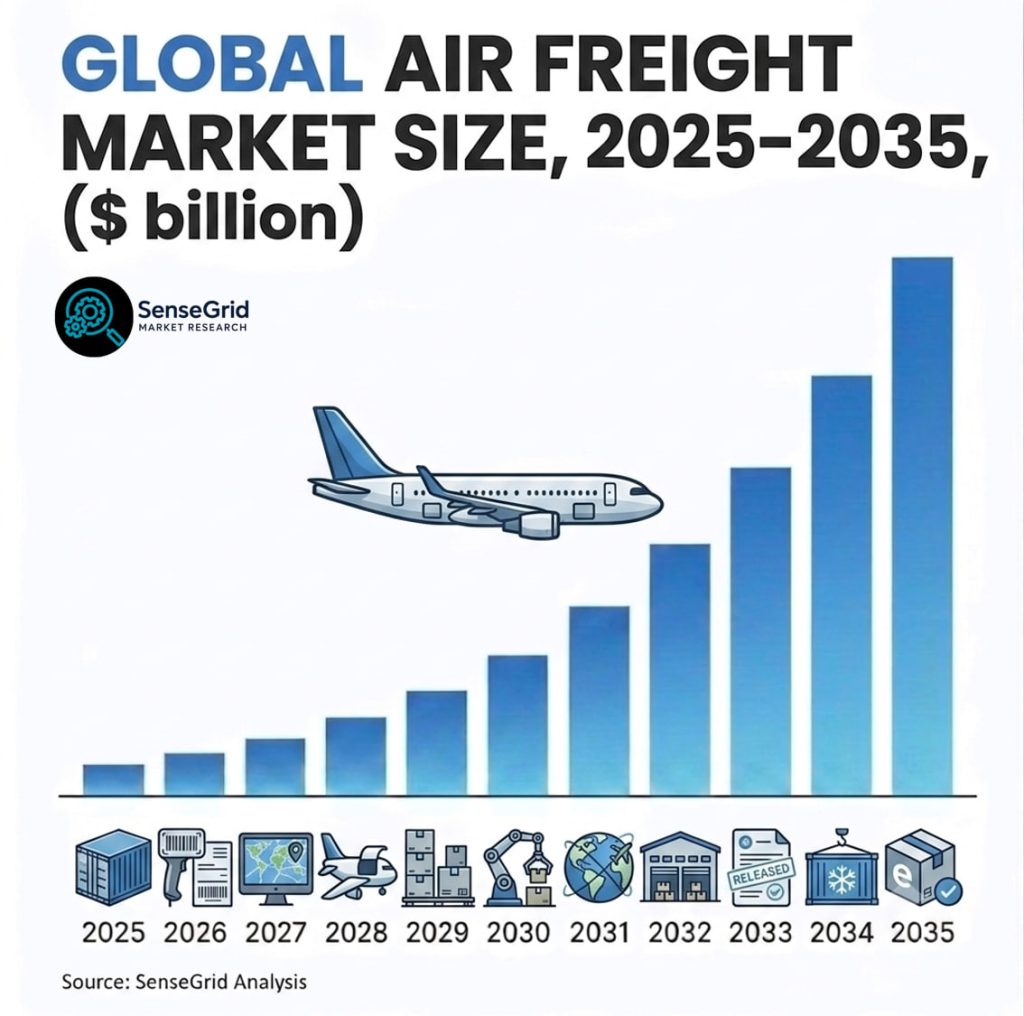
Global air freight market is growing at a CAGR of 5.9% during the forecast period (2026-2035). The industry was valued at $355.8 billion in 2025 and is projected to reach $631.1 billion in 2035. The global air freight market is growing owing to expanding cross-border e-commerce and increasing demand for fast, reliable delivery of high-value, time-sensitive goods. Additionally, ongoing supply chain diversification and globalization of trade have significantly boosted air cargo demand. According to the 𝗜𝗻𝘁𝗲𝗿𝗻𝗮𝘁𝗶𝗼𝗻𝗮𝗹 𝗔𝗶𝗿 𝗧𝗿𝗮𝗻𝘀𝗽𝗼𝗿𝘁 𝗔𝘀𝘀𝗼𝗰𝗶𝗮𝘁𝗶𝗼𝗻 (𝗜𝗔𝗧𝗔),
- global air cargo demand—measured in cargo tonne-kilometers (𝗖𝗧𝗞𝘀)—increased by approximately 𝟯.𝟭% 𝘁𝗼 𝟯.𝟰% 𝘆𝗲𝗮𝗿-𝗼𝗻-𝘆𝗲𝗮𝗿 in 2025, exceeding earlier expectations and reflecting improving global trade conditions.
- Air cargo capacity expanded alongside demand, rising by around 𝟯.𝟳% in 2025, indicating a balanced market with stable utilization levels. Asia-Pacific remains the dominant and fastest-growing air cargo market, accounting for ~𝟯𝟱.𝟵% of global cargo traffic. Demand is expected to grow by ~𝟴.𝟰–𝟴.𝟱% 𝗶𝗻 𝟮𝟬𝟮𝟱, supported by strong manufacturing exports and trade route shifts toward Europe and intra-Asia markets.
- In terms of market size, global air cargo revenues reached about $𝟭𝟱𝟱 𝗯𝗶𝗹𝗹𝗶𝗼𝗻 in 𝟮𝟬𝟮𝟱, highlighting the continued importance of cargo as a key revenue stream for airlines. This growth has been largely driven by structural shifts such as the rapid expansion of cross-border e-commerce and supply chain diversification.
- IATA projects that air cargo will continue to grow in 2026, although at a slightly slower pace owing to softer global trade conditions. Cargo volumes are expected to reach approximately𝟳𝟭.𝟲 𝗺𝗶𝗹𝗹𝗶𝗼𝗻 𝘁𝗼𝗻𝗻𝗲𝘀, with 𝟮.𝟰% growth, while revenues are forecast to increase further to around $𝟭𝟱𝟴 𝗯𝗶𝗹𝗹𝗶𝗼𝗻.
Market Dynamics
- Growth in E-commerce and Express Logistics
The rapid expansion of cross-border e-commerce is driving demand for faster and more reliable air freight services, encouraging logistics providers to expand capacity and strengthen delivery networks. For instance, DHL Express invested over €500 million in 2024 to expand its aviation and logistics infrastructure across the Middle East, supporting rising international cargo volumes.
- Strategic Airline and Logistics Collaborations
Collaborations between airlines and logistics companies are enhancing global cargo connectivity, optimizing route networks, and improving shipment efficiency. For instance, in 2024, Qatar Airways Cargo and Japan Airlines expanded their strategic partnership to strengthen cargo operations and provide broader global freight connectivity.
- Fleet Expansion and Digital Cargo Solutions
The launch of advanced freighter aircraft and digital cargo management platforms is improving operational efficiency and meeting growing demand for time-sensitive shipments. For instance, Emirates SkyCargo announced the expansion of its freighter fleet with additional Boeing 777 Freighters in 2024 to increase global cargo capacity and support long-term market growth.
Market Segmentation
- Based on the service type, the market is segmented into express freight, standard freight, and deferred freight.
- Based on the cargo type, the market is segmented into general cargo and special cargo.
- Based on the shipment type, the market is segmented into domestic and international.
- Based on the end-user industry, the market is segmented into retail & e-commerce, healthcare & pharmaceuticals, automotive, electronics & semiconductors, aerospace & defense, food & beverages, manufacturing, and others.
Standard Freight Segment Dominates the Market with the Largest Share
The standard freight segment holds the largest share of the global air freight market owing to its cost-effective pricing, extensive airline connectivity, and suitability for transporting general cargo across industries such as automotive, manufacturing, industrial equipment, consumer goods, and retail. Unlike express freight, which is used for urgent shipments, standard freight serves the majority of scheduled international cargo movements, making it the preferred service for businesses balancing cost and transit time. According to the International Air Transport Association (IATA), global air cargo demand reached a record high in 2024, with cargo tonne-kilometers (CTKs) increasing by 11.3% year-over-year, surpassing the previous peak recorded in 2021. Global air cargo demand increased by 11.3% in 2024 (CTKs), reaching an all-time high. Air cargo capacity grew by 7.4% in 2024, reflecting continued airline investments in scheduled freight operations. IATA noted that this growth was driven by strong global trade, booming e-commerce, and disruptions in ocean shipping, all of which significantly increased the utilization of standard air freight services.
Retail & E-Commerce Holds a Significant Market Share
The retail & e-commerce segment holds the largest share of the global air freight market, driven by the rapid growth of cross-border online shopping, increasing consumer demand for next-day and same-day delivery, and the expansion of global e-commerce platforms. Air freight remains the preferred transportation mode for high-value, lightweight, and time-sensitive parcels, enabling retailers to meet fast delivery expectations across international markets. According to the International Air Transport Association (IATA), e-commerce represented approximately 15% of global air cargo volumes in 2019, and its share has continued to grow rapidly following the pandemic due to the surge in online retail and cross-border parcel shipments. Around 80% of cross-border e-commerce shipments are transported by air, highlighting the industry’s dependence on air freight for international online retail fulfillment. Cross-border e-commerce sales increased from $1.9 trillion in 2022 to $2.1 trillion in 2023, representing a 13% year-over-year increase. 131 billion parcels are delivered annually globally, with parcel volumes expected to double by 2026, further boosting demand for air cargo services.
Regional Outlook
The global air freight market is segmented geographically into North America (the US and Canada), Europe (the UK, Germany, France, Italy, Spain, Russia, and Rest of Europe), Asia-Pacific (India, China, Japan, South Korea, Australia & New Zealand, ASEAN Countries, and Rest of Asia-Pacific), and the Rest of the World (Middle East & Africa and Latin America).
Expanding Air Cargo Demand Strengthens North American Market
The North American air freight market is experiencing steady growth due to expanding e-commerce, advanced logistics infrastructure, increasing pharmaceutical shipments, and the presence of global express carriers such as FedEx and UPS. Strong domestic air cargo demand and rising international trade continue to support regional market expansion. According to the International Air Transport Association (IATA)
- North American airlines reported a 6.6% year-on-year increase in international air cargo demand (CTKs) in 2024. International cargo capacity grew by 3.4% during the year.
- The region continues to benefit from high-value shipments, integrated express delivery networks, and resilient consumer demand.
- Additionally, the U.S. Bureau of Transportation Statistics (BTS) reports that U.S. airlines transported more than 64 billion freight ton-miles annually, highlighting the country’s position as one of the world’s largest air cargo markets.
Asia-Pacific Region Dominates the Market with Major Share
The Asia-Pacific air freight market holds the largest share globally, driven by its strong manufacturing base, booming cross-border e-commerce, and high export volumes of electronics, semiconductors, and consumer goods. The region is home to several of the world’s busiest cargo airports and serves as the primary hub for international trade between Asia, North America, and Europe. According to the International Air Transport Association (IATA)
- Asia-Pacific airlines recorded an 8.3% year-on-year increase in international air cargo demand (CTKs) in 2024.
- International cargo capacity increased by 11.3% during the same period, reflecting continued investments in cargo aircraft and airport infrastructure.
- Asia-Pacific remained the largest air cargo market globally, accounting for 34.2% of total international cargo tonne-kilometers (CTKs) in 2024.
Market Players Outlook
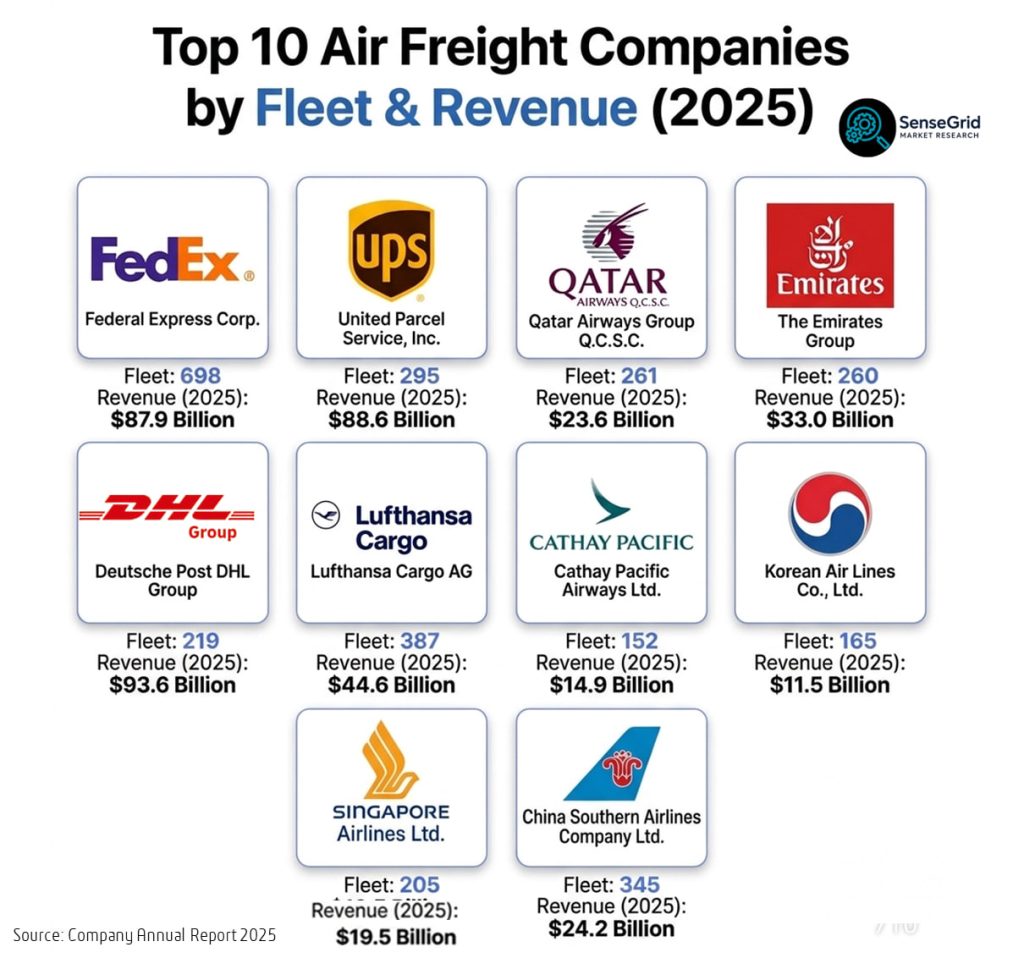
The major companies operating in the global air freight market include United Parcel Service, Inc., FedEx Corp., Deutsche Post DHL Group, Kuehne + Nagel International AG, DSV A/S. Industry players are focusing on partnerships, collaborations, and mergers, and acquisitions activities to broaden their market reach, foster innovation, and reinforce their market standing.
Recent Developments
- In December 2025, DHL Global Forwarding and Air France-KLM Martinair Cargo signed a new framework agreement to deepen their long-term partnership focused on decarbonizing the air freight sector. The agreement emphasizes emission reduction rights and “book-and-claim” mechanisms to accelerate the adoption of sustainable aviation fuel (SAF). DHL also signed an order covering 35,000 metric tons of CO₂ emission reduction rights, demonstrating a significant commitment to sustainable air cargo operations.
- In August 2025, Atlas Air Worldwide and Etihad Cargo announced a long-term partnership to support growing air freight demand across Asia, Europe, and the Middle East. Under the agreement, Atlas Air provides dedicated capacity through a newly delivered Boeing 777 freighter operating on routes connecting Hong Kong, Abu Dhabi, and Madrid. The partnership is designed to meet rising demand from e-commerce, pharmaceuticals, automotive products, and perishables.
- In April 2025, MASkargo, Qatar Airways Cargo, and IAG Cargo announced plans to establish a Global Cargo Joint Business. The collaboration aims to create one of the world’s most connected cargo networks by combining infrastructure, expertise, and route networks. Key benefits include enhanced connectivity, faster transit times, streamlined product offerings, new routing opportunities, and harmonized safety and security standards for customers globally.
The Report Include
- Market valuation analysis for 2026 with projections through 2035.
- Profiles of leading air freight companies, covering recent developments and strategic initiatives.
- Segment-wise revenue forecasts and estimates ($ Million).
- Comprehensive country-level insights across key geographic regions.
- Analysis of high-growth segments and future market opportunities.
- Evaluation of market penetration and expansion strategies.
- Competitive landscape assessment and player positioning analysis.
Key Market Players
- Air France KLM Martinair Cargo
- AirBridgeCargo Airlines LLC
- Atlas Air Worldwide Holdings, Inc.
- Bolloré Logistics
- H. Robinson Worldwide, Inc.
- Cargolux Airlines International S.A.
- Cathay Cargo
- CEVA Logistics SA
- China Airlines Cargo
- DB Schenker
- Deutsche Lufthansa AG (Lufthansa Cargo)
- DHL Express
- DSV A/S
- Emirates SkyCargo
- Ethiopian Airlines Cargo & Logistics Services
- EVA Airways Corporation (EVA Air Cargo)
- Expeditors International of Washington, Inc.
- FedEx Corp.
- GEODIS SA
- Hellmann Worldwide Logistics SE & Co. KG
- Korean Air Cargo
- Kuehne + Nagel International AG
- MSC Air Cargo
- Nippon Cargo Airlines Co., Ltd.
- Qatar Airways Cargo
- SF Airlines Co., Ltd.
- Singapore Airlines Cargo Pte. Ltd.
- Turkish Cargo
- United Parcel Service, Inc. (UPS)
- XPO, Inc.
LIST OF TABLES
- Air Freight Market Forecast & Estimation Analysis by Service Type, 2025–2035 ($ Million)
- Air Express Freight Market Forecast & Estimation Analysis by Region, 2025–2035 ($ Million)
- Air Standard Freight Market Forecast & Estimation Analysis by Region, 2025–2035 ($ Million)
- Air Deferred Freight Market Forecast & Estimation Analysis by Region, 2025–2035 ($ Million)
- Global Air Freight Market Forecast & Estimation Analysis by Cargo Type, 2025–2035 ($ Million)
- Air General Cargo Market Forecast & Estimation Analysis by Region, 2025–2035 ($ Million)
- Air Special Cargo Market Forecast & Estimation Analysis by Region, 2025–2035 ($ Million)
- Air Freight Market Forecast & Estimation Analysis by Shipment Type, 2025–2035 ($ Million)
- Domestic Air Freight Market Forecast & Estimation Analysis by Region, 2025–2035 ($ Million)
- International Air Freight Market Forecast & Estimation Analysis by Region, 2025–2035 ($ Million)
- Air Freight Market Forecast & Estimation Analysis by End-Use Industry, 2025–2035 ($ Million)
- Air Freight Market for Retail & E-commerce Forecast & Estimation Analysis by Region, 2025–2035 ($ Million)
- Air Freight Market for Healthcare & Pharmaceuticals Forecast & Estimation Analysis by Region, 2025–2035 ($ Million)
- Air Freight Market for Automotive Forecast & Estimation Analysis by Region, 2025–2035 ($ Million)
- Air Freight Market for Electronics & Semiconductors Forecast & Estimation Analysis by Region, 2025–2035 ($ Million)
- Air Freight Market for Aerospace & Defense Forecast & Estimation Analysis by Region, 2025–2035 ($ Million)
- Air Freight Market for Food & Beverages Forecast & Estimation Analysis by Region, 2025–2035 ($ Million)
- Air Freight Market for Manufacturing Forecast & Estimation Analysis by Region, 2025–2035 ($ Million)
- Air Freight Market for Other End-Use Industry Forecast & Estimation Analysis by Region, 2025–2035 ($ Million)
- Air Freight Market Research and Analysis by Region, 2025–2035 ($ Million)
- North America Air Freight Market Forecast & Estimation Analysis by Region, 2025–2035 ($ Million)
- North America Air Freight Market Forecast & Estimation Analysis by Service Type, 2025–2035 ($ Million)
- North America Air Freight Market Forecast & Estimation Analysis by Cargo Type, 2025–2035 ($ Million)
- North America Air Freight Market Forecast & Estimation Analysis by Shipment Type, 2025–2035 ($ Million)
- North America Air Freight Market Forecast & Estimation Analysis by End-Use Industry, 2025–2035 ($ Million)
- Europe Air Freight Market Forecast & Estimation Analysis by Region, 2025–2035 ($ Million)
- Europe Air Freight Market Forecast & Estimation Analysis by Service Type, 2025–2035 ($ Million)
- Europe Air Freight Market Forecast & Estimation Analysis by Cargo Type, 2025–2035 ($ Million)
- Europe Air Freight Market Forecast & Estimation Analysis by Shipment Type, 2025–2035 ($ Million)
- Europe Air Freight Market Forecast & Estimation Analysis by End-Use Industry, 2025–2035 ($ Million)
- Asia-Pacific Air Freight Market Forecast & Estimation Analysis by Region, 2025–2035 ($ Million)
- Asia-Pacific Air Freight Market Forecast & Estimation Analysis by Service Type, 2025–2035 ($ Million)
- Asia-Pacific Air Freight Market Forecast & Estimation Analysis by Cargo Type, 2025–2035 ($ Million)
- Asia-Pacific Air Freight Market Forecast & Estimation Analysis by Shipment Type, 2025–2035 ($ Million)
- Asia-Pacific Air Freight Market Forecast & Estimation Analysis by End-Use Industry, 2025–2035 ($ Million)
- Rest of the World Air Freight Market Forecast & Estimation Analysis by Region, 2025–2035 ($ Million)
- Rest of the World Air Freight Market Forecast & Estimation Analysis by Service Type, 2025–2035 ($ Million)
- Rest of the World Air Freight Market Forecast & Estimation Analysis by Cargo Type, 2025–2035 ($ Million)
- Rest of the World Air Freight Market Forecast & Estimation Analysis by Shipment Type, 2025–2035 ($ Million)
- Rest of the World Air Freight Market Forecast & Estimation Analysis by End-Use Industry, 2025–2035 ($ Million)
List of Figures
- Air Freight Market Share Forecast & Estimation by Service Type, 2025 Vs 2035 (%)
- Air Express Freight Market Share Forecast & Estimation by Region, 2025 Vs 2035 (%)
- Air Standard Freight Market Share Forecast & Estimation by Region, 2025 Vs 2035 (%)
- Air Deferred Freight Market Share Forecast & Estimation by Region, 2025 Vs 2035 (%)
- Air Freight Market Share Forecast & Estimation by Cargo Type, 2025 Vs 2035 (%)
- Air General Cargo Market Share Forecast & Estimation by Region, 2025 Vs 2035 (%)
- Air Special Cargo Market Share Forecast & Estimation by Region, 2025 Vs 2035 (%)
- Air Freight Market Share Forecast & Estimation by Shipment Type, 2025 Vs 2035 (%)
- Domestic Air Freight Market Share Forecast & Estimation by Region, 2025 Vs 2035 (%)
- International Air Freight Market Share Forecast & Estimation by Region, 2025 Vs 2035 (%)
- Air Freight Market Share Forecast & Estimation by End-Use Industry, 2025 Vs 2035 (%)
- Air Freight Market for Retail & E-commerce Share Forecast & Estimation by Region, 2025 Vs 2035 (%)
- Air Freight Market for Healthcare & Pharmaceuticals Share Forecast & Estimation by Region, 2025 Vs 2035 (%)
- Air Freight Market for Automotive Share Forecast & Estimation by Region, 2025 Vs 2035 (%)
- Air Freight Market for Electronics & Semiconductors Share Forecast & Estimation by Region, 2025 Vs 2035 (%)
- Air Freight Market for Aerospace & Defense Share Forecast & Estimation by Region, 2025 Vs 2035 (%)
- Air Freight Market for Food & Beverages Share Forecast & Estimation by Region, 2025 Vs 2035 (%)
- Air Freight Market for Manufacturing Share Forecast & Estimation by Region, 2025 Vs 2035 (%)
- Air Freight Market for Others Share Forecast & Estimation by Region, 2025 Vs 2035 (%)
- Global Air Freight Market Forecast & Estimation by Region, 2025–2035 ($ Million)
- US Air Freight Market Size Estimation, 2025–2035 ($ Million)
- Canada Air Freight Market Size Estimation, 2025–2035 ($ Million)
- UK Air Freight Market Size Estimation, 2025–2035 ($ Million)
- France Air Freight Market Size Estimation, 2025–2035 ($ Million)
- Germany Air Freight Market Size Estimation, 2025–2035 ($ Million)
- Italy Air Freight Market Size Estimation, 2025–2035 ($ Million)
- Spain Air Freight Market Size Estimation, 2025–2035 ($ Million)
- Russia Air Freight Market Size Estimation, 2025–2035 ($ Million)
- Rest of Europe Air Freight Market Size Estimation, 2025–2035 ($ Million)
- India Air Freight Market Size Estimation, 2025–2035 ($ Million)
- China Air Freight Market Size Estimation, 2025–2035 ($ Million)
- Japan Air Freight Market Size Estimation, 2025–2035 ($ Million)
- South Korea Air Freight Market Size Estimation, 2025–2035 ($ Million)
- Australia and New Zealand Air Freight Market Size Estimation, 2025–2035 ($ Million)
- ASEAN Economies Air Freight Market Size Estimation, 2025–2035 ($ Million)
- Rest of Asia-Pacific Air Freight Market Size Estimation, 2025–2035 ($ Million)
- Latin America Air Freight Market Size Estimation, 2025–2035 ($ Million)
- Middle East & Africa Air Freight Market Size Estimation, 2025–2035 ($ Million)
Download Global Air Freight Market Sample Report
Contact Us
- Chat On WhatsApp
- Phone :+91-9131799396
- Hi Link Residency, Airport Road, Indore, 452005
- sensegridmarketresearch@gmail.com
Select User License Type
Analyst Support, Customization & Verified Analysis
REPORT BY INDUSTRIES
- Food & Beverages
- Healthcare & Lifesciences
- Semiconductors & Electronics
- Information Technology
- Automotive
- Automation
- Energy & Power
- Consumer Goods & Services
- Agriculture