“Empowering Smarter Business Decisions Through Data-Driven Insights”


Global Aircraft Engine Market Size, Share & Trends Analysis Report By Engine Type (Turbofan, Turboprop, Turboshaft, Piston Engine), By Aircraft Type (Commercial Aircraft, Military Aircraft, and Business & General Aviation), By Component (Fan, Compressor, Combustor, Turbine, Nozzle, and Others), and By End User (Original Equipment Manufacturer and Aftermarket / MRO (Maintenance, Repair & Overhaul),Forecast (2026–2035).
- Report Code: SMR-100010
- Historic Range: 2025–2035
- Publish date: Jun-2026
Global Aircraft Engine Market Size, Share & Trends Analysis Report By Engine Type (Turbofan, Turboprop, Turboshaft, Piston Engine), By Aircraft Type (Commercial Aircraft, Military Aircraft, and Business & General Aviation), By Component (Fan, Compressor, Combustor, Turbine, Nozzle, and Others), and By End User (Original Equipment Manufacturer and Aftermarket / MRO (Maintenance, Repair & Overhaul), Forecast (2026–2035).
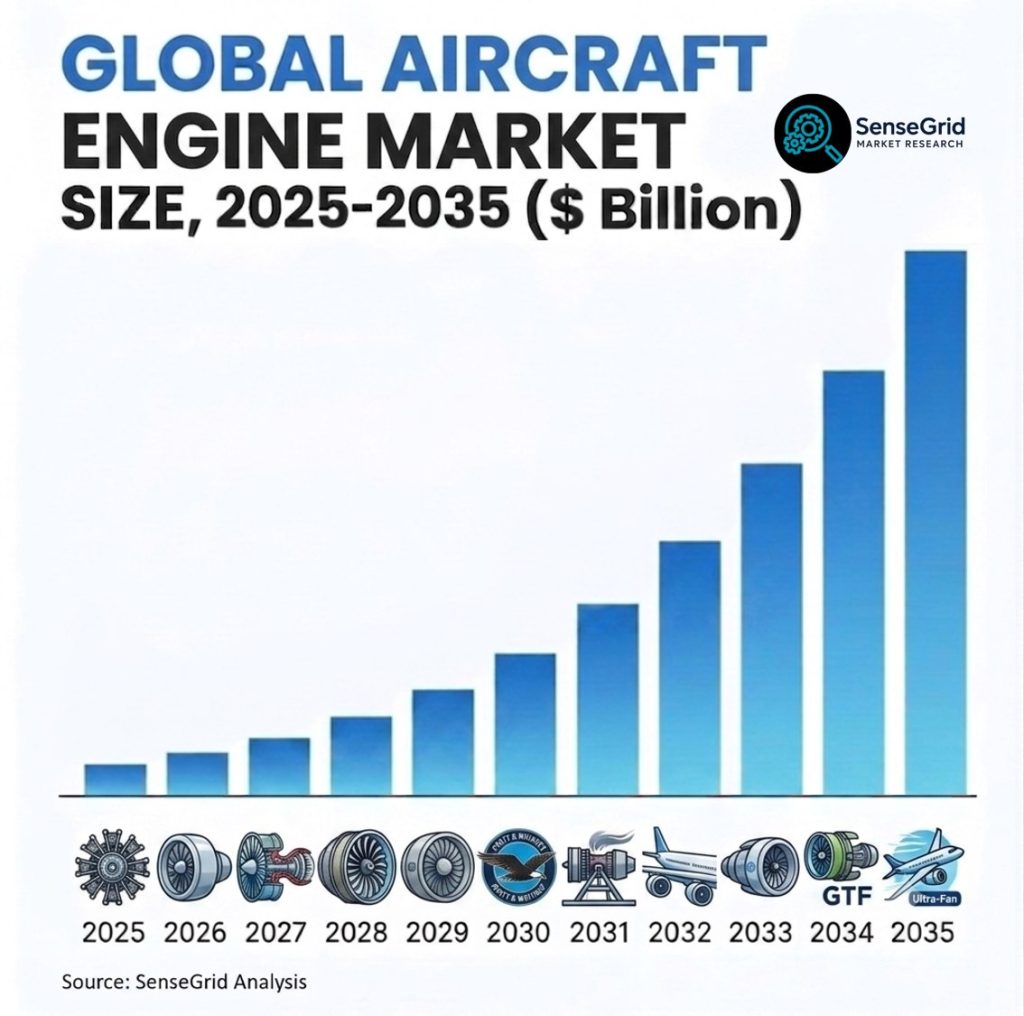
The global aircraft engine market is growing at a CAGR of 9.1% during the forecast period (2026–2035). The industry was valued at $86.7 billion in 2025 and is projected to reach $203.3 billion by 2035. The market is witnessing robust growth owing to increasing commercial aircraft deliveries, rising global air passenger traffic, fleet modernization programs, and growing investments in next-generation fuel-efficient engine technologies. According to the International Air Transport Association (IATA), global passenger demand, measured in Revenue Passenger Kilometers (RPKs), increased by 10.4% in 2024 compared with the previous year, while total passenger traffic exceeded approximately 5 billion passengers, surpassing pre-pandemic levels. In addition, Airbus delivered 766 commercial aircraft in 2024 and reported an order backlog of 8,658 aircraft, highlighting sustained long-term demand for new aircraft and advanced propulsion systems. Furthermore, the Federal Aviation Administration projects the U.S. commercial aircraft fleet to increase from 7,387 aircraft in 2024 to 10,607 aircraft by 2045, reflecting continued expansion of the aviation industry. These factors are expected to drive strong demand for aircraft engines, spare engines, and maintenance, repair, and overhaul (MRO) services throughout the forecast period.
Market Dynamics
- Rising Investment in Next-Generation Aircraft Engine Programs
The global aircraft engine market is expanding due to large-scale investments in advanced propulsion systems focused on fuel efficiency, durability, and emission reduction. Airlines and manufacturers are increasingly prioritizing next-generation engines to meet stricter environmental regulations and rising fuel costs.
- Strategic Collaborations for Sustainable and Hydrogen Aviation Engines
Collaborations between engine manufacturers, aircraft OEMs, and governments are accelerating the development of sustainable propulsion systems such as hydrogen-powered and hybrid engines. For instance, in 2025, Rolls-Royce Holdings and Airbus expanded their collaboration under the ZERO e hydrogen aircraft program, focusing on developing hydrogen combustion engine technology for future zero-emission aircraft.
- Launch of Advanced High-Efficiency Engines Driving Fleet Modernization
Aircraft engine manufacturers are launching new-generation engines that significantly improve fuel efficiency, reliability, and lifecycle costs, driving airlines to replace older fleets. For instance, in 2025, Pratt & Whitney expanded global deployment of its GTF Advantage engine, an upgraded version of its geared turbofan platform.
Market Segmentation
- Based on engine type, the market is segmented into turbofan engines, turboprop engines, turboshaft engines, and piston engines.
- Based on aircraft type, the market is segmented into commercial aircraft, military aircraft, and business & general aviation.
- Based on end-user type, the market is segmented into original equipment manufacturer and aftermarket / MRO (maintenance, repair & overhaul).
- Based on component, the market is segmented into fan, compressor, turbine, combustor, nozzle, & others.
Commercial Aircraft Segment Dominates the Market with the Largest Share
The commercial aircraft segment is growing at the fastest rate in the global aircraft engine market due to rising global air passenger traffic, increasing aircraft deliveries, fleet modernization programs, and strong demand for fuel-efficient next-generation engines. According to the International Air Transport Association (IATA), global passenger traffic (Revenue Passenger Kilometers) increased by 10.4% in 2024, while total passenger numbers reached approximately 5 billion, surpassing pre-pandemic levels. In addition, Airbus delivered 766 commercial aircraft in 2024 and reported an order backlog of 8,658 aircraft, reflecting sustained long-term demand for new aircraft and engines. The continued expansion of commercial airline fleets, the replacement of aging aircraft with more fuel-efficient models, and increasing investments in sustainable aviation are expected to drive the fastest growth of the commercial aircraft segment throughout the forecast period.
Original Equipment Manufacturer Holds a Significant Market Share
The global aircraft engine market is experiencing significant growth, driven by increasing aircraft production by original equipment manufacturers (OEMs) such as Airbus and Boeing to meet the rising demand for commercial aviation. According to the International Air Transport Association, the global backlog for new aircraft has reached a record 17,000 aircraft, representing around 14 years of production at current delivery rates. This unprecedented order backlog is fueling long-term demand for new aircraft engines supplied by OEMs and engine manufacturers.
Additionally, IATA reports that despite ongoing supply chain constraints, approximately 1,692 new aircraft deliveries are expected in 2025, with airlines continuing to modernize fleets using more fuel-efficient, next-generation aircraft. Each new aircraft delivered creates direct demand for OEM-installed engines, supporting sustained growth in the aircraft engine market.
Regional Outlook
The global 𝐚𝐢𝐫𝐜𝐫𝐚𝐟𝐭 𝐞𝐧𝐠𝐢𝐧𝐞 market is segmented geographically into North America (the US and Canada), Europe (the UK, Germany, France, Italy, Spain, Russia, and Rest of Europe), Asia-Pacific (India, China, Japan, South Korea, Australia & New Zealand, ASEAN Countries, and Rest of Asia-Pacific), and the Rest of the World (Middle East & Africa and Latin America).
Europe Aircraft Engine Market Expands Through Aerospace Innovation
Europe accounted for a significant share of the global aircraft engine market in 2025, supported by its advanced aerospace manufacturing capabilities, strong commercial aviation sector, and continuous investment in next-generation aircraft propulsion technologies. The region includes leading engine manufacturers such as Rolls-Royce Holdings plc and Safran S.A., which play a critical role in supplying engines for commercial, business, and defense aircraft worldwide. According to Airbus , the company delivered 766 commercial aircraft in 2024 and recorded 878 gross new aircraft orders, resulting in an order backlog of 8,658 aircraft at year-end. This substantial backlog is expected to generate sustained demand for new aircraft engines and long-term maintenance, repair, and overhaul (MRO) service. In addition, the European Union Aviation Safety Agency continues to support the certification of next-generation, fuel-efficient engine technologies aligned with the European Green Deal and the aviation sector’s decarbonization objectives. Europe also benefits from significant investments in sustainable aviation.
North America Region Dominates the Market with Major Share
North America held the largest share of the global aircraft engine market in 2025, driven by the presence of leading engine manufacturers such as GE Aerospace, Pratt & Whitney, and Honeywell International Inc., along with a well-established commercial and defense aerospace ecosystem. According to the Federal Aviation Administration (FAA), the U.S. commercial aircraft fleet is projected to increase from 7,387 aircraft in 2024 to 10,607 aircraft by 2045, representing an average annual growth rate of 1.7%. The FAA also projects the U.S. mainline passenger jet fleet to expand from 4,829 aircraft in 2024 to 6,854 aircraft by 2045, driven by the replacement of older aircraft with more fuel-efficient next-generation models. In addition, the International Air Transport Association reported that the global commercial aircraft fleet comprised approximately 35,550 aircraft (including 30,300 active aircraft) as of June 2025. Although supply chain constraints continue to affect deliveries, record aircraft order backlogs are driving sustained demand for new-generation engines, maintenance, repair, and overhaul (MRO) services.
Market Players Outlook
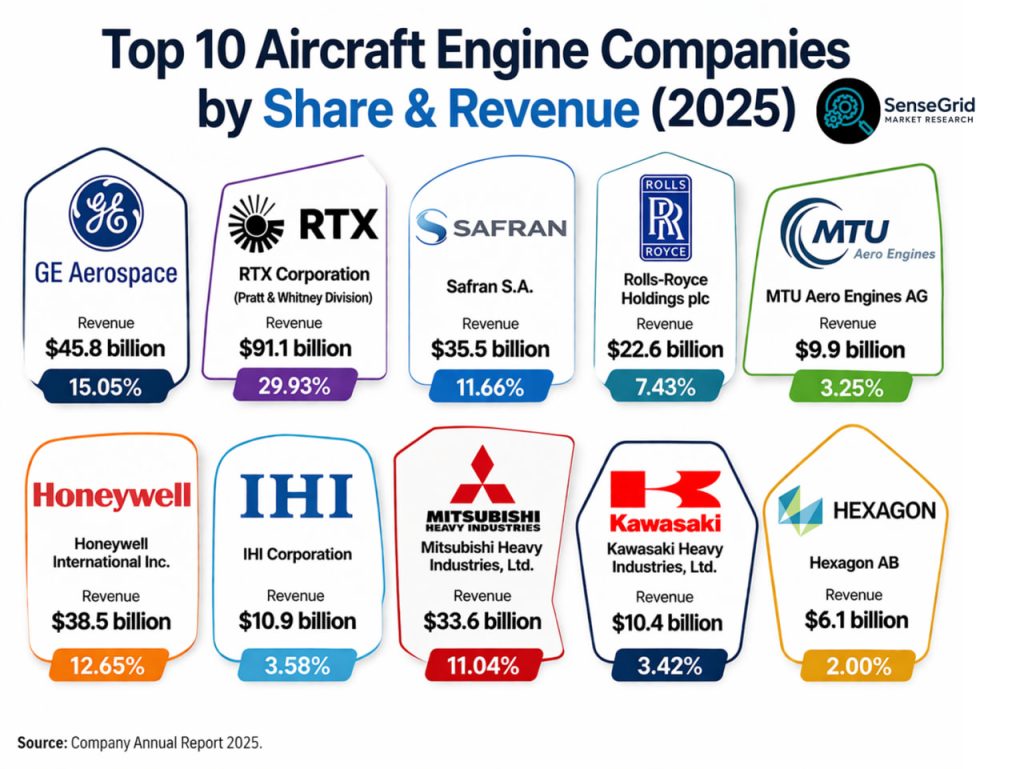
The major companies operating in the global 𝐚𝐢𝐫𝐜𝐫𝐚𝐟𝐭 𝐞𝐧𝐠𝐢𝐧𝐞 market include GE Aerospace, Pratt & Whitney, Rolls-Royce Holdings, Safran Aircraft Engines, MTU Aero Engines among others. Industry players are focusing on partnerships, collaborations, and mergers and acquisitions activities to broaden their market reach, foster innovation, and reinforce their market standing.
Recent Developments
- In June 2026, Rolls-Royce proposed a partnership with India to jointly develop the engine for the Advanced Medium Combat Aircraft (AMCA). The proposal includes full technology transfer, joint design and development, local manufacturing, and shared intellectual property rights, making it one of the most comprehensive international aerospace engine collaboration offers presented to India.
- In June 2026, Rolls-Royce proposed a partnership with India to jointly develop the engine for the Advanced Medium Combat Aircraft (AMCA). The proposal includes full technology transfer, joint design and development, local manufacturing, and shared intellectual property rights, making it one of the most comprehensive international aerospace engine collaboration offers presented to India
- In April 2026, Pratt & Whitney received the “Best Supplier of the Year – Outstanding Collaboration” award from Embraer for its strong performance in supporting the PW1900G geared turbofan engine program, which powers the Embraer E2 family of aircraft. The partnership is strategically important because the PW1900G engine plays a key role in next-generation narrow-body regional jets, which are increasingly demanded for fuel-efficient short and medium-haul routes. The collaboration also reflects the broader industry shift toward high-efficiency geared turbofan engine architectures.
- In November 2025, Azad Engineering signed a long-term agreement with Pratt & Whitney Canada to manufacture high-precision aerospace engine components used in commercial and regional aircraft engines. The agreement reflects a broader industry trend where major engine manufacturers are increasingly relying on specialized global suppliers in India to improve cost efficiency and scale production. It also supports Pratt & Whitney’s expanding portfolio of geared turbofan engines, which are widely used in the Airbus A320neo and other modern aircraft platforms.
- In October 2025, Rolls-Royce Holdings expanded its global supply chain by partnering with India’s Bharat Forge to manufacture high-precision fan blades for Pearl business jet engines. The Pearl engine series is widely used in business jets and regional aircraft, and fan blades are one of the most critical components affecting engine thrust, efficiency, and durability. By shifting part of production to India, Rolls-Royce is also leveraging India’s growing aerospace manufacturing ecosystem and skilled engineering workforce.
The Report Covers
- Market valuation analysis for 2026 with projections through 2035.
- Profiles of leading 𝐚𝐢𝐫𝐜𝐫𝐚𝐟𝐭 𝐞𝐧𝐠𝐢𝐧𝐞 companies, covering recent developments and strategic initiatives.
- Segment-wise revenue forecasts and estimates ($ Million).
- Comprehensive country-level insights across key geographic regions.
- Analysis of high-growth segments and future market opportunities.
- Evaluation of market penetration and expansion strategies.
- Competitive landscape assessment and player positioning analysis.
Key Market Players
- Aero Engine Corp. of China
- Aviadvigatel JSC
- Bharat Forge Ltd.
- CFM International
- Engine Alliance LLC
- General Electric Aerospace
- Heron Engines Pvt. Ltd.
- Hindustan Aeronautics Ltd.
- Honeywell Aerospace Technologies
- IHI Corp.
- Ivchenko-Progress SE
- JetCat GmbH
- Kawasaki Heavy Industries, Ltd.
- Klimov JSC
- Kratos Turbine Technologies, Inc.
- Magellan Aerospace Corp.
- Mitsubishi Heavy Industries, Ltd.
- Motor Sich JSC
- MTU Aero Engines AG
- NPO Saturn
- PBS Group, a.s.
- PBS Velká Bíteš, a.s.
- Pratt & Whitney
- Rolls-Royce Holdings plc
- Safran Aircraft Engines
- TEI – TUSAŞ Engine Industries, Inc.
- Textron Aviation Inc.
- United Engine Corp.
- Volvo Aero Corp.
- Williams International Co., L.L.C.
LIST OF TABLES
- Aircraft Engine Market Forecast & Estimation Analysis by Engine Type, 2025–2035 ($ Million)
- Aircraft Turbofan Engine Market Forecast & Estimation Analysis by Region, 2025–2035 ($ Million)
- Aircraft Turboprop Engine Market Forecast & Estimation Analysis by Region, 2025–2035 ($ Million)
- Aircraft Turboshaft Engine Market Forecast & Estimation Analysis by Region, 2025–2035 ($ Million)
- Aircraft Piston Engine Market Forecast & Estimation Analysis by Region, 2025–2035 ($ Million)
- Aircraft Engine Market Forecast & Estimation Analysis by Aircraft Type, 2025–2035 ($ Million)
- Commercial Aircraft Engine Market Forecast & Estimation Analysis by Region, 2025–2035 ($ Million)
- Military Aircraft Engine Market Forecast & Estimation Analysis by Region, 2025–2035 ($ Million)
- Business & General Aviation Aircraft Engine Market Forecast & Estimation Analysis by Region, 2025–2035 ($ Million)
- Aircraft Engine Market Forecast & Estimation Analysis by Component, 2025–2035 ($ Million)
- Aircraft Fan Component Market Forecast & Estimation Analysis by Region, 2025–2035 ($ Million)
- Aircraft Compressor Component Market Forecast & Estimation Analysis by Region, 2025–2035 ($ Million)
- Aircraft Combustor Component Market Forecast & Estimation Analysis by Region, 2025–2035 ($ Million)
- Aircraft Turbine Component Market Forecast & Estimation Analysis by Region, 2025–2035 ($ Million)
- Aircraft Nozzle Component Market Forecast & Estimation Analysis by Region, 2025–2035 ($ Million)
- Aircraft Other Engine Component Market Forecast & Estimation Analysis by Region, 2025–2035 ($ Million)
- Aircraft Engine Market Forecast & Estimation Analysis by End User, 2025–2035 ($ Million)
- Aircraft Engine Market for OEMs Forecast & Estimation Analysis by Region, 2025–2035 ($ Million)
- Aircraft Engine Aftermarket / MRO Market Forecast & Estimation Analysis by Region, 2025–2035 ($ Million)
- Aircraft Engine Market Research and Analysis by Region, 2025–2035 ($ Million)
- North American Aircraft Engine Market Forecast & Estimation Analysis by Region, 2025–2035 ($ Million)
- North American Aircraft Engine Market Forecast & Estimation Analysis by Engine Type, 2025–2035 ($ Million)
- North American Aircraft Engine Market Forecast & Estimation Analysis by Aircraft Type, 2025–2035 ($ Million)
- North American Aircraft Engine Market Forecast & Estimation Analysis by Component, 2025–2035 ($ Million)
- North American Aircraft Engine Market Forecast & Estimation Analysis by End User, 2025–2035 ($ Million)
- European Aircraft Engine Market Forecast & Estimation Analysis by Region, 2025–2035 ($ Million)
- European Aircraft Engine Market Forecast & Estimation Analysis by Engine Type, 2025–2035 ($ Million)
- European Aircraft Engine Market Forecast & Estimation Analysis by Aircraft Type, 2025–2035 ($ Million)
- European Aircraft Engine Market Forecast & Estimation Analysis by Component, 2025–2035 ($ Million)
- European Aircraft Engine Market Forecast & Estimation Analysis by End User, 2025–2035 ($ Million)
- Asia-Pacific Aircraft Engine Market Forecast & Estimation Analysis by Region, 2025–2035 ($ Million)
- Asia-Pacific Aircraft Engine Market Forecast & Estimation Analysis by Engine Type, 2025–2035 ($ Million)
- Asia-Pacific Aircraft Engine Market Forecast & Estimation Analysis by Aircraft Type, 2025–2035 ($ Million)
- Asia-Pacific Aircraft Engine Market Forecast & Estimation Analysis by Component, 2025–2035 ($ Million)
- Asia-Pacific Aircraft Engine Market Forecast & Estimation Analysis by End User, 2025–2035 ($ Million)
- Rest of the World Aircraft Engine Market Forecast & Estimation Analysis by Region, 2025–2035 ($ Million)
- Rest of the World Aircraft Engine Market Forecast & Estimation Analysis by Engine Type, 2025–2035 ($ Million)
- Rest of the World Aircraft Engine Market Forecast & Estimation Analysis by Aircraft Type, 2025–2035 ($ Million)
- Rest of the World Aircraft Engine Market Forecast & Estimation Analysis by Component, 2025–2035 ($ Million)
- Rest of the World Aircraft Engine Market Forecast & Estimation Analysis by End User, 2025–2035 ($ Million)
List of Figures
- Aircraft Engine Market Share Forecast & Estimation by Engine Type, 2025 Vs 2035 (%)
- Aircraft Turbofan Engine Market Share Forecast & Estimation by Region, 2025 Vs 2035 (%)
- Aircraft Turboprop Engine Market Share Forecast & Estimation by Region, 2025 Vs 2035 (%)
- Aircraft Turboshaft Engine Market Share Forecast & Estimation by Region, 2025 Vs 2035 (%)
- Aircraft Piston Engine Market Share Forecast & Estimation by Region, 2025 Vs 2035 (%)
- Aircraft Engine Market Share Forecast & Estimation by Aircraft Type, 2025 Vs 2035 (%
- Commercial Aircraft Engine Market Share Forecast & Estimation by Region, 2025 Vs 2035 (%)
- Military Aircraft Engine Market Share Forecast & Estimation by Region, 2025 Vs 2035 (%)
- Business & General Aviation Aircraft Engine Market Share Forecast & Estimation by Region, 2025 Vs 2035 (%)
- Aircraft Engine Market Share Forecast & Estimation by Component, 2025 Vs 2035 (%)
- Aircraft Fan Component Market Share Forecast & Estimation by Region, 2025 Vs 2035 (%)
- Aircraft Compressor Component Market Share Forecast & Estimation by Region, 2025 Vs 2035 (%)
- Aircraft Combustor Component Market Share Forecast & Estimation by Region, 2025 Vs 2035 (%)
- Aircraft Turbine Component Market Share Forecast & Estimation by Region, 2025 Vs 2035 (%)
- Aircraft Nozzle Component Market Share Forecast & Estimation by Region, 2025 Vs 2035 (%)
- Aircraft Other Engine Component Market Share Forecast & Estimation by Region, 2025 Vs 2035 (%)
- Aircraft Engine Market Share Forecast & Estimation by End User, 2025 Vs 2035 (%)
- Aircraft Engine For OEMs Market Share Forecast & Estimation by Region, 2025 Vs 2035 (%)
- Aircraft Engine Aftermarket / MRO Market Share Forecast & Estimation by Region, 2025 Vs 2035 (%)
- Aircraft Engine Market Forecast & Estimation by Region, 2025–2035 ($ Million)
- US Aircraft Engine Market Size Estimation, 2025–2035 ($ Million)
- Canada Aircraft Engine Market Size Estimation, 2025–2035 ($ Million)
- UK Aircraft Engine Market Size Estimation, 2025–2035 ($ Million)
- France Aircraft Engine Market Size Estimation, 2025–2035 ($ Million)
- Germany Aircraft Engine Market Size Estimation, 2025–2035 ($ Million)
- Italy Aircraft Engine Market Size Estimation, 2025–2035 ($ Million)
- Spain Aircraft Engine Market Size Estimation, 2025–2035 ($ Million)
- Russia Aircraft Engine Market Size Estimation, 2025–2035 ($ Million)
- Rest of Europe Aircraft Engine Market Size Estimation, 2025–2035 ($ Million)
- India Aircraft Engine Market Size Estimation, 2025–2035 ($ Million)
- China Aircraft Engine Market Size Estimation, 2025–2035 ($ Million)
- Japan Aircraft Engine Market Size Estimation, 2025–2035 ($ Million)
- South Korea Aircraft Engine Market Size Estimation, 2025–2035 ($ Million)
- Australia and New Zealand Aircraft Engine Market Size Estimation, 2025–2035 ($ Million)
- ASEAN Economies Aircraft Engine Market Size Estimation, 2025–2035 ($ Million)
- Rest of Asia-Pacific Aircraft Engine Market Size Estimation, 2025–2035 ($ Million)
- Latin America Aircraft Engine Market Size Estimation, 2025–2035 ($ Million)
- Middle East & Africa Aircraft Engine Market Size Estimation, 2025–2035 ($ Million)
Download Global Aircraft Engine Market Sample Report
Contact Us
- Chat On WhatsApp
- Phone :+91-9131799396
- Hi Link Residency, Airport Road, Indore, 452005
- sensegridmarketresearch@gmail.com
Select User License Type
Analyst Support, Customization & Verified Analysis
REPORT BY INDUSTRIES
- Food & Beverages
- Healthcare & Lifesciences
- Semiconductors & Electronics
- Information Technology
- Automotive
- Automation
- Energy & Power
- Consumer Goods & Services
- Agriculture