“Empowering Smarter Business Decisions Through Data-Driven Insights”


Global Digital Twin Market Size, Share & Trends Analysis Report By Component (Software and Services), By Deployment Mode (Cloud and On-Premises), By Type (Product Digital Twin, Process Digital Twin, System Digital Twin and Asset Digital Twin), By Technology (IoT, Artificial Intelligence & Machine Learning, Big Data Analytics, Cloud Computing, AR/VR and Blockchain), By Application (Predictive Maintenance, Product Design & Development, Business Optimization, Performance Monitoring, Inventory Management and Others), By End User (Manufacturing, Healthcare, Automotive, Aerospace & Defense, Energy & Utilities, Smart Cities, Retail and Others), Forecast (2026–2035)
- Report Code: SMR-100010
- Historic Range: 2025–2035
- Publish date: Jun-2026
Global Digital Twin Market Size, Share & Trends Analysis Report By Component (Software and Services), By Deployment Mode (Cloud and On-Premises), By Type (Product Digital Twin, Process Digital Twin, System Digital Twin and Asset Digital Twin), By Technology (IoT, Artificial Intelligence & Machine Learning, Big Data Analytics, Cloud Computing, AR/VR and Blockchain), By Application (Predictive Maintenance, Product Design & Development, Business Optimization, Performance Monitoring, Inventory Management and Others), By End User (Manufacturing, Healthcare, Automotive, Aerospace & Defense, Energy & Utilities, Smart Cities, Retail and Others), Forecast (2026–2035)
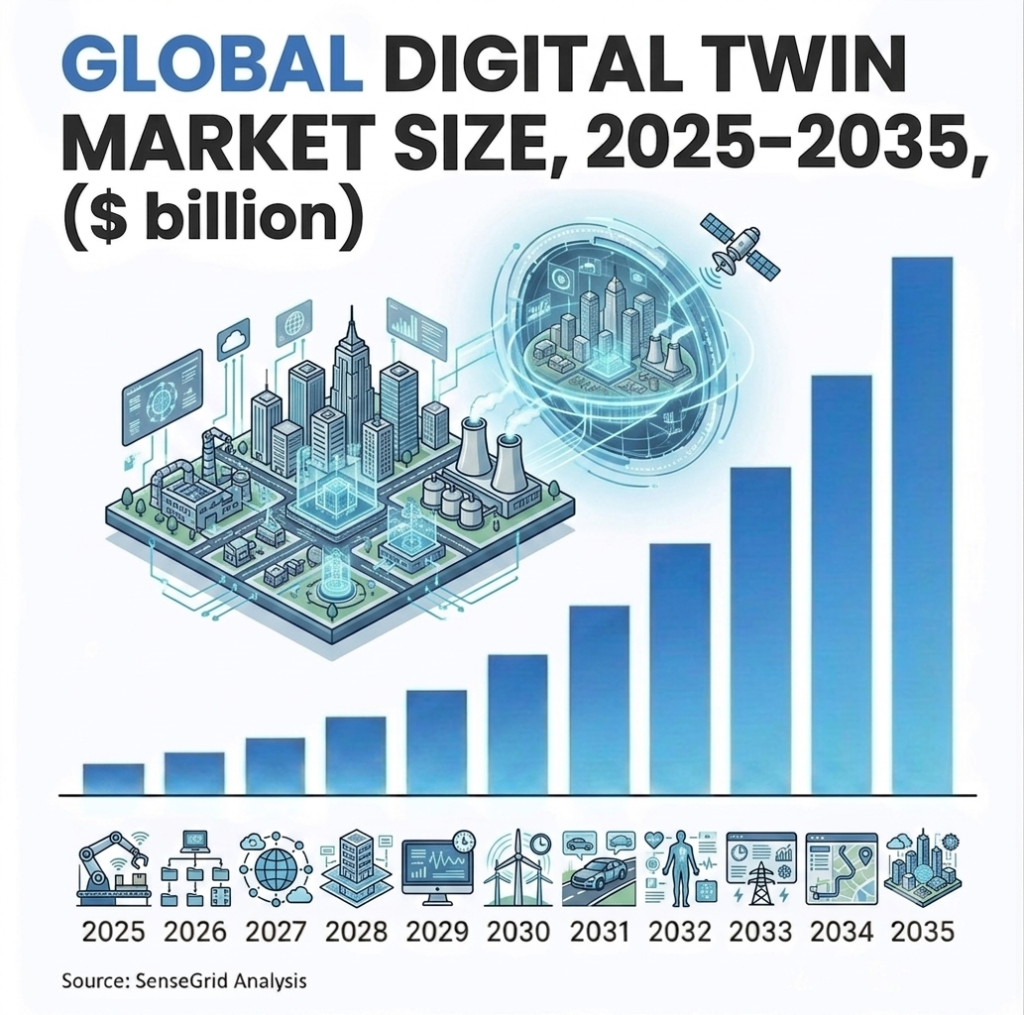
Global digital twin market is growing at a CAGR of 25.0% during the forecast period (2026-2035). The industry was valued at $20.0 billion in 2025 and is projected to reach $186.2 billion in 2035. The growing adoption of Industry 4.0 and smart manufacturing initiatives, coupled with increasing demand for real-time asset monitoring and predictive maintenance, along with continuous advancements in artificial intelligence (AI), Internet of Things (IoT), cloud computing, and simulation technologies, is driving the growth of the Global Digital Twin Market. According to the National Institute of Standards and Technology (NIST),
- Digital twins have the potential to generate $37.9 billion annually in benefits if adopted across the US manufacturing industry.
- Planned production downtime accounts for 8.3%–13.3% of manufacturing time, resulting in approximately $245 billion in annual losses for US discrete manufacturing. Digital twins can help reduce these losses through predictive monitoring and optimization.
- Manufacturing defects contribute an additional $32–58.6 billion in annual losses in US discrete manufacturing, which digital twins can help minimize through simulation and quality optimization.
- The estimated total economic benefits of future data tracking and analytics technologies, including digital twins, are approximately $88.6 billion in the US.
Market Dynamics
- Rising Investments in AI-Powered Digital Twin Platforms Drive Market Growth
Investments in AI, cloud computing, and industrial digitalization are accelerating digital twin adoption across manufacturing, energy, and infrastructure. For instance, in May 2026, Siemens AG invested $50 million in Xometry, Inc. as part of a strategic partnership to integrate AI-powered supply chain intelligence into the Siemens Xcelerator platform, strengthening digital manufacturing and digital twin capabilities.
- Strategic Collaborations Accelerate Digital Twin Adoption
Growing collaborations between technology providers and industrial enterprises are expanding the deployment of digital twin solutions for predictive maintenance and operational optimization. For instance, in April 2026, Wipro Limited partnered with Kongsberg Digital to deliver AI-powered digital twin solutions for the energy and utilities sector, improving asset performance and operational efficiency.
- New Digital Twin Platform Launches Fuel Industry Innovation
The launch of advanced digital twin platforms integrated with AI, IoT, and cloud technologies is enhancing real-time monitoring, simulation, and decision-making across industries. For instance, in June 2026, Tech Mahindra Ltd. and Microsoft Corporation launched an AI-driven 5G network digital twin solution leveraging Azure Digital Twins and Microsoft Fabric to optimize telecom network operations and accelerate 5G modernization.
Market Segmentation
- Based on component type, the market is segmented into software and services.
- Based on deployment mode, the market is segmented into cloud and on-premises.
- Based on type, the market is segmented into product digital twin, process digital twin, system digital twin, and asset digital twin.
- Based on technology, the market is segmented into IoT, artificial intelligence & machine learning, big data analytics, cloud computing, AR/VR, and blockchain.
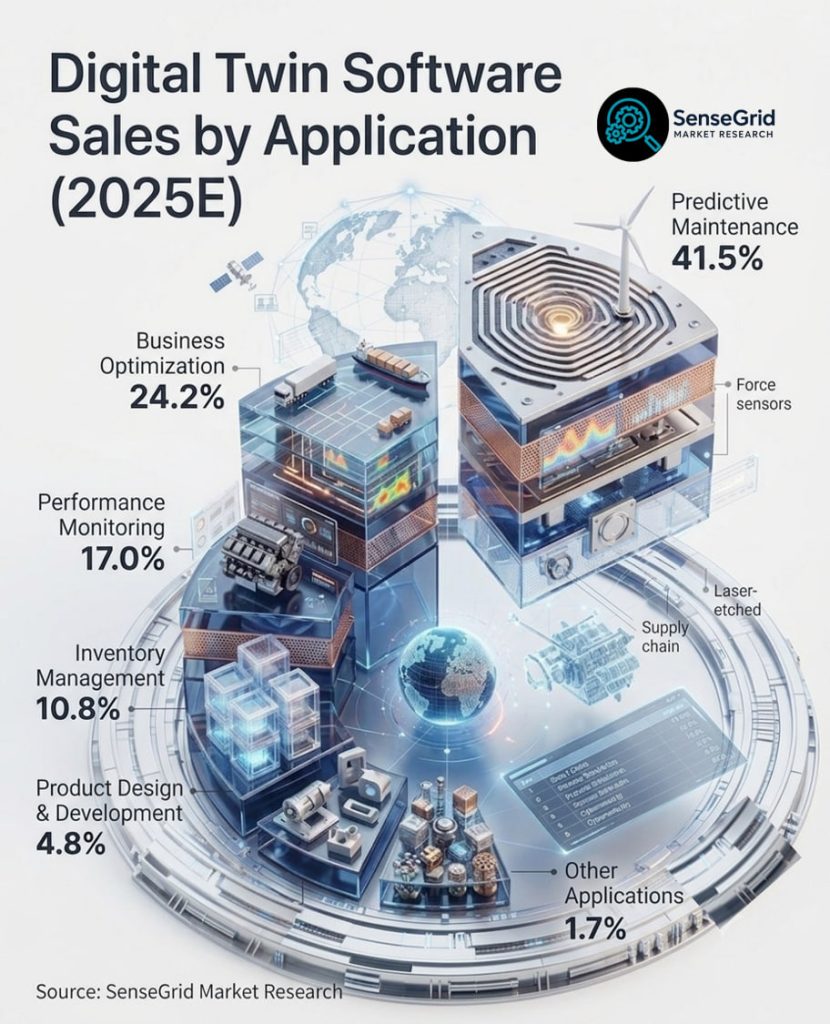
- Based on application type, the market is segmented into predictive maintenance, product design & development, business optimization, performance monitoring, inventory management, and others.
- Based on end user, the market is segmented into manufacturing, healthcare, automotive, aerospace & defense, energy & utilities, smart cities, retail, and others.
Product Digital Twin Segment Dominates the market with the largest share.
In 2025, the product digital twin segment held the highest share of the global digital twin market, driven by its strong adoption in product design, simulation, and lifecycle optimization across manufacturing, automotive, and aerospace industries. The market is witnessing increasing integration of AI, IoT, and cloud-based simulation technologies, enabling real-time product monitoring and predictive performance analysis. The growing adoption of product digital twins is supported by publicly reported industrial transformation data indicating that digital twin technologies reduce product development time by 15%–25% and improve engineering efficiency by up to 20%–30% through advanced simulation and virtual prototyping. Additionally, operational and maintenance cost reductions of around 10%–15% have been observed in manufacturing environments using product-level digital twins.
The cloud deployment segment holds a significant market share.
In 2025, the cloud deployment segment held the highest share of the global digital twin market by deployment mode, driven by rapid adoption of cloud computing, IoT integration, and AI-enabled real-time simulation across industrial and enterprise ecosystems. In parallel, industry transformation studies aligned with NIST manufacturing frameworks indicate that digital twin adoption—largely supported by cloud infrastructure—can deliver substantial operational improvements, including a 10%–25% reduction in downtime, enhanced system efficiency, and improved decision-making across manufacturing and infrastructure sectors. These efficiency gains are a key driver for increasing cloud adoption across industries such as automotive, aerospace, energy, and smart manufacturing. Publicly available industry reports indicate that more than 60% of newly deployed digital twin systems globally are cloud-based.
Regional Outlook
The global digital twin market is segmented geographically into North America (the US and Canada), Europe (the UK, Germany, France, Italy, Spain, Russia, and Rest of Europe), Asia-Pacific (India, China, Japan, South Korea, Australia & New Zealand, ASEAN Countries, and Rest of Asia-Pacific), and the Rest of the World (Middle East & Africa and Latin America).
Europe’s Advanced Manufacturing Ecosystem Supports Digital Twin Adoption
Europe’s digital twin market growth is driven by rapid adoption of Industry 4.0, smart manufacturing, and digital engineering. According to the European Commission, the manufacturing sector contributes around 15% of the EU’s GDP and employs approximately 30 million people, creating substantial demand for digital twin solutions to improve production efficiency and predictive maintenance. In addition, the Destination Earth (DestinE) initiative, funded through the Digital Europe Programme, is accelerating investments in digital twin technologies for industrial innovation and infrastructure resilience. The presence of major companies such as Siemens AG, Dassault Systèmes SE, ABB Ltd., Schneider Electric SE, and AVEVA Group Limited further strengthens Europe’s position as the second-largest digital twin market.
North America Region Dominates the Market with Major Share
North America held the largest share of the global digital twin market, driven by rapid adoption of Industry 4.0 technologies, strong investments in AI, IoT, cloud computing, and the presence of leading technology providers. According to the U.S. National Institute of Standards and Technology (NIST), unplanned downtime accounts for 8.3%–13.3% of planned production time in U.S. discrete manufacturing, resulting in approximately $245 billion in annual losses. NIST estimates that the widespread deployment of digital twin technologies could generate up to $37.9 billion in annual economic benefits for the U.S. manufacturing sector through improved predictive maintenance, optimized production, and enhanced operational efficiency. Furthermore, the Digital Twin Consortium and NIST continue to accelerate digital twin adoption by developing interoperability standards and best practices across manufacturing, aerospace, healthcare, infrastructure, and energy. The region is also home to major digital twin solution providers, including Microsoft Corporation, International Business Machines Corporation (IBM), PTC Inc., Amazon Web Services, Inc. (AWS), and Autodesk, Inc., further strengthening North America’s leadership in the global digital twin market.
Market Players Outlook
The major companies operating in the global digital twin market include Siemens AG, Microsoft Corporation, Dassault Systèmes SE, IBM Corp., and PTC Inc. Industry players are focusing on partnerships, collaborations, and mergers and acquisitions activities to broaden their market reach, foster innovation, and reinforce their market standing.
Recent Developments
- In June 2026, Tech Mahindra Ltd. and Microsoft Corporation announced a strategic partnership to develop an AI-powered 5G network digital twin solution. The collaboration leverages Microsoft Azure Digital Twins, Microsoft Fabric, and AI technologies to enable telecom operators to optimize network performance, automate operations, improve predictive maintenance, and accelerate 5G service deployment.
- In May 2026, Siemens AG and Xometry, Inc. entered into a strategic partnership to integrate AI-driven supply chain capabilities into the Siemens Xcelerator platform. As part of the agreement, Siemens also made a US$50 million strategic investment in Xometry to strengthen digital manufacturing and digital twin technologies across industrial enterprises.
- In April 2026, Wipro Limited and Kongsberg Digital formed a strategic partnership to accelerate the adoption of AI-powered digital twin solutions in the energy and utilities sector. The collaboration combines Wipro’s AI expertise with Kongsberg Digital’s industrial digital twin platform to improve asset performance, predictive maintenance, and operational efficiency.
- In April 2026, Globant S.A. and Autodesk, Inc. expanded their strategic collaboration, with Globant becoming an Autodesk Tandem Digital Twin Solution Provider. The partnership aims to accelerate digital twin implementation across manufacturing, infrastructure, airports, and smart buildings by enabling intelligent asset management and real-time operational insights.
- In September 2025, Globant S.A. and Synthesis AI announced a strategic partnership to enhance AI-powered digital twin applications using synthetic data technology. The collaboration is focused on improving digital twin accuracy and scalability for manufacturing, retail, logistics, and smart infrastructure, enabling more advanced simulation and predictive analytics.
The Report Covers
- Market valuation analysis for 2026 with projections through 2035.
- Profiles of leading digital twin companies, covering recent developments and strategic initiatives.
- Segment-wise revenue forecasts and estimates ($ Million).
- Comprehensive country-level insights across key geographic regions.
- Analysis of high-growth segments and future market opportunities.
- Evaluation of market penetration and expansion strategies.
- Competitive landscape assessment and player positioning analysis.
Key Market Players
- ABB Ltd.
- Altair Engineering Inc.
- Amazon Web Services, Inc. (AWS)
- ANSYS, Inc.
- Autodesk, Inc.
- AVEVA Group Limited
- Bentley Systems, Incorporated
- Bosch Rexroth AG
- Cisco Systems, Inc.
- Cognite AS
- Dassault Systèmes SE
- Dell Technologies Inc.
- Emerson Electric Co.
- General Electric Company
- Hexagon AB
- Hitachi, Ltd.
- Honeywell International Inc.
- International Business Machines Corporation (IBM)
- Matterport, Inc.
- Microsoft Corporation
- NVIDIA Corporation
- Oracle Corporation
- PTC Inc.
- Rockwell Automation, Inc.
- SAP SE
- Schneider Electric SE
- Siemens AG
- TIBCO Software Inc.
- TwinThread, Inc.
- Unity Software Inc.
LIST OF TABLES
- Digital Twin Market Forecast & Estimation Analysis by Component Type, 2025–2035 ($ Million)
- Software Digital Twin Market Forecast & Estimation Analysis by Region, 2025–2035 ($ Million)
- Services Digital Twin Market Forecast & Estimation Analysis by Region, 2025–2035 ($ Million)
- Digital Twins Market Forecast & Estimation Analysis by Deployment Type, 2025–2035 ($ Million)
- On-Premises Digital Twin Market Forecast & Estimation Analysis by Region, 2025–2035 ($ Million)
- Cloud Digital Twin Market Forecast & Estimation Analysis by Region, 2025–2035 ($ Million)
- Digital Twins Market Forecast & Estimation Analysis by Type, 2025–2035 ($ Million)
- Product Digital Twin Market Forecast & Estimation Analysis by Region, 2025–2035 ($ Million)
- Process Digital Twin Market Forecast & Estimation Analysis by Region, 2025–2035 ($ Million)
- System Digital Twin Market Forecast & Estimation Analysis by Region, 2025–2035 ($ Million)
- Asset Digital Twin Market Forecast & Estimation Analysis by Region, 2025–2035 ($ Million)
- Digital Twins Market Forecast & Estimation Analysis by Technology, 2025–2035 ($ Million)
- Internet of Things (IoT) Digital Twin Market Forecast & Estimation Analysis by Region, 2025–2035 ($ Million)
- AI & ML Digital Twin Market Forecast & Estimation Analysis by Region, 2025–2035 ($ Million)
- Big Data Analytics Digital Twin Market Forecast & Estimation Analysis by Region, 2025–2035 ($ Million)
- Cloud Computing Digital Twin Market Forecast & Estimation Analysis by Region, 2025–2035 ($ Million)
- AR/VR Digital Twin Market Forecast & Estimation Analysis by Region, 2025–2035 ($ Million)
- Blockchain Digital Twin Market Forecast & Estimation Analysis by Region, 2025–2035 ($ Million)
- Digital Twins Market Forecast & Estimation Analysis by Application, 2025–2035 ($ Million)
- Predictive Maintenance Digital Twin Market Forecast & Estimation Analysis by Region, 2025–2035 ($ Million)
- Product Design & Development Digital Twin Market Forecast & Estimation Analysis by Region, 2025–2035 ($ Million)
- Business Optimization Digital Twin Market Forecast & Estimation Analysis by Region, 2025–2035 ($ Million)
- Performance Monitoring Digital Twin Market Forecast & Estimation Analysis by Region, 2025–2035 ($ Million)
- Inventory Management Digital Twin Market Forecast & Estimation Analysis by Region, 2025–2035 ($ Million)
- Other Digital Twin Application Market Forecast & Estimation Analysis by Region, 2025–2035 ($ Million)
- Digital Twins Market Forecast & Estimation Analysis by End-User, 2025–2035 ($ Million)
- Digital Twin for Manufacturing Market Forecast & Estimation Analysis by Region, 2025–2035 ($ Million)
- Digital Twin for Healthcare Market Forecast & Estimation Analysis by Region, 2025–2035 ($ Million)
- Digital Twin for Automotive Market Forecast & Estimation Analysis by Region, 2025–2035 ($ Million)
- Digital Twin for Aerospace & Defense Market Forecast & Estimation Analysis by Region, 2025–2035 ($ Million)
- Digital Twin for Energy & Utilities Market Forecast & Estimation Analysis by Region, 2025–2035 ($ Million)
- Digital Twin for Smart Cities Market Forecast & Estimation Analysis by Region, 2025–2035 ($ Million)
- Digital Twin for Retail Market Forecast & Estimation Analysis by Region, 2025–2035 ($ Million)
- Digital Twin for Other End-User Market Forecast & Estimation Analysis by Region, 2025–2035 ($ Million)
- Digital Twins Market Research and Analysis by Region, 2025–2035 ($ Million)
- North American Digital Twins Market Forecast & Estimation Analysis by Region, 2025–2035 ($ Million)
- North American Digital Twins Market Forecast & Estimation Analysis by Component Type, 2025–2035 ($ Million)
- North American Digital Twins Market Forecast & Estimation Analysis by Deployment Type, 2025–2035 ($ Million)
- North American Digital Twins Market Forecast & Estimation Analysis by Type, 2025–2035 ($ Million)
- North American Digital Twins Market Forecast & Estimation Analysis by Application, 2025–2035 ($ Million)
- North American Digital Twins Market Forecast & Estimation Analysis by End User, 2025–2035 ($ Million)
- Europe Digital Twins Market Forecast & Estimation Analysis by Region, 2025–2035 ($ Million)
- Europe Digital Twins Market Forecast & Estimation Analysis by Component Type, 2025–2035 ($ Million)
- Europe Digital Twins Market Forecast & Estimation Analysis by Deployment Type, 2025–2035 ($ Million)
- Europe Digital Twins Market Forecast & Estimation Analysis by Type, 2025–2035 ($ Million)
- Europe Digital Twins Market Forecast & Estimation Analysis by Application, 2025–2035 ($ Million)
- Europe Digital Twins Market Forecast & Estimation Analysis by End User, 2025–2035 ($ Million)
- Asia-Pacific Digital Twins Market Forecast & Estimation Analysis by Region, 2025–2035 ($ Million)
- Asia-Pacific Digital Twins Market Forecast & Estimation Analysis by Component Type, 2025–2035 ($ Million)
- Asia-Pacific Digital Twins Market Forecast & Estimation Analysis by Deployment Type, 2025–2035 ($ Million)
- Asia-Pacific Digital Twins Market Forecast & Estimation Analysis by Type, 2025–2035 ($ Million)
- Asia-Pacific Digital Twins Market Forecast & Estimation Analysis by Application, 2025–2035 ($ Million)
- Asia-Pacific Digital Twins Market Forecast & Estimation Analysis by End User, 2025–2035 ($ Million)
- Rest of the World Digital Twins Market Forecast & Estimation Analysis by Region, 2025–2035 ($ Million)
- Rest of the World Digital Twins Market Forecast & Estimation Analysis by Component Type, 2025–2035 ($ Million)
- Rest of the World Digital Twins Market Forecast & Estimation Analysis by Deployment Type, 2025–2035 ($ Million)
- Rest of the World Digital Twins Market Forecast & Estimation Analysis by Type, 2025–2035 ($ Million)
- Rest of the World Digital Twins Market Forecast & Estimation Analysis by Application, 2025–2035 ($ Million)
- Rest of the World Digital Twins Market Forecast & Estimation Analysis by End User, 2025–2035 ($ Million)
List of Figures
- Digital Twins Market Share Forecast & Estimation by Component Type, 2025 Vs 2035 (%)
- Software Digital Twin Market Forecast & Estimation Analysis by Region, 2025 Vs 2035 (%)
- Services Digital Twin Market Share Forecast & Estimation by Region, 2025 Vs 2035 (%)
- Digital Twins Market Share Forecast & Estimation by Deployment Type, 2025 Vs 2035 (%)
- On-Premises Digital Twin Market Share Forecast & Estimation by Region, 2025 Vs 2035 (%)
- Cloud Digital Twin Market Share Forecast & Estimation by Region, 2025 Vs 2035 (%)
- Digital Twins Market Share Forecast & Estimation by Type, 2025 Vs 2035 (%)
- Product Digital Twins Market Share Forecast & Estimation by Region, 2025 Vs 2035 (%)
- Process Digital Twins Market Share Forecast & Estimation by Region, 2025 Vs 2035 (%)
- System Digital Twins Market Share Forecast & Estimation by Region, 2025 Vs 2035 (%)
- Asset Digital Twins Market Share Forecast & Estimation by Region, 2025 Vs 2035 (%)
- Digital Twins Market Share Forecast & Estimation by Technology, 2025 Vs 2035 (%)
- Internet of Things (IoT) Digital Twins Market Share Forecast & Estimation by Region, 2025 Vs 2035 (%)
- AI & ML Digital Twins Market Share Forecast & Estimation by Region, 2025 Vs 2035 (%)
- Big Data Analytics Digital Twins Market Share Forecast & Estimation by Region, 2025 Vs 2035 (%)
- Cloud Computing Digital Twins Market Share Forecast & Estimation by Region, 2025 Vs 2035 (%)
- AR/VR Digital Twins Market Share Forecast & Estimation by Region, 2025 Vs 2035 (%)
- Blockchain Digital Twins Market Share Forecast & Estimation by Region, 2025 Vs 2035 (%)
- Digital Twins Market Share Forecast & Estimation by Application, 2025 Vs 2035 (%)
- Predictive Maintenance Digital Twins Market Share Forecast & Estimation by Region, 2025 Vs 2035 (%)
- Product Design & Development Digital Twins Market Share Forecast & Estimation by Region, 2025 Vs 2035 (%)
- Business Optimization Digital Twins Market Share Forecast & Estimation by Region, 2025 Vs 2035 (%)
- Performance Monitoring Digital Twins Market Share Forecast & Estimation by Region, 2025 Vs 2035 (%)
- Inventory Management Digital Twins Market Share Forecast & Estimation by Region, 2025 Vs 2035 (%)
- Other Digital Twins Application Market Share Forecast & Estimation by Region, 2025 Vs 2035 (%)
- Digital Twins Market Share Forecast & Estimation by End User, 2025 Vs 2035 (%)
- Digital Twins for Manufacturing Market Share Forecast & Estimation by Region, 2025 Vs 2035 (%)
- Digital Twins for Healthcare Market Share Forecast & Estimation by Region, 2025 Vs 2035 (%)
- Digital Twins for Automotive Market Share Forecast & Estimation by Region, 2025 Vs 2035 (%)
- Digital Twins for Aerospace & Defense Market Share Forecast & Estimation by Region, 2025 Vs 2035 (%)
- Digital Twins for Energy & Utilities Market Share Forecast & Estimation by Region, 2025 Vs 2035 (%)
- Digital Twins for Smart Cities Market Share Forecast & Estimation by Region, 2025 Vs 2035 (%)
- Digital Twins for Retail Market Share Forecast & Estimation by Region, 2025 Vs 2035 (%)
- Digital Twins for Other End-User Market Share Forecast & Estimation by Region, 2025 Vs 2035 (%)
- Digital Twins Market Forecast & Estimation by Region, 2025–2035 ($ Million)
- US Digital Twins Market Size Estimation, 2025–2035 ($ Million)
- Canada Digital Twins Market Size Estimation, 2025–2035 ($ Million)
- UK Digital Twins Market Size Estimation, 2025–2035 ($ Million)
- France Digital Twins Market Size Estimation, 2025–2035 ($ Million)
- Germany Digital Twins Market Size Estimation, 2025–2035 ($ Million)
- Italy Digital Twins Market Size Estimation, 2025–2035 ($ Million)
- Spain Digital Twins Market Size Estimation, 2025–2035 ($ Million)
- Russia Digital Twins Market Size Estimation, 2025–2035 ($ Million)
- Rest of Europe Digital Twins Market Size Estimation, 2025–2035 ($ Million)
- India Digital Twins Market Size Estimation, 2025–2035 ($ Million)
- China Digital Twins Market Size Estimation, 2025–2035 ($ Million)
- Japan Digital Twins Market Size Estimation, 2025–2035 ($ Million)
- South Korea Digital Twins Market Size Estimation, 2025–2035 ($ Million)
- Australia and New Zealand Digital Twins Market Size Estimation, 2025–2035 ($ Million)
- ASEAN Economies Digital Twins Market Size Estimation, 2025–2035 ($ Million)
- Rest of Asia-Pacific Digital Twins Market Size Estimation, 2025–2035 ($ Million)
- Latin America Digital Twins Market Size Estimation, 2025–2035 ($ Million)
- Middle East & Africa Digital Twins Market Size Estimation, 2025–2035 ($ Million)
Download Global Digital Twin Market Sample Report
Contact Us
- Chat On WhatsApp
- Phone :+91-9131799396
- Hi Link Residency, Airport Road, Indore, 452005
- sensegridmarketresearch@gmail.com
Select User License Type
Analyst Support, Customization & Verified Analysis
REPORT BY INDUSTRIES
- Food & Beverages
- Healthcare & Lifesciences
- Semiconductors & Electronics
- Information Technology
- Automotive
- Automation
- Energy & Power
- Consumer Goods & Services
- Agriculture