“Empowering Smarter Business Decisions Through Data-Driven Insights”


Global Sustainable Aviation Fuel Market Size, Share & Trends Analysis Report By Fuel Type (Biofuel (HEFA-SPK, FT-SPK, ATJ-SPK), Power-to-Liquid (PtL / e-fuels) and Hydrogen-based aviation fuels), By Blending Capacity (Below 30%, 30%–50% and Above 50% (future-ready / 100% SAF capable), By Production Technology (HEFA (Hydroprocessed Esters and Fatty Acids), Fischer-Tropsch (FT), Alcohol-to-Jet (ATJ) and Power-to-Liquid (PtL), and By Aircraft Type (Commercial Aviation, Military Aviation, Business & General Aviation and Cargo Aviation), Forecast (2026-2035)
- Report Code: SMR-100010
- Historic Range: 2025–2035
- Publish date: Jun-2026
Global Sustainable Aviation Fuel Market Size, Share & Trends Analysis Report By Fuel Type (Biofuel (HEFA-SPK, FT-SPK, ATJ-SPK), Power-to-Liquid (PtL / e-fuels) and Hydrogen-based aviation fuels), By Blending Capacity (Below 30%, 30%–50% and Above 50% (future-ready / 100% SAF capable), By Production Technology (HEFA (Hydroprocessed Esters and Fatty Acids), Fischer-Tropsch (FT), Alcohol-to-Jet (ATJ) and Power-to-Liquid (PtL), and By Aircraft Type (Commercial Aviation, Military Aviation, Business & General Aviation and Cargo Aviation), Forecast (2026-2035)
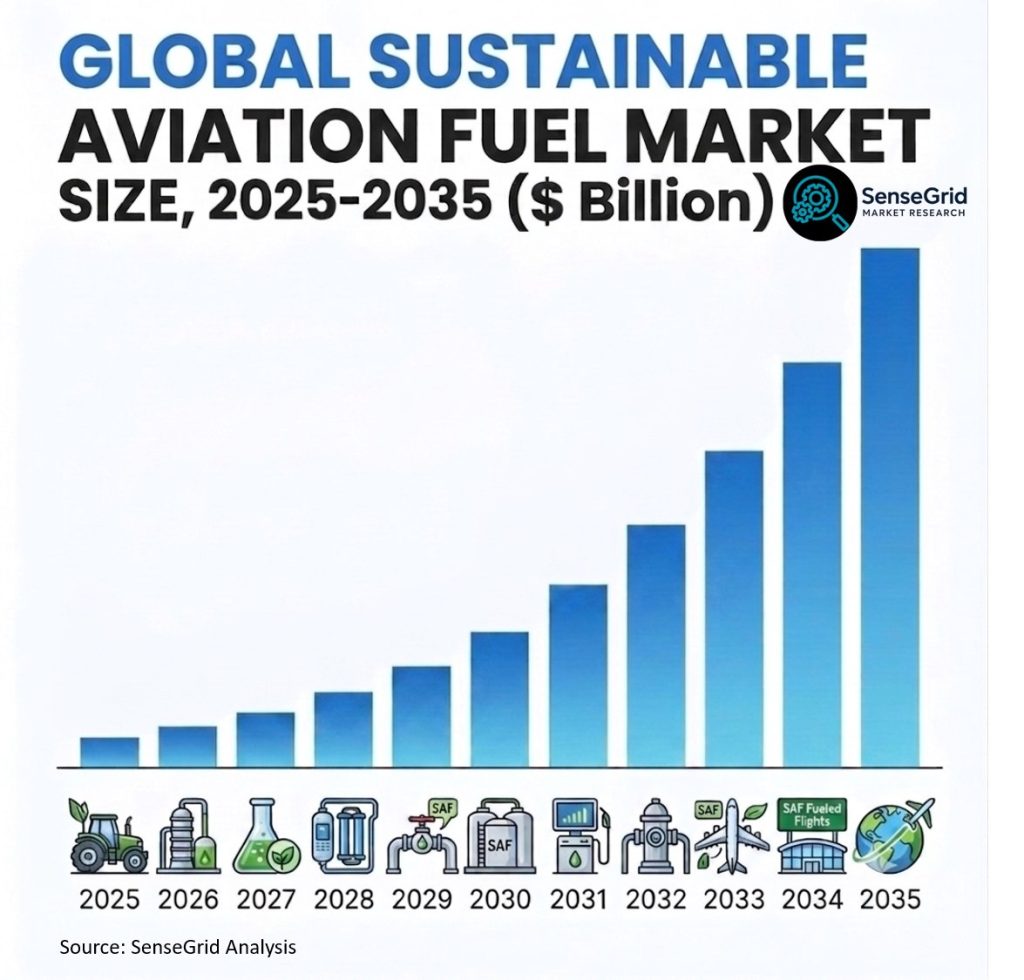
Global sustainable aviation fuel (SAF) market is growing at a CAGR of 33.5% during the forecast period (2026-2035). The industry was valued at $3.2 billion in 2025 and is projected to reach $57.7 billion in 2035. The global sustainable aviation fuel market is experiencing significant growth owing to increasing regulatory pressure to reduce carbon emissions in the aviation sector. According to the Air Transport Action Group (ATAG), as of 2025, the global SAF sector is experiencing rapid expansion and increasing policy support. More than 𝟏𝟒𝟎 SAF projects are currently underway, including over 𝟏𝟎𝟎 active initiatives across more than 𝟑𝟎 countries. In 2024, approximately 𝟏 𝐦𝐢𝐥𝐥𝐢𝐨𝐧 𝐭𝐨𝐧𝐬 (𝟏.𝟑 𝐛𝐢𝐥𝐥𝐢𝐨𝐧 𝐥𝐢𝐭𝐞𝐫𝐬) of SAF were used in commercial aviation, representing more than double the 𝟐𝟒𝟎,𝟎𝟎𝟎 tons produced in 2023. Production is projected to reach 𝟐.𝟏 𝐦𝐢𝐥𝐥𝐢𝐨𝐧 𝐭𝐨𝐧𝐧𝐞𝐬 in 2025, accounting for around 𝟎.𝟕% of total airline fuel consumption. Additionally, over 𝟏𝟕𝟎 airports globally have begun distributing SAF as of 2025.
Market Dynamics
- Shift Toward e-SAF and Power-to-Liquid (PtL) Fuels
According to the International Air Transport Association (IATA), the aviation industry will require nearly 500 million tonnes of SAF annually by 2050 to achieve net-zero emission targets. The report estimates that e-SAF and PtL fuels could contribute around 176 million tonnes of future SAF production, highlighting their growing role in the global fuel mix. In parallel, governments and aviation stakeholders are investing heavily in green hydrogen infrastructure and carbon capture technologies to support synthetic fuel production pathways.
- Government Incentives Accelerating SAF Adoption.
Several governments are introducing long-term regulatory frameworks to reduce investment risks and create stable demand for low-carbon aviation fuels. The UK, for instance, implemented its SAF mandate in 2025, requiring a gradual increase in SAF usage within the aviation fuel mix through 2040. The UK government has allocated funding support for commercial-scale SAF projects through its Advanced Fuels Fund. This policy environment is encouraging companies such as Shell plc and Neste Corporation to expand SAF supply agreements and production capabilities in Europe.
- Airline Sustainability Commitments Driving Procurement.
As more carriers adopt sustainability-focused procurement policies, SAF is expected to become an essential component of aviation decarbonization strategies globally. For instance,
- In 2025, Japan Airlines signed a SAF procurement agreement with Raven SR to support its carbon neutrality roadmap and expand sustainable fuel usage on international operations.
- Lufthansa Group partnered with OMV for the supply of Sustainable Aviation Fuel to support emission reduction targets and sustainable flight operations across Europe.
- Qantas Airways expanded its SAF collaboration with Airbus and Ampol to support domestic SAF production projects and strengthen long-term decarbonization initiatives in Australia.
Market Segmentation
- Based on the fuel type, the market is segmented into (biofuel (HEFA-SPK, FT-SPK, ATJ-SPK), power-to-liquid (PtL / e-fuels) and hydrogen-based aviation fuels).
- Based on the blending capacity, the market is segmented into below 30%, 30%–50% and above 50% (future-ready / 100% SAF capable).
- By Production Technology (HEFA (Hydroprocessed Esters and Fatty Acids), Fischer-Tropsch (FT), Alcohol-to-Jet (ATJ) and Power-to-Liquid (PtL)
- By Aircraft Type (Commercial Aviation, Military Aviation, Business & General Aviation and Cargo Aviation)
Biofuel Segment Dominates the Market with the Largest Share
In 2025, Biofuel held the highest market share of 78.0%, accounting for a market size of $2.5 billion. The market is estimated to reach $30.0 billion by 2035, growing at a CAGR of 28.2% during the forecast period. The increasing adoption of biofuel-based pathways such as HEFA-SPK, FT-SPK, and ATJ-SPK. Among these, HEFA-SPK currently dominates commercial SAF production because of its technological maturity and compatibility with existing aircraft engines and airport infrastructure. Governments across Europe, North America, and Asia-Pacific are introducing blending mandates and carbon reduction targets to accelerate SAF deployment. According to the UK Department for Transport, the SAF mandate requires sustainable aviation fuel to account for 2% of total jet fuel consumption in 2025, increasing to 10% by 2030 and 22% by 2040. The report also highlights that most SAF currently supplied is produced through the HEFA pathway using waste oils and fats as feedstocks. Such policy frameworks are creating long-term demand visibility for biofuel-derived SAF technologies globally.
Commercial Aviation Holds a Significant Market Share
Commercial Aviation held the highest market share of 74.0% in the sustainable aviation fuel market by aircraft type and accounted for a market size of $2,368.0 million in 2025. The market is projected to reach $38,659.0 million by 2035, growing at a CAGR of 32.1% during the forecast period. According to the International Civil Aviation Organization, global passenger traffic reached approximately 4.7 billion passengers in 2024, representing a 7.9% increase compared to the previous year, while total scheduled aircraft departures increased to nearly 37.4 million flights globally. The organization also projects long-term annual air traffic growth averaging around 4.1% over the next two decades, creating substantial pressure on the aviation sector to adopt sustainable fuel alternatives. In parallel, the International Air Transport Association estimated that global SAF production could reach nearly 2 million tonnes in 2025, although this would still represent less than 1% of total aviation fuel demand, highlighting the need for continued commercial aviation-driven SAF expansion.
Regional Outlook
The global sustainable aviation fuel market is segmented geographically into North America (the US and Canada), Europe (the UK, Germany, France, Italy, Spain, Russia, and Rest of Europe), Asia-Pacific (India, China, Japan, South Korea, Australia & New Zealand, ASEAN Countries, and Rest of Asia-Pacific), and the Rest of the World (Middle East & Africa and Latin America).
Europe SAF Demand Accelerates Through Blending Targets
Europe accounted for a market share of 32.0% in 2025, representing a market size of $1,024.0 million. The market is estimated to reach $16,156.0 million by 2035, growing at a CAGR of 31.7% during the forecast period. According to the European Union Aviation Safety Agency (EASA), in October 2025, SAF accounted for 0.6% of total aviation fuel consumption in the EU in 2024, equivalent to around 193 kilotonnes, marking a significant early-stage market scale-up.
The European SAF ecosystem is currently concentrated in a few major aviation hubs, with France, Germany, Spain, Sweden, and the Netherlands accounting for nearly 99% of total SAF supply in the region. This indicates a highly centralized supply chain structure driven by early adopters and large fuel suppliers. The EU has also established binding targets requiring at least 2% SAF blending from 2025, increasing to around 6% by 2030, which is expected to significantly expand production capacity across member states.
North America Region Dominates the Market with Major Share
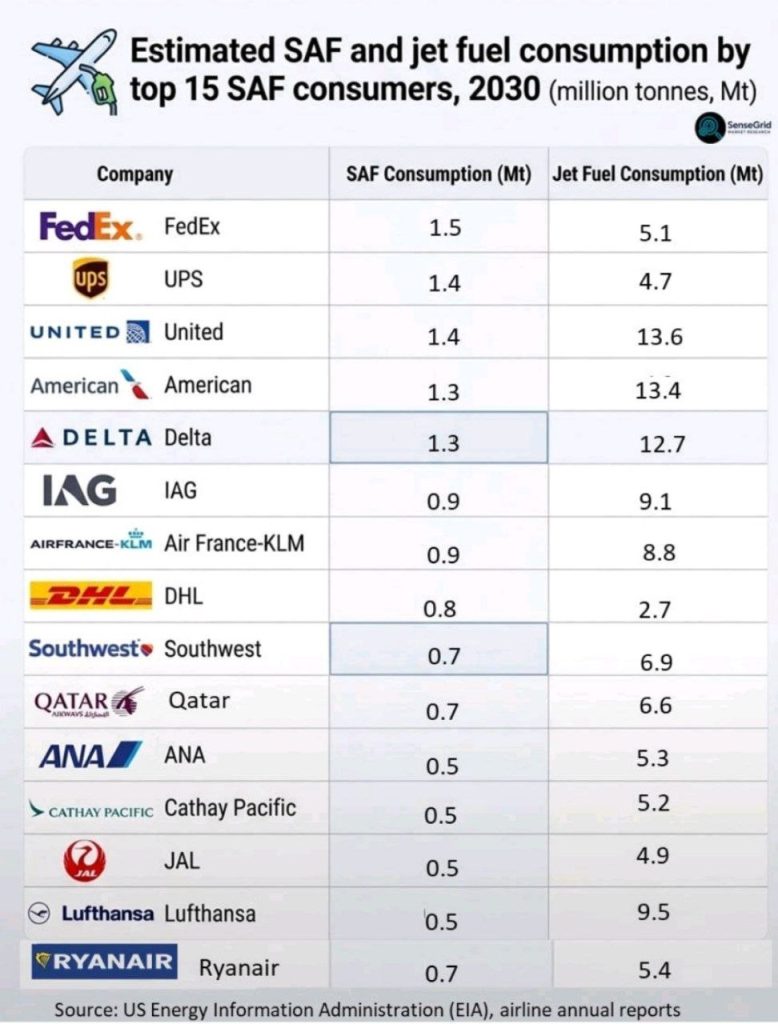
North America held the highest market share of 39.0% in the sustainable aviation fuel market and accounted for $1,248.0 million in 2025. The market is projected to reach $19,041.0 million by 2035, growing at a CAGR of 31.4% during the forecast period. According to the International Air Transport Association (IATA) and US Department of Energy estimates, In December 2024, North America accounted for more than 45% of global SAF production capacity in 2024. SAF production in the US exceeded 2,000 million liters in 2024 and is projected to expand substantially with multiple refinery conversion projects under development across California, Texas, and Louisiana. Furthermore, major airlines, including United Airlines, Delta Air Lines, and American Airlines, have signed long-term SAF procurement agreements to reduce lifecycle carbon emissions. Industry estimates indicate that the North American SAF market is expected to witness double-digit growth through 2030, supported by increasing aviation fuel demand, favorable renewable fuel regulations, and continuous investments in HEFA, alcohol-to-jet, and power-to-liquid fuel technologies.
Market Players Outlook
The major companies operating in the global sustainable aviation fuel market include BP Plc, Chevron Corp., Exxon Mobil Corp., Shell plc, TotalEnergies SE, among others. Industry players are focusing on partnerships, collaborations, and mergers, and acquisitions activities to broaden their market reach, foster innovation, and reinforce their market standing.
Recent Developments
- In May 2026, Bayer and bp formed a strategic alliance to scale camelina as an intermediate crop for biofuels jointly. Collaboration to commercialize camelina for producing biodiesel, renewable diesel (RD), and sustainable aviation fuels (SAF) / bp will bring expertise in fuel and refining, Bayer’s industry-leading expertise in seed technology, and an extensive farmer customer base / Camelina brings added value as an intermediate crop, rotational crop, and on underutilized land.
- In January 2026, Corteva Inc. and bp announced the launch of Etlas, their new 50:50 joint venture that produces oil from crops – including canola, mustard, and sunflower – for use in biofuels such as sustainable (or synthetic) aviation fuel (SAF) and renewable diesel (RD). Etlas will harness both Corteva’s century-long expertise in seed technology to develop crops ideally suited to produce SAF and RD, as well as bp’s expertise in refining and marketing fuel for the commercial transportation market.
- In May 2025, bp successfully led a task force to achieve approval from the UK Ministry of Defence for co-processing Sustainable Aviation Fuel (SAF) with up to 30% renewable hydroprocessed Esters and Fatty acids HEFA feedstock concentration, a significant increase from the current limit of 5%. This standard is now approved for the production of JetA1 globally. This achievement allows BP and other fuel producers to accelerate SAF production at higher concentrations using existing refinery process units.
The Report Covers
- Market valuation analysis for 2026 with projections through 2035.
- Profiles of leading sustainable aviation fuel (SAF) companies, covering recent developments and strategic initiatives.
- Segment-wise revenue forecasts and estimates ($ Million).
- Comprehensive country-level insights across key geographic regions.
- Analysis of high-growth segments and future market opportunities.
- Evaluation of market penetration and expansion strategies.
- Competitive landscape assessment and player positioning analysis.
Key Market Players
- Aemetis, Inc.
- Alder Fuels, Inc.
- Alder Renewables
- Axens SA
- BP p.l.c.
- Calumet, Inc.
- DG Fuels LLC
- Eni S.p.A.
- Fulcrum BioEnergy, Inc.
- Gevo, Inc.
- Honeywell International Inc.
- LanzaJet, Inc.
- Moeve
- Montana Renewables, LLC
- Neste Corporation
- OMV AG
- PBF Energy Inc.
- Phillips 66
- Preem AB
- Repsol S.A.
- Sasol Limited
- Shell plc
- SkyNRG B.V.
- Suncor Energy Inc.
- Synhelion SA
- Topsoe A/S
- TotalEnergies SE
- Twelve Benefit Corporation
- Velocys plc
- World Energy LLC
LIST OF TABLES
- Sustainable Aviation Fuel Market Forecast & Estimation Analysis by Fuel Type, 2025–2035 ($ Million)
- Biofuel Sustainable Aviation Fuel Market Forecast & Estimation Analysis by Region, 2025–2035 ($ Million)
- Power-to-liquid (PtL / e-fuels) Sustainable Aviation Fuel Market Forecast & Estimation Analysis by Region, 2025–2035 ($ Million)
- Hydrogen-Based Aviation Fuels Sustainable Aviation Fuel Market Forecast & Estimation Analysis by Region, 2025–2035 ($ Million)
- Sustainable Aviation Fuel Market Forecast & Estimation Analysis by Blending Capacity, 2025–2035 ($ Million)
- Below 30% Sustainable Aviation Fuel Market Forecast & Estimation Analysis, 2025–2035 ($ Million)
- 30%–50% Sustainable Aviation Fuel Market Forecast & Estimation Analysis, 2025–2035 ($ Million)
- Above 50% Sustainable Aviation Fuel Market Forecast & Estimation Analysis, 2025–2035 ($ Million)
- Sustainable Aviation Fuel Market Forecast & Estimation Analysis by Production Technology, 2025–2035 ($ Million)
- HEFA (Hydroprocessed Esters and Fatty Acids) Sustainable Aviation Fuel Market Forecast & Estimation Analysis by Region, 2025–2035 ($ Million)
- Fischer-Tropsch (FT) Sustainable Aviation Fuel Market Forecast & Estimation Analysis by Region, 2025–2035 ($ Million)
- Alcohol-to-Jet (ATJ) Sustainable Aviation Fuel Market Forecast & Estimation Analysis by Region, 2025–2035 ($ Million)
- Power-to-Liquid (PtL) Sustainable Aviation Fuel Market Forecast & Estimation Analysis by Region, 2025–2035 ($ Million)
- Sustainable Aviation Fuel Market Forecast & Estimation Analysis by Aircraft Type, 2025–2035 ($ Million)
- Sustainable Aviation Fuel For Commercial Aviation Market Forecast & Estimation Analysis, 2025–2035 ($ Million)
- Sustainable Aviation Fuel For Military Aviation Market Forecast & Estimation Analysis, 2025–2035 ($ Million)
- Sustainable Aviation Fuel For Business & General Aviation Market Forecast & Estimation Analysis, 2025–2035 ($ Million)
- Sustainable Aviation Fuel For Cargo Aviation Market Forecast & Estimation Analysis, 2025–2035 ($ Million)
- Sustainable Aviation Fuel Market Research and Analysis by Region, 2025–2035 ($ Million)
- North American Sustainable Aviation Fuel Market Forecast & Estimation Analysis by Region, 2025–2035 ($ Million)
- North American Sustainable Aviation Fuel Market Forecast & Estimation Analysis by Fuel Type, 2025–2035 ($ Million)
- North American Sustainable Aviation Fuel Market Forecast & Estimation Analysis by Blending Capacity, 2025–2035 ($ Million)
- North American Sustainable Aviation Fuel Market Forecast & Estimation Analysis by Production Technology, 2025–2035 ($ Million)
- North American Sustainable Aviation Fuel Market Forecast & Estimation Analysis by Aircraft Type, 2025–2035 ($ Million)
- European Sustainable Aviation Fuel Market Forecast & Estimation Analysis by Region, 2025–2035 ($ Million)
- European Sustainable Aviation Fuel Market Forecast & Estimation Analysis by Fuel Type, 2025–2035 ($ Million)
- European Sustainable Aviation Fuel Market Forecast & Estimation Analysis by Blending Capacity, 2025–2035 ($ Million)
- European Sustainable Aviation Fuel Market Forecast & Estimation Analysis by Production Technology, 2025–2035 ($ Million)
- European Sustainable Aviation Fuel Market Forecast & Estimation Analysis by Aircraft Type, 2025–2035 ($ Million)
- Asia-Pacific Sustainable Aviation Fuel Market Forecast & Estimation Analysis by Region, 2025–2035 ($ Million)
- Asia-Pacific Sustainable Aviation Fuel Market Forecast & Estimation Analysis by Fuel Type, 2025–2035 ($ Million)
- Asia-Pacific Sustainable Aviation Fuel Market Forecast & Estimation Analysis by Blending Capacity, 2025–2035 ($ Million)
- Asia-Pacific Sustainable Aviation Fuel Market Forecast & Estimation Analysis by Production Technology, 2025–2035 ($ Million)
- Asia-Pacific Sustainable Aviation Fuel Market Forecast & Estimation Analysis by Aircraft Type, 2025–2035 ($ Million)
- Rest of the World Sustainable Aviation Fuel Market Forecast & Estimation Analysis by Region, 2025–2035 ($ Million)
- Rest of the World Sustainable Aviation Fuel Market Forecast & Estimation Analysis by Fuel Type, 2025–2035 ($ Million)
- Rest of the World Sustainable Aviation Fuel Market Forecast & Estimation Analysis by Blending Capacity, 2025–2035 ($ Million)
- Rest of the World Sustainable Aviation Fuel Market Forecast & Estimation Analysis by Production Technology, 2025–2035 ($ Million)
- Rest of the World Sustainable Aviation Fuel Market Forecast & Estimation Analysis by Aircraft Type, 2025–2035 ($ Million)
List of Figures
- Sustainable Aviation Fuel Market Share Forecast & Estimation by Fuel Type, 2025 Vs 2035 (%)
- Biofuel Sustainable Aviation Fuel Market Share Forecast & Estimation by Region, 2025 Vs 2035 (%)
- Power-to-liquid (PtL / e-fuels) Sustainable Aviation Fuel Market Share Forecast & Estimation by Region, 2025 Vs 2035 (%)
- Hydrogen-Based Aviation Fuels Sustainable Aviation Fuel Market Share Forecast & Estimation by Region, 2025 Vs 2035 (%)
- Sustainable Aviation Fuel Market Share Forecast & Estimation by Blending Capacity, 2025 Vs 2035 (%)
- Below 30% Sustainable Aviation Fuel Market Share Forecast & Estimation by Region, 2025 Vs 2035 (%)
- 30%–50% Sustainable Aviation Fuel Market Share Forecast & Estimation by Region, 2025 Vs 2035 (%)
- Above 50% Sustainable Aviation Fuel Market Share Forecast & Estimation by Region, 2025 Vs 2035 (%)
- Sustainable Aviation Fuel Market Share Forecast & Estimation by Production Technology, 2025 Vs 2035 (%)
- HEFA (Hydroprocessed Esters and Fatty Acids) Sustainable Aviation Fuel Market Share Forecast & Estimation by Region, 2025 Vs 2035 (%)
- Fischer-Tropsch (FT) Sustainable Aviation Fuel Market Share Forecast & Estimation by Region, 2025 Vs 2035 (%)
- Alcohol-to-Jet (ATJ) Sustainable Aviation Fuel Market Share Forecast & Estimation by Region, 2025 Vs 2035 (%)
- Power-to-Liquid (PtL) Sustainable Aviation Fuel Market Share Forecast & Estimation by Region, 2025 Vs 2035 (%)
- Sustainable Aviation Fuel Market Share Forecast & Estimation by Aircraft Type, 2025 Vs 2035 (%)
- Sustainable Aviation Fuel For Commercial Aviation Market Share Forecast & Estimation by Region, 2025 Vs 2035 (%)
- Sustainable Aviation Fuel For Military Aviation Market Share Forecast & Estimation by Region, 2025 Vs 2035 (%)
- Sustainable Aviation Fuel For Business & General Aviation Market Share Forecast & Estimation by Region, 2025 Vs 2035 (%)
- Sustainable Aviation Fuel For Cargo Aviation Market Share Forecast & Estimation by Region, 2025 Vs 2035 (%)
- Sustainable Aviation Fuel Market Forecast & Estimation by Region, 2025–2035 ($ Million)
- US Sustainable Aviation Fuel Market Size Estimation, 2025–2035 ($ Million)
- Canada Sustainable Aviation Fuel Market Size Estimation, 2025–2035 ($ Million)
- UK Sustainable Aviation Fuel Market Size Estimation, 2025–2035 ($ Million)
- France Sustainable Aviation Fuel Market Size Estimation, 2025–2035 ($ Million)
- Germany Sustainable Aviation Fuel Market Size Estimation, 2025–2035 ($ Million)
- Italy Sustainable Aviation Fuel Market Size Estimation, 2025–2035 ($ Million)
- Spain Sustainable Aviation Fuel Market Size Estimation, 2025–2035 ($ Million)
- Russia Sustainable Aviation Fuel Market Size Estimation, 2025–2035 ($ Million)
- Rest of Europe Sustainable Aviation Fuel Market Size Estimation, 2025–2035 ($ Million)
- India Sustainable Aviation Fuel Market Size Estimation, 2025–2035 ($ Million)
- China Sustainable Aviation Fuel Market Size Estimation, 2025–2035 ($ Million)
- Japan Sustainable Aviation Fuel Market Size Estimation, 2025–2035 ($ Million)
- South Korea Sustainable Aviation Fuel Market Size Estimation, 2025–2035 ($ Million)
- Australia and New Zealand Sustainable Aviation Fuel Market Size Estimation, 2025–2035 ($ Million)
- ASEAN Economies Sustainable Aviation Fuel Market Size Estimation, 2025–2035 ($ Million)
- Rest of Asia-Pacific Sustainable Aviation Fuel Market Size Estimation, 2025–2035 ($ Million)
- Latin America Sustainable Aviation Fuel Market Size Estimation, 2025–2035 ($ Million)
- Middle East and Africa Sustainable Aviation Fuel Market Size Estimation, 2025–2035 ($ Million)
Download Global Sustainable Aviation Fuel Market Sample Report
Contact Us
- Chat On WhatsApp
- Phone :+91-9131799396
- Hi Link Residency, Airport Road, Indore, 452005
- sensegridmarketresearch@gmail.com
Select User License Type
Analyst Support, Customization & Verified Analysis
REPORT BY INDUSTRIES
- Food & Beverages
- Healthcare & Lifesciences
- Semiconductors & Electronics
- Information Technology
- Automotive
- Automation
- Energy & Power
- Consumer Goods & Services
- Agriculture