“Empowering Smarter Business Decisions Through Data-Driven Insights”


Global Optical Interconnect Market Size, Share & Trends Analysis Report By Component (Optical Transceivers, Optical Cables, Optical Connectors, Silicon Photonics, Optical Switches, and Others), By Data Rate (Less than 10 Gbps, 10–40 Gbps, 40–100 Gbps and Above 100 Gbps), By Application (Data Centers, Telecommunications, High-Performance Computing (HPC), Consumer Electronics, Automotive, and Others), By End User (Cloud Service Providers, Telecom Operators, Enterprises, Government & Defense and Others), Forecast (2026–2035)
- Report Code: SMR-100010
- Historic Range: 2025–2035
- Publish date: Jun-2026
Global Optical Interconnect Market Size, Share & Trends Analysis Report By Component (Optical Transceivers, Optical Cables, Optical Connectors, Silicon Photonics, Optical Switches, and Others), By Data Rate (Less than 10 Gbps, 10–40 Gbps, 40–100 Gbps and Above 100 Gbps), By Application (Data Centers, Telecommunications, High-Performance Computing (HPC), Consumer Electronics, Automotive, and Others), By End User (Cloud Service Providers, Telecom Operators, Enterprises, Government & Defense and Others), Forecast (2026–2035)
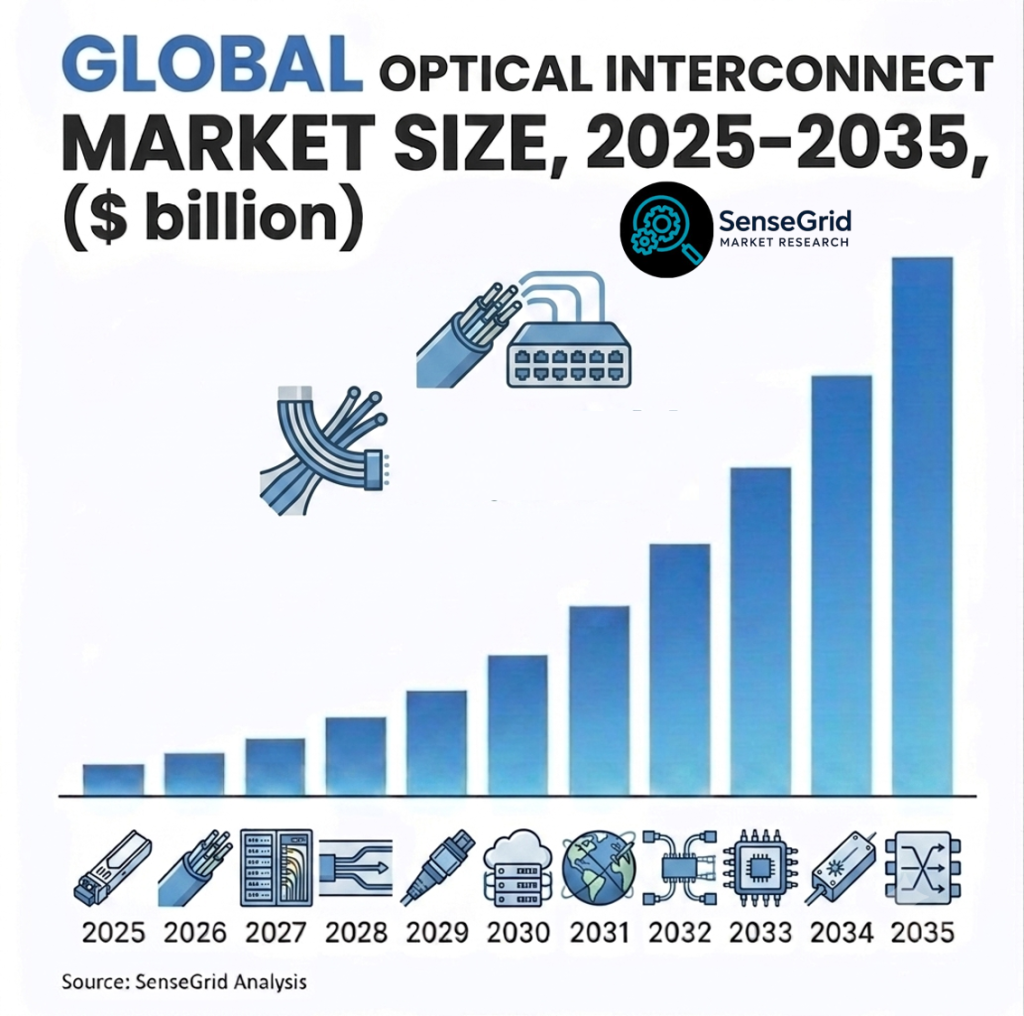
Global optical interconnect market is growing at a CAGR of 10.2% during the forecast period (2026-2035). The industry was valued at $17.2 billion in 2025 and is projected to reach $45.5 billion in 2035. The global optical interconnect market is experiencing strong growth driven by the rapid expansion of AI-driven data centers, increasing cloud computing adoption, rising demand for high-speed data transmission, and the deployment of 5G networks. As hyperscale data centers handle massive volumes of data generated by artificial intelligence, machine learning, and big data analytics, the need for low-latency, high-bandwidth, and energy-efficient connectivity solutions has significantly increased. According to the International Telecommunication Union (ITU), global internet traffic has increased by more than 25× since 2010, with data centers now accounting for over 60% of total global IP traffic.
- As of 2025, more than 1,000 hyperscale data centers are operational globally, with annual expansion rates estimated at 15%–20%, driven by cloud service providers.
- In 2024, global deployment of 400G optical transceivers surpassed 50% of new data center networking upgrades, while early adoption of 800G interconnect systems reached approximately 15%–20% of next-generation AI infrastructure deployments, reflecting the rapid shift toward ultra-high-speed optical networks.
Market Dynamics
- Rising Investments in AI Data Centers Accelerate Demand for Optical Interconnects
The rapid expansion of AI and hyperscale data centers is increasing the need for high-speed, low-latency optical interconnect solutions. For instance, in January 2025, Microsoft announced an investment of approximately US$80 billion in AI-enabled data centers during fiscal 2025, significantly boosting demand for advanced optical networking infrastructure to support AI workloads.
- Strategic Collaborations Enhance Next-Generation Optical Connectivity
Partnerships among semiconductor and networking companies are accelerating the development of high-bandwidth optical interconnect technologies. For instance, in March 2025, NVIDIA and TSMC expanded their collaboration on silicon photonics and advanced packaging technologies to support next-generation AI networking and optical interconnect solutions for hyperscale data centers.
- New Product Launches Drive High-Speed Optical Interconnect Adoption
Continuous product innovation is enabling faster and more energy-efficient data transmission across cloud and AI infrastructure. For instance, in March 2025, NVIDIA launched its Spectrum-X Photonics Ethernet and Quantum-X Photonics InfiniBand networking switches, integrating silicon photonics to deliver ultra-high-speed optical interconnects with lower power consumption for AI factories and large-scale data centers.
Market Segmentation
- Based on component, the market is segmented into optical transceivers, optical cables, optical connectors, silicon photonics, and optical switches.
- Based on data rate, the market is segmented into less than 10 Gbps, 10–40 Gbps, 40–100 Gbps, and above 100 Gbps.
- Based on application, the market is segmented into data centers, telecommunications, high-performance computing (HPC), consumer electronics, and automotive.
- Based on end user, the market is segmented into cloud service providers, telecom operators, enterprises, and government & defense.
Optical Transceivers Segment Dominates the Market with the Largest Share
In 2025, the optical transceivers segment held the highest market share, driven by its critical role in enabling high-speed data transmission in data centers, telecom networks, and hyperscale cloud infrastructure. Optical transceivers are widely deployed across 100G, 400G, and emerging 800G network architectures, supporting exponential growth in global internet traffic and AI-driven workloads. According to the International Telecommunication Union (ITU), global internet traffic has increased more than 25-fold since 2010, with data center traffic now representing over 60% of total IP traffic worldwide, significantly boosting demand for high-performance optical interconnect components such as transceivers. Industry studies indicate that more than 70% of new data center deployments globally incorporate high-density optical transceiver solutions to support AI, machine learning, and real-time analytics workloads.
Data Center Holds a Significant Market Share
In 2025, the data centers segment held the highest share, driven by the rapid expansion of hyperscale cloud infrastructure and AI-driven computing workloads. Global hyperscale data center capacity surpassed 1,000+ operational facilities worldwide in 2025, with continuous annual growth exceeding 15%–20% in installed capacity, directly increasing demand for optical interconnect systems. Optical links operating at 400G and 800G speeds are now being deployed in more than 60% of new data center networking upgrades, reflecting the shift toward ultra-high bandwidth infrastructure. Industry infrastructure estimates indicate that over 70% of newly built data centers globally are designed with fiber-first architectures.
Regional Outlook
The global optical interconnect market is segmented geographically into North America (the US and Canada), Europe (the UK, Germany, France, Italy, Spain, Russia, and Rest of Europe), Asia-Pacific (India, China, Japan, South Korea, Australia & New Zealand, ASEAN Countries, and Rest of Asia-Pacific), and the Rest of the World (Middle East & Africa and Latin America).
Asia-Pacific’s Semiconductor Accelerates Optical Interconnect Demand
The Asia-Pacific optical interconnect market is witnessing substantial growth due to the region’s leadership in semiconductor manufacturing, silicon photonics, and AI-driven data center expansion. According to SEMI (Semiconductor Equipment and Materials International), global semiconductor manufacturing capacity is projected to increase by approximately 7% in 2025, reaching a record level of more than 42 million wafers per month (300 mm equivalent). Asia remains the dominant semiconductor manufacturing hub, accounting for over 70% of the world’s semiconductor fabrication capacity, led by Taiwan, South Korea, China, and Japan. This strong manufacturing ecosystem is accelerating the production of advanced photonic integrated circuits (PICs), silicon photonics, optical transceivers, and co-packaged optics (CPO), which are essential components of high-speed optical interconnects. Furthermore, continuous investments by leading semiconductor manufacturers and hyperscale cloud providers in AI servers, high-performance computing (HPC), and hyperscale data centers are driving demand for 800G and emerging 1.6T optical interconnect solutions across the Asia-Pacific region, reinforcing its position as the world’s second-largest optical interconnect market.
North America Region Dominates the Market with Major Share
North America dominates the optical interconnect market owing to its dominance in AI infrastructure, hyperscale cloud computing, and next-generation optical networking innovation. According to OFC 2025, organized by Optica, the IEEE Communications Society, and the IEEE Photonics Society, the rapid deployment of 800G and emerging 1.6T optical interconnect technologies, co-packaged optics (CPO), silicon photonics, and coherent pluggable optics is transforming data center networks to meet the exponential bandwidth demands of generative AI and high-performance computing (HPC). The conference highlighted that North American hyperscale cloud providers—including Amazon Web Services (AWS), Microsoft Azure, Google Cloud, and Meta—are leading global investments in AI data centers, driving large-scale adoption of optical interconnect solutions for high-speed, low-latency data transmission. OFC 2025 also demonstrated the industry’s transition toward 200G-per-lane and 400G-per-lane optical technologies, reinforcing North America’s position as the global hub for optical communications innovation and commercialization. These advancements continue to accelerate demand for optical transceivers, silicon photonics, and data center interconnect (DCI) solutions across the region.
Market Players Outlook
The major companies operating in the global optical interconnect market include Broadcom Inc., Coherent Corp., Lumentum Holdings Inc., Marvell Technology, Inc., and Cisco Systems, Inc. Industry players are focusing on partnerships, collaborations, and mergers and acquisitions activities to broaden their market reach, foster innovation, and reinforce their market standing.
Recent Developments
- In March 2026, Broadcom Inc., NVIDIA Corporation, Advanced Micro Devices, Inc. (AMD), Microsoft Corporation, Meta Platforms, Inc., and OpenAI formed the Optical Compute Interconnect (OCI) Multi-Source Agreement (MSA) to establish an open optical interconnect standard for AI infrastructure. The collaboration aims to accelerate the adoption of high-bandwidth, low-latency optical interconnects, improve interoperability across vendors, and support next-generation AI data centers through standardized optical connectivity.
- In November 2025, GlobalFoundries Inc. acquired Advanced Micro Foundry (AMF), a Singapore-based silicon photonics foundry, to strengthen its optical interconnect capabilities. The acquisition expands GlobalFoundries’ silicon photonics manufacturing portfolio, enabling advanced optical interconnect solutions for AI data centers, telecommunications, LiDAR, and high-performance computing applications.
- In November 2025, GlobalFoundries Inc. acquired InfiniLink, a startup specializing in high-speed optical connectivity technologies, as part of its strategic investment in AI networking infrastructure. The acquisition enhances the company’s capabilities in co-packaged optics (CPO), pluggable optical transceivers, and next-generation optical interconnect solutions designed for hyperscale AI data centers.
- In September 2025, Marvell Technology, Inc. partnered with Samtec Inc. at the European Conference on Optical Communication (ECOC) 2025 to showcase next-generation optical interconnect technologies for AI infrastructure. The collaboration demonstrated advanced co-packaged optics (CPO) and 200G/lane optical connectivity solutions designed to deliver higher bandwidth, lower latency, and improved energy efficiency for hyperscale AI data centers and accelerated computing networks.
- In April 2025, Keysight Technologies, Inc., McGill University, Ciena Corporation, and HyperLight Corporation collaborated to demonstrate the industry’s first 448G PAM4 driverless optical transmission technology. The collaboration advances ultra-high-speed optical interconnects, enabling faster and more energy-efficient connectivity for AI clusters, cloud computing, and hyperscale data center networks.
The Report Covers
- Market valuation analysis for 2026 with projections through 2035.
- Profiles of leading optical interconnect companies, covering recent developments and strategic initiatives.
- Segment-wise revenue forecasts and estimates ($ Million).
- Comprehensive country-level insights across key geographic regions.
- Analysis of high-growth segments and future market opportunities.
- Evaluation of market penetration and expansion strategies.
- Competitive landscape assessment and player positioning analysis.
Key Market Players
- NVIDIA Corp.
- Broadcom Inc.
- Coherent Corp.
- Corning Inc.
- Amphenol Corp.
- TE Connectivity plc
- Molex LLC
- Lumentum Holdings Inc.
- Sumitomo Electric Industries, Ltd.
- Fujitsu Ltd.
- Marvell Technology, Inc.
- Cisco Systems, Inc.
- Ciena Corp.
- Nokia Corp.
- Juniper Networks, Inc.
- InnoLight Technology (Suzhou) Ltd.
- Accelink Technologies Co., Ltd.
- Hisense Broadband Multimedia Technologies Co., Ltd.
- Eoptolink Technology Inc., Ltd.
- Source Photonics Holdings (Cayman) Ltd.
- Intel Corp.
- GlobalFoundries Inc.
- Hamamatsu Photonics K.K.
- NEC Corp.
- Huawei Technologies Co., Ltd.
- MACOM Technology Solutions Holdings, Inc.
- Credo Technology Group Holding Ltd.
- POET Technologies Inc.
- Furukawa Electric Co., Ltd.
- Hitachi, Ltd.
LIST OF TABLES
- Optical Interconnect Market Forecast & Estimation Analysis by Component Type, 2025–2035 ($ Million)
- Optical Transceivers Interconnect Market Forecast & Estimation Analysis by Region, 2025–2035 ($ Million)
- Optical Cables Interconnect Market Forecast & Estimation Analysis by Region, 2025–2035 ($ Million)
- Optical Connectors Interconnect Market Forecast & Estimation Analysis by Region, 2025–2035 ($ Million)
- Optical Silicon Photonics Interconnect Market Forecast & Estimation Analysis by Region, 2025–2035 ($ Million)
- Optical Switches Interconnect Market Forecast & Estimation Analysis by Region, 2025–2035 ($ Million)
- Other Optical Interconnect Component Type Market Forecast & Estimation Analysis by Region, 2025–2035 ($ Million)
- Optical Switches Market Forecast & Estimation Analysis by Data Rate Type, 2025–2035 ($ Million)
- Less than 10 Gbps Optical Interconnect Market Forecast & Estimation Analysis by Region, 2025–2035 ($ Million)
- 10–40 Gbps Optical Interconnect Market Forecast & Estimation Analysis by Region, 2025–2035 ($ Million)
- 40–100 Gbps Optical Interconnect Market Forecast & Estimation Analysis by Region, 2025–2035 ($ Million)
- Above 100 Gbps Optical Interconnect Market Forecast & Estimation Analysis by Region, 2025–2035 ($ Million)
- Optical Interconnects Market Forecast & Estimation Analysis by Application, 2025–2035 ($ Million)
- Optical Interconnect for Data Centers Market Forecast & Estimation Analysis by Region, 2025–2035 ($ Million)
- Optical Interconnect for Telecommunications Market Forecast & Estimation Analysis by Region, 2025–2035 ($ Million)
- Optical Interconnect for High-Performance Computing (HPC) Market Forecast & Estimation Analysis by Region, 2025–2035 ($ Million)
- Optical Interconnect for Consumer Electronics Market Forecast & Estimation Analysis by Region, 2025–2035 ($ Million)
- Optical Interconnect for Automotive Market Forecast & Estimation Analysis by Region, 2025–2035 ($ Million)
- Optical Interconnects Market Forecast & Estimation Analysis by End-User, 2025–2035 ($ Million)
- Optical Interconnect for Cloud Service Providers Market Forecast & Estimation Analysis by Region, 2025–2035 ($ Million)
- Optical Interconnect for Telecom Operators Market Forecast & Estimation Analysis by Region, 2025–2035 ($ Million)
- Optical Interconnect for Enterprises Market Forecast & Estimation Analysis by Region, 2025–2035 ($ Million)
- Optical Interconnect for Government & Defense Market Forecast & Estimation Analysis by Region, 2025–2035 ($ Million)
- Optical Interconnects Market Research and Analysis by Region, 2025–2035 ($ Million)
- North American Optical Interconnects Market Forecast & Estimation Analysis by Region, 2025–2035 ($ Million)
- North American Optical Interconnects Market Forecast & Estimation Analysis by Component Type, 2025–2035 ($ Million)
- North American Optical Interconnects Market Forecast & Estimation Analysis by Data Rate Type, 2025–2035 ($ Million)
- North American Optical Interconnects Market Forecast & Estimation Analysis by Application, 2025–2035 ($ Million)
- North American Optical Interconnects Market Forecast & Estimation Analysis by End User, 2025–2035 ($ Million)
- Europe Optical Interconnects Market Forecast & Estimation Analysis by Region, 2025–2035 ($ Million)
- Europe Optical Interconnects Market Forecast & Estimation Analysis by Component Type, 2025–2035 ($ Million)
- Europe Optical Interconnects Market Forecast & Estimation Analysis by Data Rate Type, 2025–2035 ($ Million)
- Europe Optical Interconnects Market Forecast & Estimation Analysis by Application, 2025–2035 ($ Million)
- Europe Optical Interconnects Market Forecast & Estimation Analysis by End User, 2025–2035 ($ Million)
- Asia-Pacific Optical Interconnects Market Forecast & Estimation Analysis by Region, 2025–2035 ($ Million)
- Asia-Pacific Optical Interconnects Market Forecast & Estimation Analysis by Component Type, 2025–2035 ($ Million)
- Asia-Pacific Optical Interconnects Market Forecast & Estimation Analysis by Data Rate Type, 2025–2035 ($ Million)
- Asia-Pacific Optical Interconnects Market Forecast & Estimation Analysis by Application, 2025–2035 ($ Million)
- Asia-Pacific Optical Interconnects Market Forecast & Estimation Analysis by End User, 2025–2035 ($ Million)
- Rest of the World Optical Interconnects Market Forecast & Estimation Analysis by Region, 2025–2035 ($ Million)
- Rest of the World Optical Interconnects Market Forecast & Estimation Analysis by Component Type, 2025–2035 ($ Million)
- Rest of the World Optical Interconnects Market Forecast & Estimation Analysis by Data Rate Type, 2025–2035 ($ Million)
- Rest of the World Optical Interconnects Market Forecast & Estimation Analysis by Application, 2025–2035 ($ Million)
- Rest of the World Optical Interconnects Market Forecast & Estimation Analysis by End User, 2025–2035 ($ Million)
List of Figures
- Optical Interconnects Market Share Forecast & Estimation by Component Type, 2025 Vs 2035 (%)
- Optical Transceivers Interconnect Market Forecast & Estimation Analysis by Region, 2025 Vs 2035 (%)
- Optical Cables Interconnect Market Share Forecast & Estimation by Region, 2025 Vs 2035 (%)
- Optical Connectors Interconnect Market Forecast & Estimation Analysis by Region, 2025 Vs 2035 (%)
- Optical Silicon Photonics Interconnect Market Forecast & Estimation Analysis by Region, 2025 Vs 2035 (%)
- Optical Switches Interconnect Market Forecast & Estimation Analysis by Region, 2025 Vs 2035 (%)
- Other Optical Interconnect Component Type Market Forecast & Estimation Analysis by Region, 2025 Vs 2035 (%)
- Optical Interconnects Market Share Forecast & Estimation by Data Rate Type, 2025 Vs 2035 (%)
- Less than 10 Gbps Optical Interconnect Market Share Forecast & Estimation by Region, 2025 Vs 2035 (%)
- 10–40 Gbps Interconnect Market Share Forecast & Estimation by Region, 2025 Vs 2035 (%)
- 40–100 Gbps Interconnect Market Share Forecast & Estimation by Region, 2025 Vs 2035 (%)
- Above 100 Gbps Interconnect Market Share Forecast & Estimation by Region, 2025 Vs 2035 (%)
- Optical Interconnects Market Share Forecast & Estimation by Application, 2025 Vs 2035 (%)
- Optical Interconnects for Data Centers Market Share Forecast & Estimation by Region, 2025 Vs 2035 (%)
- Optical Interconnects for Telecommunications Market Share Forecast & Estimation by Region, 2025 Vs 2035 (%)
- Optical Interconnects for High-Performance Computing (HPC) Market Share Forecast & Estimation by Region, 2025 Vs 2035 (%)
- Optical Interconnects for Consumer Electronics Market Share Forecast & Estimation by Region, 2025 Vs 2035 (%)
- Optical Interconnects for Automotive Market Share Forecast & Estimation by Region, 2025 Vs 2035 (%)
- Optical Interconnects Market Share Forecast & Estimation by End User, 2025 Vs 2035 (%)
- Optical Interconnects for Cloud Service Providers Market Share Forecast & Estimation by Region, 2025 Vs 2035 (%)
- Optical Interconnects for Telecom Operators Market Share Forecast & Estimation by Region, 2025 Vs 2035 (%)
- Optical Interconnects for Enterprises Market Share Forecast & Estimation by Region, 2025 Vs 2035 (%)
- Optical Interconnects for Government & Defense Market Share Forecast & Estimation by Region, 2025 Vs 2035 (%)
- Optical Interconnects Market Forecast & Estimation by Region, 2025–2035 ($ Million)
- US Optical Interconnects Market Size Estimation, 2025–2035 ($ Million)
- Canada Optical Interconnects Market Size Estimation, 2025–2035 ($ Million)
- UK Optical Interconnects Market Size Estimation, 2025–2035 ($ Million)
- France Optical Interconnects Market Size Estimation, 2025–2035 ($ Million)
- Germany Optical Interconnects Market Size Estimation, 2025–2035 ($ Million)
- Italy Optical Interconnects Market Size Estimation, 2025–2035 ($ Million)
- Spain Optical Interconnects Market Size Estimation, 2025–2035 ($ Million)
- Russia Optical Interconnects Market Size Estimation, 2025–2035 ($ Million)
- Rest of Europe Optical Interconnects Market Size Estimation, 2025–2035 ($ Million)
- India Optical Interconnects Market Size Estimation, 2025–2035 ($ Million)
- China Optical Interconnects Market Size Estimation, 2025–2035 ($ Million)
- Japan Optical Interconnects Market Size Estimation, 2025–2035 ($ Million)
- South Korea Optical Interconnects Market Size Estimation, 2025–2035 ($ Million)
- Australia and New Zealand Optical Interconnects Market Size Estimation, 2025–2035 ($ Million)
- ASEAN Economies Optical Interconnects Market Size Estimation, 2025–2035 ($ Million)
- Rest of Asia-Pacific Optical Interconnects Market Size Estimation, 2025–2035 ($ Million)
- Latin America Optical Interconnects Market Size Estimation, 2025–2035 ($ Million)
- Middle East & Africa Optical Interconnects Market Size Estimation, 2025–2035 ($ Million)
Download Global Optical Interconnect Market Sample Report
Contact Us
- Chat On WhatsApp
- Phone :+91-9131799396
- Hi Link Residency, Airport Road, Indore, 452005
- sensegridmarketresearch@gmail.com
Select User License Type
Analyst Support, Customization & Verified Analysis
REPORT BY INDUSTRIES
- Food & Beverages
- Healthcare & Lifesciences
- Semiconductors & Electronics
- Information Technology
- Automotive
- Automation
- Energy & Power
- Consumer Goods & Services
- Agriculture