“Empowering Smarter Business Decisions Through Data-Driven Insights”


Global Telecom Market Size, Share & Trends Analysis Report By Service Type (Mobile Services, Fixed-Line Services, Broadband Services, Pay TV Services, and Others), By Technology (4G/LTE, 5G, Fiber Optic, Satellite, and Others), By Deployment Type (On-Premises and Cloud-Based), By Enterprise Size (Small & Medium Enterprises (SMEs) and Large Enterprises), By End User (Residential, Commercial, and Government), Forecast (2026–2035)
- Report Code: SMR-100010
- Historic Range: 2025–2035
- Publish date: Jun-2026
Global Telecom Market Size, Share & Trends Analysis Report By Service Type (Mobile Services, Fixed-Line Services, Broadband Services, Pay TV Services, and Others), By Technology (4G/LTE, 5G, Fiber Optic, Satellite, and Others), By Deployment Type (On-Premises and Cloud-Based), By Enterprise Size (Small & Medium Enterprises (SMEs) and Large Enterprises), By End User (Residential, Commercial, and Government), Forecast (2026–2035)
Industry Overview
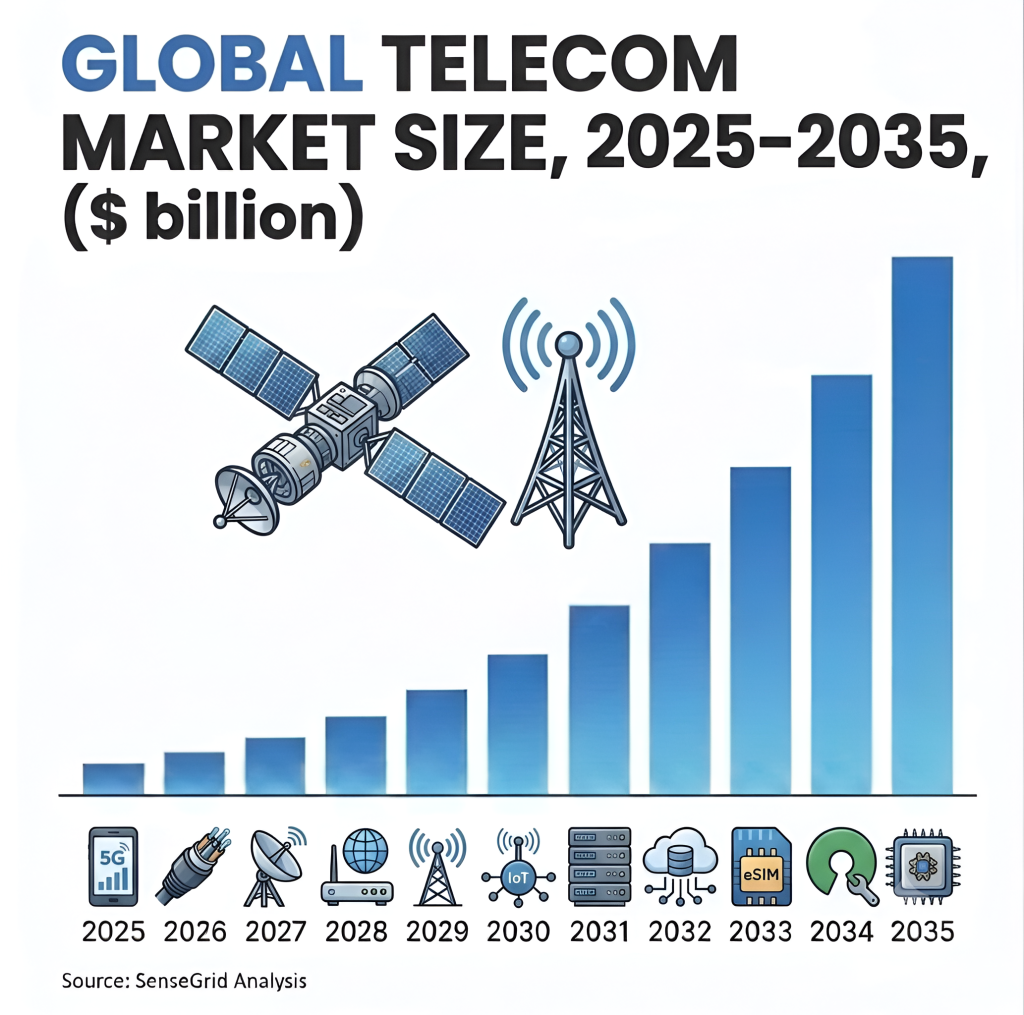
Global telecom market is growing at a CAGR of 7.2% during the forecast period (2026-2035). The industry was valued at $2,050.0 billion in 2025 and is projected to reach $4,109.4 billion in 2035. The rapid deployment of 5G networks, increasing internet penetration, rising smartphone adoption, expanding mobile broadband subscriptions, and the growing demand for high-speed, low-latency connectivity. The continuous surge in data traffic fueled by video streaming, cloud computing, remote working, online education, digital payments, and e-commerce is encouraging telecom operators to invest heavily in fiber-optic networks, network virtualization, and next-generation wireless infrastructure. Governments across both developed and emerging economies are also accelerating investments in digital infrastructure and broadband expansion initiatives to bridge the digital divide and support inclusive economic growth. According to the International Telecommunication Union (ITU), in 2025,
- 0 billion people (approximately 74% of the global population) were using the Internet in 2025, reflecting continued growth in digital connectivity globally.
- 2 billion people remain offline globally, creating significant opportunities for telecom operators to expand broadband and mobile network infrastructure.
- 5G networks covered 55.1% of the global population in 2025, accelerating demand for next-generation telecom infrastructure and high-speed connectivity.
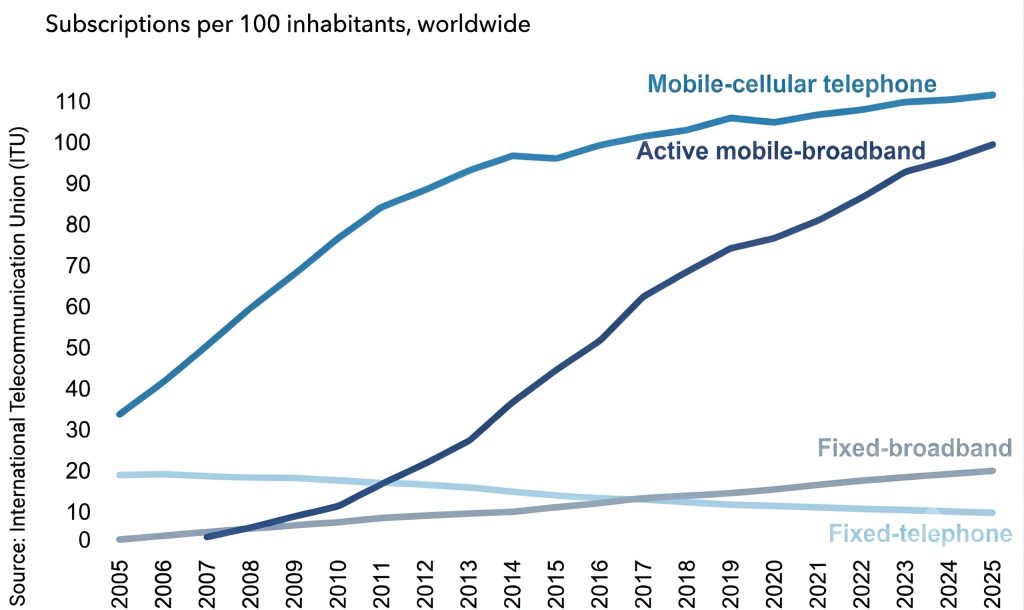
- Active mobile-broadband subscriptions reached 99.4 per 100 inhabitants globally in 2025, highlighting the increasing adoption of mobile internet services.
- More than 96% of the global population is now covered by a mobile broadband network, supporting wider access to digital services and communications.
- 5G subscriptions account for more than one-third of all global mobile-broadband subscriptions, demonstrating the rapid commercialization and adoption of next-generation wireless technology.
Market Dynamics
- Rapid Expansion of 5G Networks
The global rollout of 5G technology is a major driver of the telecom market. Telecom operators are investing heavily in 5G infrastructure to deliver ultra-fast connectivity, low latency, and support for applications such as IoT, autonomous vehicles, smart cities, and industrial automation.
- Rising Mobile Internet and Smartphone Penetration
The increasing number of mobile internet users and smartphone subscriptions worldwide continues to boost demand for telecom services, including mobile broadband, voice, and data connectivity.
- Growing Adoption of Cloud Computing and IoT
The expansion of cloud services, edge computing, artificial intelligence (AI), and the Internet of Things (IoT) is driving demand for high-speed, reliable telecom networks capable of supporting billions of connected devices.
Market Segmentation
- Based on the service type, the market is segmented into mobile services, fixed-line services, broadband services, pay TV services, and others.
- Based on the technology, the market is segmented into 4G/LTE, 5G, fiber optic, satellite, and others.
- Based on the deployment type, the market is segmented into on-premises and cloud-based.
- Based on the enterprise size, the market is segmented into small & medium enterprises (SMES) and large enterprises.
- Based on the end user, the market is segmented into residential, commercial, and government.
Mobile Services Segment Dominates the Market with the Largest Share
Mobile services held the largest share of the global telecom market owing to the rapid growth of smartphone adoption, mobile broadband usage, 4G/5G network expansion, and increasing mobile data consumption globally. According to the GSMA’s Mobile Economy 2025 report, there were 5.8 billion unique mobile subscribers globally in 2024, representing 71% of the world’s population. The report also states that mobile technologies and services generated $6.5 trillion in economic value in 2024, equivalent to 5.8% of global GDP, highlighting the dominant role of mobile services in the telecommunications industry.
Furthermore, the International Telecommunication Union (ITU) reported that 5.8 billion people (71% of the global population) were using the Internet in 2024, with the majority accessing the internet through mobile broadband networks. The continued expansion of mobile internet connectivity is driving demand for mobile voice, data, and value-added telecom services. Additionally, according to the GSMA, global 5G connections are projected to exceed 2.9 billion by 2030, accounting for around 57% of all mobile connections. The accelerating deployment of 5G networks is further strengthening the dominance of the mobile services segment by enabling high-speed connectivity, IoT applications, cloud services, and AI-driven digital transformation.
5G Segment Holds a Significant Market Share
5G segment held the largest share of the global telecom market owing to rapid network deployment, increasing mobile broadband demand, enterprise digitalization, and the growing adoption of IoT, AI, edge computing, and smart city applications. According to the GSMA’s Mobile Economy 2025 report, 5G connections surpassed 2 billion globally by the end of 2024, making 5G the fastest-growing mobile technology in history. The GSMA projects that 5G connections will exceed 2.9 billion by 2030, accounting for 57% of all global mobile connections, driven by continuous investments from telecom operators in network expansion and spectrum deployment.
Furthermore, the International Telecommunication Union (ITU) reported that 5.8 billion people, or 71% of the global population, were using the Internet in 2024, with mobile broadband remaining the primary means of internet access globally. The rapid expansion of high-speed mobile connectivity continues to accelerate demand for 5G infrastructure, including base stations, small cells, fiber backhaul, and cloud-native telecom networks. In addition, according to GSMA, mobile technologies and services contributed $6.5 trillion to the global economy in 2024, equivalent to 5.8% of global GDP, with 5G playing a key role in supporting advanced applications such as autonomous vehicles, industrial automation, immersive media, and private enterprise networks.
Regional Outlook
The global telecom market is segmented geographically into North America (the US and Canada), Europe (the UK, Germany, France, Italy, Spain, Russia, and Rest of Europe), Asia-Pacific (India, China, Japan, South Korea, Australia & New Zealand, ASEAN Countries, and Rest of Asia-Pacific), and the Rest of the World (Middle East & Africa and Latin America).
North America Driven by 5G and Fiber Expansion
The North American telecom market is driven by advanced 5G infrastructure, high smartphone penetration, extensive fiber-optic broadband deployment, enterprise digitalization, and strong investments in AI-enabled communication networks. According to the GSMA’s Mobile Economy North America 2025 report, mobile technologies and services generated approximately $1.6 trillion in economic value in 2024, equivalent to 5% of North America’s GDP. The GSMA forecasts this contribution will increase to $3.7 trillion by 2030, representing 10.2% of regional GDP, driven by the continued expansion of 5G, artificial intelligence (AI), cloud computing, and digital services.
The report highlights that the United States and Canada each have around 60% of mobile connections on 5G networks, making North America one of the world’s most advanced 5G regions. Around 320 million people across North America use the mobile internet, and 5G is expected to account for approximately 84% of all mobile connections by 2030, further accelerating demand for telecom infrastructure, network modernization, edge computing, and enterprise connectivity solutions.
Asia-Pacific Region Dominates the Market with Major Share
The Asia-Pacific telecom market is growing owing to its massive mobile subscriber base, rapid 5G deployment, expanding fiber-optic infrastructure, increasing smartphone adoption, and accelerating digital transformation across China, India, Japan, South Korea, and Southeast Asia. According to the GSMA’s Mobile Economy Asia Pacific 2025 report, mobile technologies and services contributed $950 billion (5.6% of regional GDP) to the Asia-Pacific economy in 2024, and this contribution is projected to increase to $1.4 trillion by 2030. The report also states that the region will have 1.8 billion mobile internet users by 2030, while 5G is expected to account for 50% of all mobile connections by 2030.
Countries including Australia, Japan, Singapore, and South Korea are already approaching mass-market 5G adoption. Furthermore, the GSMA estimates that almost 40% of all new mobile internet subscribers added globally between 2025 and 2030 will come from Asia-Pacific, with India, Indonesia, Pakistan, and China being the major contributors. This expanding subscriber base continues to drive investments in telecom infrastructure, cloud connectivity, fiber broadband, and next-generation mobile networks.
Market Players Outlook
The major companies operating in the global telecom market include AT&T Inc., Verizon Communications Inc., China Mobile Ltd, Deutsche Telekom AG, and Vodafone Group Plc. Industry players are focusing on partnerships, collaborations, and mergers, and acquisitions activities to broaden their market reach, foster innovation, and reinforce their market standing.
Recent Developments
- In July 2026, Orange S.A., Iliad S.A., and Bouygues Telecom submitted a €20.35 billion joint bid to acquire SFR, marking one of the largest telecom consolidation deals in Europe. The transaction is under review by the French Competition Authority.
- In July 2026, Telecom Italia S.p.A. (TIM) approved a takeover bid from Poste Italiane S.p.A. valued at approximately €13 billion, strengthening Poste Italiane’s position in Italy’s telecommunications and digital infrastructure sector.
- In July 2026, India’s DTH and cable operators urged the government to adopt technology-neutral regulations under the new Telecommunications Act, aiming to create a level playing field across satellite, cable, and internet-based communication services.
- In June 2026, the Cellular Operators Association of India (COAI) appointed Rahul Vatts as its Chairperson for 2026–27, with a focus on accelerating digital infrastructure development, 5G expansion, and telecom sector growth.
- In January 2025, the Government of India launched National Broadband Mission (NBM) 2.0 (2025–2030) to expand high-speed broadband connectivity, improve fiber infrastructure, and accelerate nationwide 5G deployment.
The Report Covers
- Market valuation analysis for 2026 with projections through 2035.
- Profiles of leading telecom companies, covering recent developments and strategic initiatives.
- Segment-wise revenue forecasts and estimates ($ Million).
- Comprehensive country-level insights across key geographic regions.
- Analysis of high-growth segments and future market opportunities.
- Evaluation of market penetration and expansion strategies.
- Competitive landscape assessment and player positioning analysis.
Key Market Players
- América Móvil, S.A.B. de C.V.
- AT&T Inc.
- Bell Canada
- Bharti Airtel Ltd.
- BT Group plc
- China Mobile Ltd.
- China Telecom Corp. Ltd.
- China United Network Communications Group Co., Ltd.
- Comcast Corp.
- Deutsche Telekom AG
- Emirates Telecommunications Group Company PJSC (e&)
- KDDI Corp.
- KT Corp.
- Liberty Global plc
- MTN Group Ltd.
- Nippon Telegraph and Telephone Corp.
- Orange S.A.
- Reliance Jio Infocomm Ltd.
- Rogers Communications Inc.
- Saudi Telecom Company
- Singapore Telecommunications Ltd.
- SK Telecom Co., Ltd.
- SoftBank Corp.
- Telefónica, S.A.
- Telstra Group Ltd.
- Telus Corp.
- T-Mobile US, Inc.
- Verizon Communications Inc.
- Vodafone Group Plc
- Zain Group
Table of Contents
- Telecom Market Forecast & Estimation Analysis by Service Type, 2025–2035 ($ Million)
- Telecom Mobile Services Market Forecast & Estimation Analysis by Region, 2025–2035 ($ Million)
- Telecom Fixed-Line Services Market Forecast & Estimation Analysis by Region, 2025–2035 ($ Million)
- Telecom Broadband Services Market Forecast & Estimation Analysis by Region, 2025–2035 ($ Million)
- Telecom Pay TV Services Market Forecast & Estimation Analysis by Region, 2025–2035 ($ Million)
- Other Telecom Services Type Market Forecast & Estimation Analysis by Region, 2025–2035 ($ Million)
- Telecom Market Forecast & Estimation Analysis by Technology, 2025–2035 ($ Million)
- Telecom 4G/LTE Market Forecast & Estimation Analysis by Region, 2025–2035 ($ Million)
- Telecom 5G Market Forecast & Estimation Analysis by Region, 2025–2035 ($ Million)
- Telecom Fiber Optic Market Forecast & Estimation Analysis by Region, 2025–2035 ($ Million)
- Telecom Satellite Market Forecast & Estimation Analysis by Region, 2025–2035 ($ Million)
- Other Telecom Technologies Market Forecast & Estimation Analysis by Region, 2025–2035 ($ Million)
- Telecom Market Forecast & Estimation Analysis by Deployment Type, 2025–2035 ($ Million)
- On-Premises Telecom Market Forecast & Estimation Analysis by Region, 2025–2035 ($ Million)
- Cloud-Based Telecom Market Forecast & Estimation Analysis by Region, 2025–2035 ($ Million)
- Telecom Market Forecast & Estimation Analysis by Enterprise Size, 2025–2035 ($ Million)
- Small & Medium Enterprises (SMEs) Telecom Market Forecast & Estimation Analysis by Region, 2025–2035 ($ Million)
- Large Enterprises Telecom Market Forecast & Estimation Analysis by Region, 2025–2035 ($ Million)
- Telecom Market Forecast & Estimation Analysis by End User, 2025–2035 ($ Million)
- Telecom for Residential Market Forecast & Estimation Analysis by Region, 2025–2035 ($ Million)
- Telecom for Commercial Market Forecast & Estimation Analysis by Region, 2025–2035 ($ Million)
- Telecom for Government Market Forecast & Estimation Analysis by Region, 2025–2035 ($ Million)
- Telecom Market Research and Analysis by Region, 2025–2035 ($ Million)
- North America Telecom Market Forecast & Estimation Analysis by Region, 2025–2035 ($ Million)
- North America Telecom Market Forecast & Estimation Analysis by Service Type, 2025–2035 ($ Million)
- North America Telecom Market Forecast & Estimation Analysis by Technology, 2025–2035 ($ Million)
- North America Telecom Market Forecast & Estimation Analysis by Deployment Type, 2025–2035 ($ Million)
- North America Telecom Market Forecast & Estimation Analysis by Enterprise Size, 2025–2035 ($ Million)
- North America Telecom Market Forecast & Estimation Analysis by End User, 2025–2035 ($ Million)
- Europe Telecom Market Forecast & Estimation Analysis by Region, 2025–2035 ($ Million)
- Europe Telecom Market Forecast & Estimation Analysis by Service Type, 2025–2035 ($ Million)
- Europe Telecom Market Forecast & Estimation Analysis by Technology, 2025–2035 ($ Million)
- Europe Telecom Market Forecast & Estimation Analysis by Deployment Type, 2025–2035 ($ Million)
- Europe Telecom Market Forecast & Estimation Analysis by Enterprise Size, 2025–2035 ($ Million)
- Europe Telecom Market Forecast & Estimation Analysis by End User, 2025–2035 ($ Million)
- Asia-Pacific Telecom Market Forecast & Estimation Analysis by Region, 2025–2035 ($ Million)
- Asia-Pacific Telecom Market Forecast & Estimation Analysis by Service Type, 2025–2035 ($ Million)
- Asia-Pacific Telecom Market Forecast & Estimation Analysis by Technology, 2025–2035 ($ Million)
- Asia-Pacific Telecom Market Forecast & Estimation Analysis by Deployment Type, 2025–2035 ($ Million)
- Asia-Pacific Telecom Market Forecast & Estimation Analysis by Enterprise Size, 2025–2035 ($ Million)
- Asia-Pacific Telecom Market Forecast & Estimation Analysis by End User, 2025–2035 ($ Million)
- Rest of the World Telecom Market Forecast & Estimation Analysis by Region, 2025–2035 ($ Million)
- Rest of the World Telecom Market Forecast & Estimation Analysis by Service Type, 2025–2035 ($ Million)
- Rest of the World Telecom Market Forecast & Estimation Analysis by Technology, 2025–2035 ($ Million)
- Rest of the World Telecom Market Forecast & Estimation Analysis by Deployment Type, 2025–2035 ($ Million)
- Rest of the World Telecom Market Forecast & Estimation Analysis by Enterprise Size, 2025–2035 ($ Million)
- Rest of the World Telecom Market Forecast & Estimation Analysis by End User, 2025–2035 ($ Million)
List of Figures
- Telecom Market Share Forecast & Estimation by Service Type, 2025 Vs 2035 (%)
- Telecom Mobile Services Market Share Forecast & Estimation by Region, 2025 Vs 2035 (%)
- Telecom Fixed-Line Services Market Share Forecast & Estimation by Region, 2025 Vs 2035 (%)
- Telecom Broadband Services Market Share Forecast & Estimation by Region, 2025 Vs 2035 (%)
- Telecom Pay TV Services Market Share Forecast & Estimation by Region, 2025 Vs 2035 (%)
- Other Telecom Services Type Market Share Forecast & Estimation by Region, 2025 Vs 2035 (%)
- Telecom Market Share Forecast & Estimation by Technology, 2025 Vs 2035 (%)
- Telecom 4G/LTE Market Share Forecast & Estimation by Region, 2025 Vs 2035 (%)
- Telecom 5G Market Share Forecast & Estimation by Region, 2025 Vs 2035 (%)
- Telecom Fiber Optic Market Share Forecast & Estimation by Region, 2025 Vs 2035 (%)
- Telecom Satellite Market Share Forecast & Estimation by Region, 2025 Vs 2035 (%)
- Other Telecom Technologies Market Share Forecast & Estimation by Region, 2025 Vs 2035 (%)
- Telecom Market Share Forecast & Estimation by Deployment Type, 2025 Vs 2035 (%)
- On-Premises Telecom Market Share Forecast & Estimation by Region, 2025 Vs 2035 (%)
- Cloud-Based Telecom Market Share Forecast & Estimation by Region, 2025 Vs 2035 (%)
- Global Telecom Market Share Forecast & Estimation by Enterprise Size, 2025 Vs 2035 (%)
- Small & Medium Enterprises (SMEs) Telecom Market Share Forecast & Estimation by Region, 2025 Vs 2035 (%)
- Large Enterprises Telecom Market Share Forecast & Estimation by Region, 2025 Vs 2035 (%)
- Telecom Market Share Forecast & Estimation by End User, 2025 Vs 2035 (%)
- Telecom for Residential Market Share Forecast & Estimation by Region, 2025 Vs 2035 (%)
- Telecom for Commercial Market Share Forecast & Estimation by Region, 2025 Vs 2035 (%)
- Telecom for Government Market Share Forecast & Estimation by Region, 2025 Vs 2035 (%)
- Telecom Market Forecast & Estimation by Region, 2025–2035 ($ Million)
- US Telecom Market Size Estimation, 2025–2035 ($ Million)
- Canada Telecom Market Size Estimation, 2025–2035 ($ Million)
- UK Telecom Market Size Estimation, 2025–2035 ($ Million)
- France Telecom Market Size Estimation, 2025–2035 ($ Million)
- Germany Telecom Market Size Estimation, 2025–2035 ($ Million)
- Italy Telecom Market Size Estimation, 2025–2035 ($ Million)
- Spain Telecom Market Size Estimation, 2025–2035 ($ Million)
- Rest of Europe Telecom Market Size Estimation, 2025–2035 ($ Million)
- China Telecom Market Size Estimation, 2025–2035 ($ Million)
- India Telecom Market Size Estimation, 2025–2035 ($ Million)
- Japan Telecom Market Size Estimation, 2025–2035 ($ Million)
- South Korea Telecom Market Size Estimation, 2025–2035 ($ Million)
- Australia & New Zealand Telecom Market Size Estimation, 2025–2035 ($ Million)
- ASEAN Economies Telecom Market Size Estimation, 2025–2035 ($ Million)
- Rest of Asia-Pacific Telecom Market Size Estimation, 2025–2035 ($ Million)
- Latin America Telecom Market Size Estimation, 2025–2035 ($ Million)
- Middle East & Africa Telecom Market Size Estimation, 2025–2035 ($ Million)
Download Global Telecom Market Sample Report
Contact Us
- Chat On WhatsApp
- Phone :+91-9131799396
- Hi Link Residency, Airport Road, Indore, 452005
- sensegridmarketresearch@gmail.com
Select User License Type
Analyst Support, Customization & Verified Analysis
REPORT BY INDUSTRIES
- Food & Beverages
- Healthcare & Lifesciences
- Semiconductors & Electronics
- Information Technology
- Automotive
- Automation
- Energy & Power
- Consumer Goods & Services
- Agriculture