“Empowering Smarter Business Decisions Through Data-Driven Insights”


South Korea Digital Therapeutics Market Research Report Segmented by Therapeutic Area (Mental Health & Behavioral Disorders, Metabolic Disorders, Neurological Disorders, Cardiovascular Diseases, Respiratory Diseases, Musculoskeletal Disorders, Substance Use & Addiction Management, Others); by Delivery Platform (Mobile Application-Based Therapeutics, Web-Based Therapeutics, Wearable-Integrated Therapeutics, Virtual Reality (VR)-Based Therapeutics, Connected Device-Based Therapeutics, Others); by Prescription Model (Prescription Digital Therapeutics (PDTx), Non-Prescription/Direct-to-Consumer Digital Therapeutics, Hybrid Digital Therapeutics, Others); by Distribution & Access Channel (Hospitals & Health Systems, Specialty Clinics, Digital Health Platforms, Employer-Sponsored Programs, Insurance-Linked Programs, Retail & Consumer Health Channels, Others); by Revenue Model (One-Time License/Purchase, Subscription-Based Revenue, Reimbursement-Based Revenue, Outcome-Based Revenue, Enterprise Contract Revenue, Others) and Region – Forecast (2026–2030)
- Report Code: VMR-19440
- Historic Range: 2023–2025
- Publish date: Jun-2026
GLOBAL SOUTH KOREA DIGITAL THERAPEUTICS MARKET (2026 – 2030)
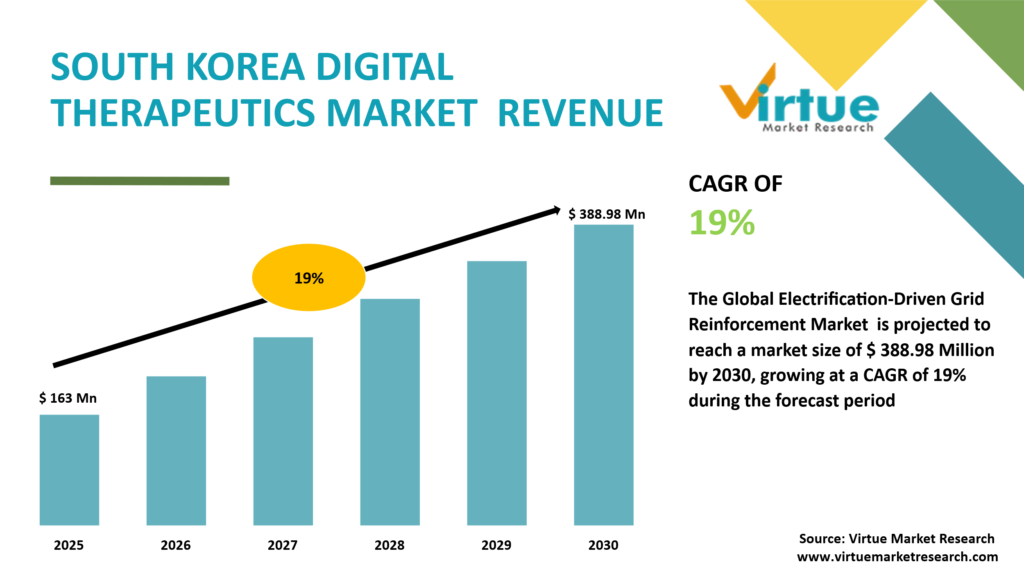
The South Korea Digital Therapeutics Market was valued at approximately USD 163 Million. It is projected to grow at a CAGR of around 19% during the forecast period of 2026–2030, reaching an estimated USD 388.98 Million by 2030.
The South Korean digital therapeutics market consists of software applications that use evidence-based digital therapeutic interventions to prevent, manage, and treat medical conditions that have been clinically proven to be effective. These solutions are increasingly being incorporated into patient care pathways, and they are being applied to complement or even, in some cases, replace traditional treatment modalities. The market includes therapeutic software that’s made available via digital channels and offered to help manage chronic diseases, behavioral health, neurological diseases, and other medically recognized uses. It doesn’t apply to general health apps, fitness trackers with no therapeutic claims, teleconsultation-only services, or hardware products that aren’t directly used for therapy.
The market is no longer a technology-driven concept; it’s a healthcare delivery market where clinical outcomes, patient engagement, and measurable treatment effectiveness are the things that matter in the market. The need for scalable healthcare solutions and increasing regulatory clarity and awareness among physicians has led to the wider adoption across various disease areas. There is a greater focus on real-world evidence generation and better adherence rates with the ability to show long-term value in everyday clinical practice for healthcare providers and developers.
The market now offers decision makers more opportunities besides product innovation. Reimbursement readiness, integration into the current healthcare workflow, and the ability to show long-term patient results are now becoming key aspects of commercial success. As South Korea’s digital health landscape continues to transform, clinical validation, adoption potential, and payment models are emerging as key considerations in the competitive positioning and long-term growth of organizations making investments, partnerships, or expansion plans.
Key Market Insights
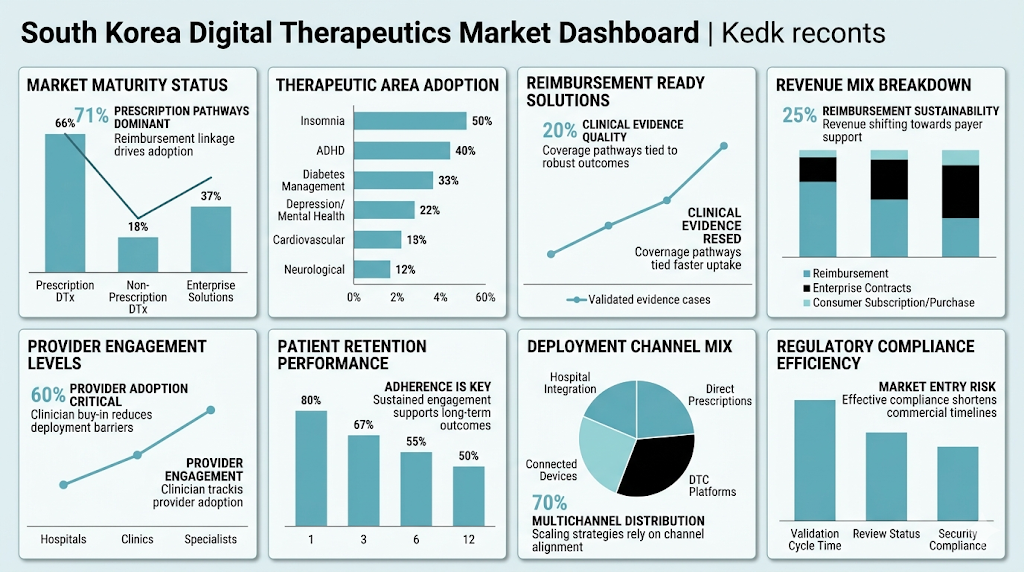
- South Korea has an increasing demand for intensification of digital therapeutics, with 2.6 clinicians per 1,000.
- Mental health budgets at 3 percent are in favor of scalable digital treatment.
- Therapeutic software pilots are easier to implement due to reimbursement for AI imaging.
- Asia accounted for 85 percent of the growth in innovative pipelines in 2024.
- South Korea led the 43 percent growth of innovative pipelines in Asia.
- The 31.8 trillion-won stimulus from South Korea could help with digital adoption in the coming months.
- Healthcare expenditure might be hindered later due to South Korea’s 124 percent debt-to-GDP ratio.
- In 2025, APAC workers will report using AI on a routine basis 70 percent of the time.
- APAC businesses increased their adoption of AI to 57 percent.
- 42% of businesses were actively using AI, and 40% were exploring.
- The cost of a breach is becoming nonnegotiable for South Korea as DTx cybersecurity.
- Digital-first prevention and access is now being pushed through systems by consumers.
Research Methodology
Scope & Definitions
- Market covers revenue generated from digital therapeutics (DTx) software platforms and clinically validated therapeutic interventions delivered digitally within South Korea.
- Includes prescription and non-prescription DTx across covered therapeutic areas; excludes general wellness apps, teleconsultation-only services, hardware-only sales, and non-therapeutic digital health solutions.
- Analysis covers historical, base-year, and forecast periods, with a standardized data dictionary, mutually exclusive segmentation structure, and controls to prevent double counting across segments.
Evidence Collection (Primary + Secondary)
- Primary research included interviews across DTx developers, healthcare providers, payers, distributors, digital health platforms, and industry experts.
- Secondary research utilized verifiable sources including Ministry of Food and Drug Safety, Ministry of Health and Welfare, company filings, investor presentations, peer-reviewed journals, clinical registries, and relevant industry associations.
- Key claims are supported by source-linked evidence and verifiable references cited within the report.
Triangulation & Validation
- Market size estimated using both bottom-up and top-down approaches.
- Findings reconciled against company disclosures, adoption indicators, reimbursement developments, and expert interviews where applicable.
- Conflicting inputs were resolved through source ranking, consistency testing, and multiple validation rounds to minimize bias.
Presentation & Auditability
- All calculations, assumptions, definitions, and segmentation rules are documented and traceable.
- Forecasts are based on transparent models, scenario testing, and market drivers.
- The report maintains a clear audit trail, enabling replication of key findings and verification of source-linked evidence.
Chapter 1 GLOBAL SOUTH KOREA DIGITAL THERAPEUTICS MARKET – Scope & Methodology
Chapter 2 GLOBAL SOUTH KOREA DIGITAL THERAPEUTICS MARKET – Executive Summary
Chapter 3 GLOBAL SOUTH KOREA DIGITAL THERAPEUTICS MARKET – Competition Scenario
Chapter 4 GLOBAL SOUTH KOREA DIGITAL THERAPEUTICS MARKET – Entry Scenario
Chapter 5 GLOBAL SOUTH KOREA DIGITAL THERAPEUTICS MARKET – Landscape
Chapter 6 GLOBAL SOUTH KOREA DIGITAL THERAPEUTICS MARKET – By Technology
Chapter 7 GLOBAL SOUTH KOREA DIGITAL THERAPEUTICS MARKET – By Component
Chapter 8 GLOBAL SOUTH KOREA DIGITAL THERAPEUTICS MARKET – By Prescription Model
Chapter 9 GLOBAL SOUTH KOREA DIGITAL THERAPEUTICS MARKET – By Distribution Channel
Chapter 10 GLOBAL SOUTH KOREA DIGITAL THERAPEUTICS MARKET – By Revenue Model
Chapter 11 GLOBAL SOUTH KOREA DIGITAL THERAPEUTICS MARKET, By Geography – Market Size, Forecast, Trends & Insights
Chapter 12 GLOBAL SOUTH KOREA DIGITAL THERAPEUTICS MARKET – Company Profiles – (Overview, Product TypePortfolio, Financials, Strategies & Developments)
Download Sample Report
Contact Us
- Chat On WhatsApp
- Phone :+91-9131799396
- Hi Link Residency, Airport Road, Indore, 452005
- sensegridmarketresearch@gmail.com
Select User License Type
Analyst Support, Customization & Verified Analysis
REPORT BY INDUSTRIES
- Food & Beverages
- Healthcare & Lifesciences
- Semiconductors & Electronics
- Information Technology
- Automotive
- Automation
- Energy & Power
- Consumer Goods & Services
- Agriculture